Working Kelpie temperament
Explore Working Kelpie temperament, independent decisions, relaxation, play and companionship without confusing enthusiasm with finished training.
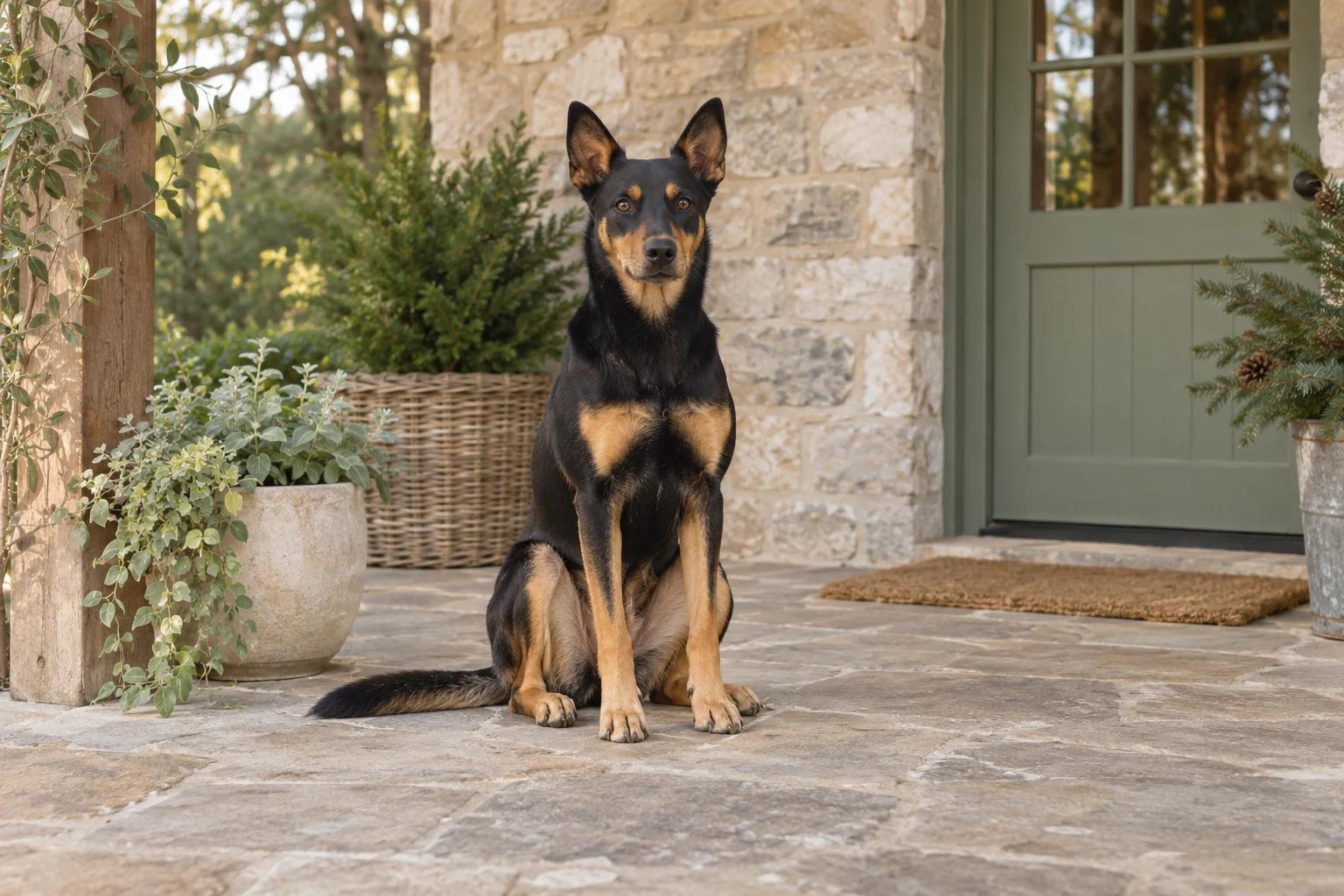
Working Kelpie temperament is often discussed through words such as alert, intelligent and eager. Those are the descriptors in the current Working Kelpie profile, but everyday life calls for a fuller picture. The dog you meet has its own experiences, preferences and learned responses. Understanding that individual means looking at how it participates, how it handles pauses and what it does when an interesting activity is not available.
Working Kelpie temperament: enthusiasm with room to relax
The Working Kelpie Council's characteristics describe an active but placid disposition, balancing keenness for work with an ability to relax. The desired temperament is not simply the most excited dog in the group. Alertness and sustained interest are different from being unable to stop reacting to everything nearby.
This gives prospective owners a useful way to interpret an enthusiastic demonstration. Watch the quieter interval as well as the active part. A Kelpie concentrating on a task and then sharing a pause is showing two different aspects of its behavior. Do not assume that the dog must remain at maximum intensity to be recognizably work-oriented.
The description is a breed ideal, not a guarantee about the animal in front of you. A youngster still learning a daily rhythm will not necessarily resemble a practiced adult. Nevertheless, it is worth resisting the idea that constant agitation is something an owner should seek out or celebrate. The attractive combination is interest in doing things and the capacity for a quieter gear, not endless motion for its own sake.
Initiative is part of cooperation, not its opposite
In The Ideal Man and Dog Relationship, John White describes the value of a stock dog that retains initiative rather than waiting for a command for every movement. His account distinguishes cooperation from making a dog mechanically dependent on instructions. It also emphasizes trust and kindness in the relationship.
That helps explain a distinctive part of Working Kelpie personality. A dog bred to respond to changing circumstances is not necessarily suited to an owner who regards every independent decision as a challenge to authority. The goal is a partner that can understand and cooperate, not an animal prevented from thinking.
For a companion owner, this does not mean granting unrestricted freedom or expecting the dog to invent appropriate household manners. It means appreciating problem-solving while teaching what you want. A Kelpie can enjoy working something out and still learn clear boundaries. Firm communication need not become a battle over who is in charge. The useful contrast is between understandable guidance and constant interference, not between total control and having no expectations at all.
Companionship needs an outlet as well as a boundary
The Council's account of the Working Kelpie as a pet explains that mental activity, physical activity and time with the owner all matter. It specifically warns against leaving the dog outside with nothing to do, where it may create its own occupation, including chasing moving traffic.
For a household, the practical lesson is to provide secure boundaries and worthwhile shared activities together. A fence addresses access; it does not supply an occupation. A game or walk provides interaction; it does not make unsupervised roaming safe. Neither element replaces the other.
This distinction is useful when interpreting Working Kelpie behavior around a garden or driveway. Do not treat attempts to follow movement as a harmless display that should be rehearsed next to a road. Prevent access to that situation while offering appropriate activities elsewhere. The aim is not to remove every interesting thing from the dog's life, but to keep interest from being expressed in a dangerous setting. A companion Kelpie needs more than somewhere outdoors to wait for its person to return.
Play can include learning to pause
Battersea's impulse-control guidance treats self-control as a learned skill. It recommends gradually extending familiar stationary behaviors, introducing distractions at manageable distances and choosing rewards that suit the desired level of excitement. A lively toy is not always the best reward when the immediate goal is calm behavior.
For a playful Kelpie, distinguish the start of a game from the moments between turns. Familiar start and stop signals, together with taught drop and leave responses, can make play easier to understand. This is not a demand that an excited dog instantly perform an unfamiliar sequence. Build the pieces before expecting them to work together.
When a distraction is added, make the existing task easier again. A nearby person carrying a toy can be a much harder situation than the same exercise in an empty room. Distance and shorter expectations help preserve successful practice. The purpose is constructive play with understandable transitions, not making the dog repeatedly fail to resist something placed beyond its current ability.
Read the individual alongside the breed description
The current profile places learning and mental engagement high in the ownership picture. That makes a short lesson a useful part of meeting an adult Kelpie, but it is not an examination that a newly arrived dog must pass. Ask the familiar keeper to show a skill the dog already knows. A familiar voice, setting and activity reveal something different from asking a stranger to direct the dog immediately.
Normal vocal communication is also part of the profile. Silence is not a requirement for a pleasant companion, and a bark by itself does not explain what the dog wants. The context matters: an arrival, a game and a quiet room are not the same situation. Avoid turning one brief vocal moment into a permanent personality label.
The existing stock-work selection article explores a specific working decision. The dog quiz is a broader starting point for considering whether the everyday demands suit you. Neither replaces learning what this particular dog has experienced.
Frequently asked questions
Which Working Kelpie characteristics appear in the current profile?
The profile uses alert, intelligent and eager as its main descriptors. These summarize a breed tendency; they do not tell you which cues an individual knows, how it behaves with unfamiliar people or what it has previously practised.
Does a high learning rating mean a Working Kelpie arrives obedient?
No. Responsiveness describes potential for learning, not completed education. A particular dog may be experienced in some situations and unfamiliar with others, regardless of its breed's rating.
Does Working Kelpie temperament establish compatibility with another pet?
No. The current profile makes compatibility an individual question. Previous experience and the behavior of both animals matter; a breed name is not a guarantee about a particular pairing or household.
Sources behind this article
- WKC characteristics and conformation ↗
- WKC the ideal man and dog relationship ↗
- WKC Working Kelpie as a pet ↗
- Battersea impulse control ↗
Article source checked: November 16, 2026. Source checked 2026-11-16
Keep reading

Airedale Terrier Temperament: What Everyday Life Can Feel Like
Read article →