Wirehaired Vizsla temperament
Understand Wirehaired Vizsla temperament through companionship, sensitive teaching, attention skills and rewards that suit the individual.
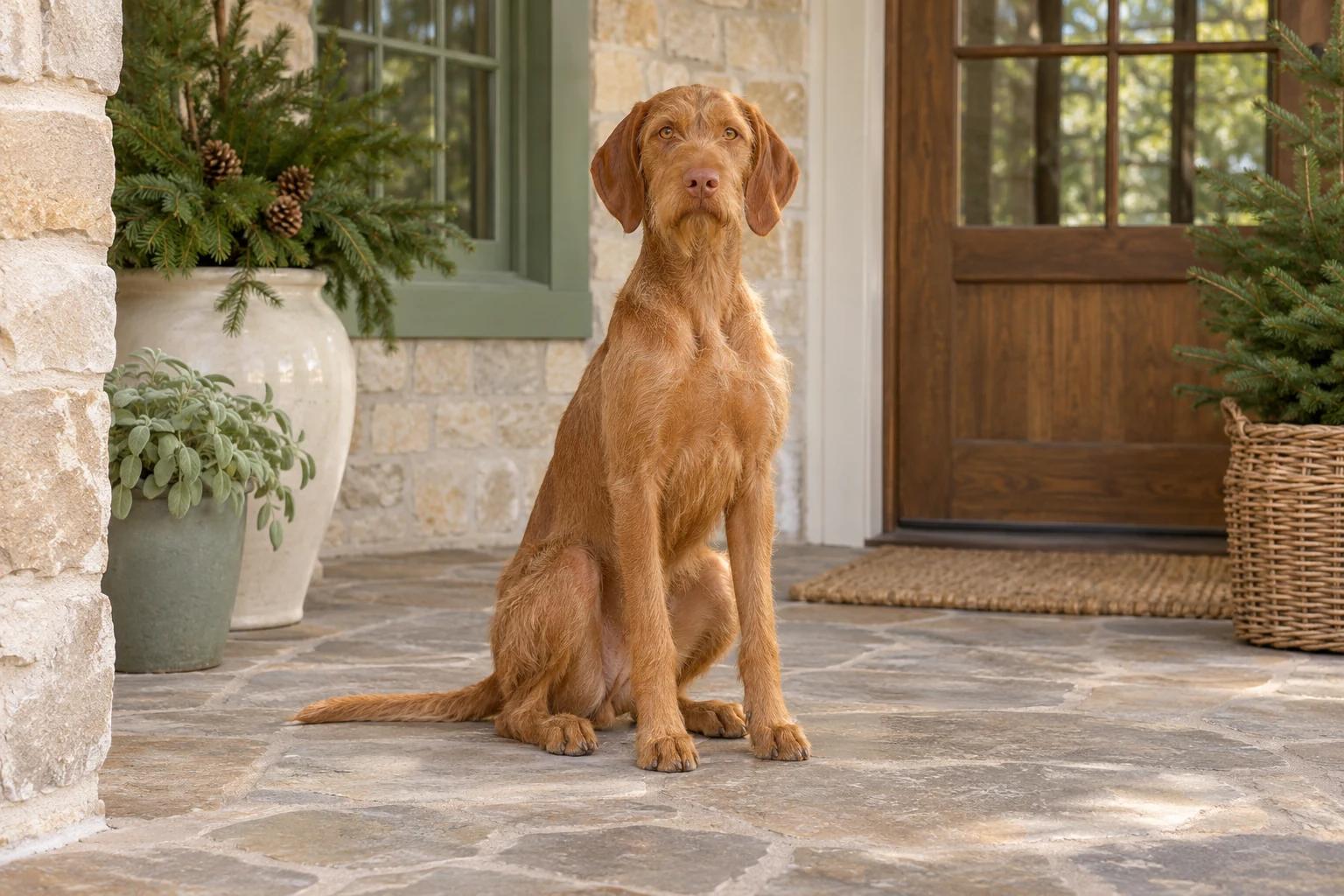
Wirehaired Vizsla temperament is easier to understand through shared activities than through a promise that every dog will be easy. The current Wirehaired Vizsla profile describes a companion with strong family interest, substantial energy and an appetite for engagement. Those qualities can make life together rewarding, but they do not arrive as a finished set of household skills.
Wirehaired Vizsla temperament: take sensitivity seriously
The Wirehaired Vizsla Club of America's suitability account describes a gentle, loyal companion and emphasizes sensitivity to harsh discipline. This is a useful starting point for thinking about the relationship: teaching should help the dog understand what works, rather than turning a misunderstanding into a confrontation.
Sensitivity is not the same as fragility, nor does it mean that a household cannot have clear expectations. It changes how you make those expectations understandable. A lesson can have a simple goal and a consistent response without becoming loud or intimidating. The dog's physical strength is not a reason to make the interaction rougher.
For a prospective owner, observe a familiar handler during an ordinary lesson. Does the interaction remain cooperative when an attempt is imperfect? Ask how the person introduces something new and what they do when the dog does not understand. These examples reveal more about the partnership you would need to build than a broad assurance that the breed is affectionate or eager to please.
Investigate a missed cue before calling it stubbornness
The AKC discussion of apparently stubborn dogs explains that an unclear cue, uncertainty about rewards or a more distracting situation can account for a response that looks uncooperative. Learning a behavior in one setting does not automatically mean that the dog understands it everywhere.
For a Wirehaired Vizsla, the practical response is to simplify the task instead of escalating your voice. Ask whether the cue was actually taught, whether you rewarded the intended action and whether the surroundings became much more demanding. A familiar skill beside the kitchen counter and the same skill near an interesting outdoor distraction are not identical lessons.
Repeating a word while the dog does something else does not explain it more clearly. Return to a setting where the skill is understandable and build from there. This keeps a temperament discussion useful: you are looking at a specific learning problem rather than assigning the dog a permanent label because one attempt did not produce the response you expected.
Give attention a clear, positive meaning
Dogs Trust's focus-training guide begins by associating the dog's name with attention and a reward. The aim is for the name to become a meaningful invitation to look toward you, not background noise that is repeated throughout the day.
Practise in a quiet place where the dog can succeed. Say the name, reward the response and use a consistent marker to identify the moment you wanted. Keep the distinction between the attention cue and the next request: first the dog looks toward you, then you can communicate what comes next.
For a Wirehaired Vizsla household, this is a concrete way to turn the desire for engagement into a teachable exchange. Do not assume that liking company means the dog automatically understands which sound should interrupt another activity. A useful name response is learned through experience. Avoid using the name repeatedly without a purpose, and keep early practice simple enough that looking toward you remains worthwhile rather than becoming the start of a confusing string of demands.
Choose rewards for this dog and this activity
Dogs Trust's reward-training guidance explains that rewards can include food, toys or attention, depending on what the individual values. The choice should also suit the behavior: a lively game and a quiet interaction do not produce the same kind of session.
For a Wirehaired Vizsla, enthusiasm for shared activity gives you possibilities to investigate, not permission to assume that one reward always works. Notice what the dog actually chooses and whether the reward fits the task you are teaching. A calm response may be better acknowledged calmly than followed by an abrupt burst of energetic play.
Timing matters as well. A marker identifies the wanted action and should be followed by the reward. During new learning, make the connection dependable rather than expecting the dog to work through repeated uncertainty. This is not about purchasing cooperation with increasingly elaborate prizes. It is about giving useful information: that action was the one you wanted, and doing it had an outcome the dog valued.
Place Wirehaired Vizsla personality in an ordinary home
The current profile presents close companionship alongside substantial activity needs. Think about what that combination means for your preferred relationship with a dog. Do you enjoy being involved in its day, or are you mainly looking for a quiet presence that rarely asks for participation? Neither preference is a moral judgment, but the distinction matters before choosing a breed.
Wirehaired Vizsla characteristics include a sizable adult body: current references put females at 45–55 pounds and males at 55–65 pounds. That physical scale is separate from temperament. A warm greeting does not prove that an adolescent has learned how to move politely through a doorway, and an affectionate adult can still have unfamiliar household experiences ahead of it.
For Wirehaired Vizsla behavior, ask about the dog's actual history rather than relying on scores alone. An adult's experience with a particular household is valuable information, but it is not a guarantee about every future setting. Our article on balance and height explores a separate physical topic. Use the dog quiz to consider companionship alongside the wider work of ownership.
FAQ
Does an affectionate Wirehaired Vizsla automatically know household manners?
No. Enjoying company and having practised a particular household skill are different things. Ask what the individual already knows rather than treating a friendly meeting as evidence of complete training.
Can adult weight tell me how a Wirehaired Vizsla will behave?
No. The current female reference of 45–55 pounds and male reference of 55–65 pounds describes physical scale. It does not establish sociability, previous experience or compatibility with a particular home.
What should I learn about an adult before bringing it home?
Ask about the settings and household situations it already knows, its usual shared activities and its previous living arrangements. Those concrete details add information that a breed description cannot provide on its own.
Sources behind this article
Article source checked: November 16, 2026. Source checked 2026-11-16
Keep reading

Airedale Terrier Temperament: What Everyday Life Can Feel Like
Read article →