Wirehaired Pointing Griffon vs German Wirehaired Pointer
Compare Wirehaired Pointing Griffon and German Wirehaired Pointer size, outline, coat details and everyday practical differences.
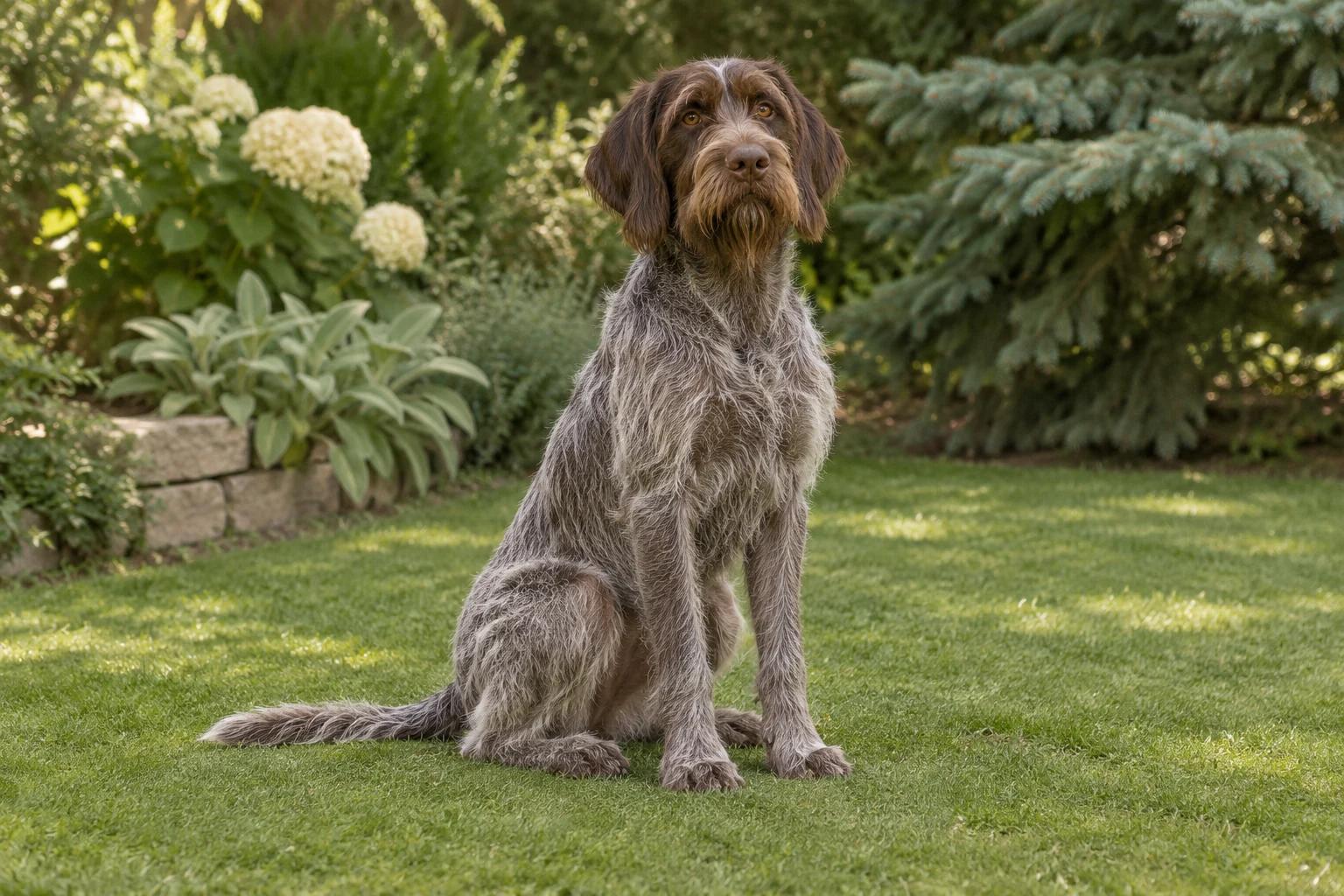
Explore the
Wirehaired Pointing Griffon
Background, care, and everyday considerations.
View breed profile →Wirehaired Pointing Griffon vs German Wirehaired Pointer is a comparison between two distinct dogs, not two spellings of the same breed. Both have expressive facial furnishings, but a useful comparison looks beyond the beard. Start with the current Wirehaired Pointing Griffon profile and German Wirehaired Pointer profile, then separate physical measurements, visible structure and the experience of living with an individual.
Wirehaired Pointing Griffon vs German Wirehaired Pointer: the Griffon outline
The AKC Griffon standard describes a slightly rectangular dog, with body length and height in a ten-to-nine relationship. The outline is substantial without being massive. A strong back slopes gently from the withers, while the chest reaches the elbows. These details are more informative than simply calling every bearded sporting dog stocky.
Look particularly at the head. The Griffon's head has a square impression, emphasized by abundant eyebrows and mustache. Its rounded eyes and facial furnishings create a different visual effect from a narrow, sparsely furnished muzzle. The ears lie close to the head, and their covering is softer than the body's outer hair.
The coat also contains different textures rather than one uniform layer of bristles. Straight, wiry outer hair lies over a fine, thick undercoat; the legs carry denser hair that is less coarse than the body covering. This helps explain why a photograph of the face alone gives an incomplete picture.
Read the German Wirehaired Pointer's coat and frame
The German Wirehaired Pointer standard also describes a body slightly longer than its height, with the same ten-to-nine proportion. Rectangular shape by itself therefore does not distinguish the two breeds. The German Wirehaired Pointer combines a muscular frame with a deep chest, a firm back and a noticeable abdominal tuck-up.
Its head description includes a moderately long head, oval eyes and a long, straight muzzle. The beard is present, but the skull covering is short. These are useful details when an unfamiliar dog has enough facial hair to obscure the underlying outline.
The standard specifies a flat-lying, wiry outer coat about one to two inches long. Undercoat density changes with the season, and the lower legs have shorter hair than the body. Instead of looking only for roughness, look at where the coat changes length and how closely it follows the frame. A shaggy-looking photograph can hide that distinction. Coat length, facial furnishings and overall outline should be considered together rather than treating any one feature as conclusive identification.
Distinguish the breeding histories
The AKC's pointing-breed comparison places these breeds in different development stories. The German Wirehaired Pointer emerged from German efforts to produce a versatile rough-coated hunting dog. Its development involved several wire-coated breeds rather than a simple change in the coat of one existing pointer.
The Griffon's story centers on Eduard Korthals, a Dutch breeder whose work took place in Germany and France. He selected among several types of dogs in developing the breed. The names identify different development histories.
For an owner, the important distinction is that a shared working category does not make the histories interchangeable. A pedigree headed with one breed name is not equivalent to a pedigree headed with the other. When learning about a puppy's background, use the full breed name rather than the shorthand “wirehair.” That shorthand can conceal precisely the distinction you are trying to understand, particularly in a conversation that moves between several pointing breeds.
Consider the Griffon's practical outdoor aftermath
VCA's Griffon account points out an everyday feature of the coat: it can carry debris home from outdoor activity. Facial hair can also hold crumbs and drip after drinking. These are ordinary housekeeping consequences of living with this particular exterior, not just matters of achieving a show-ring appearance.
For a prospective Griffon owner, imagine the end of an outing as well as the beginning. The dog arriving at the back door may bring pieces of the landscape with it. The beard beside a water bowl deserves attention independently of how clean the main body looks. This is a more concrete ownership consideration than deciding whether a scruffy face is attractive.
The same account emphasizes interesting instruction that can compete with distractions and describes several shared outdoor activities. A willing dog still needs lessons worth attending to. Do not use the breed's appealing face as a substitute for thinking about teaching, or assume that outdoor enthusiasm will organize itself into useful behavior. Appearance, practical care and learning are separate parts of the comparison.
Compare adult measurements with the sex included
The current profiles give adult Griffon weights of 35–50 pounds for females and 50–70 pounds for males. For German Wirehaired Pointers, they give 45–60 pounds for females and 55–70 pounds for males. These ranges overlap. “Which is bigger?” is therefore less useful than identifying the sex and actual measurements of the dogs being compared.
A German Wirehaired Pointer vs Wirehaired Pointing Griffon search should not turn overlapping adult references into a guaranteed ranking of two puppies. Nor should the decision between a Wirehaired Pointing Griffon or German Wirehaired Pointer be reduced to the smallest number in a breed range. Our Griffon nonhunting-home article addresses a separate household-fit question; the dog quiz helps you explore broader preferences.
FAQ
What is the difference between Wirehaired Pointing Griffon and German Wirehaired Pointer names?
They identify separate breeds. Use the complete name when researching a dog, rather than assuming that “wirehair” identifies one particular breed.
Are their adult weight ranges completely separate?
No. Current female and male ranges overlap between the breeds. An individual dog's actual weight is more useful for a direct comparison than an unqualified breed label.
Does the lighter adult reference identify the easier dog to own?
No. Physical scale does not establish an individual's prior experience, manners or compatibility with your household. Keep the measurement comparison separate from those questions.
Sources behind this article
- AKC Griffon standard ↗
- AKC German Wirehaired Pointer standard ↗
- AKC pointing-breed differences ↗
- VCA Griffon ↗
- UKC standard — adult-weight reference ↗
Article source checked: November 16, 2026. Source checked 2026-11-16Article source checked: November 18, 2026. Source checked 2026-11-18
Keep reading

Affenpinscher vs Brussels Griffon: Everyday Differences
Read article →