Wirehaired Pointing Griffon exercise needs
Explore Wirehaired Pointing Griffon exercise needs through purposeful outings, long-line handling, gradual water introductions and individual routines.
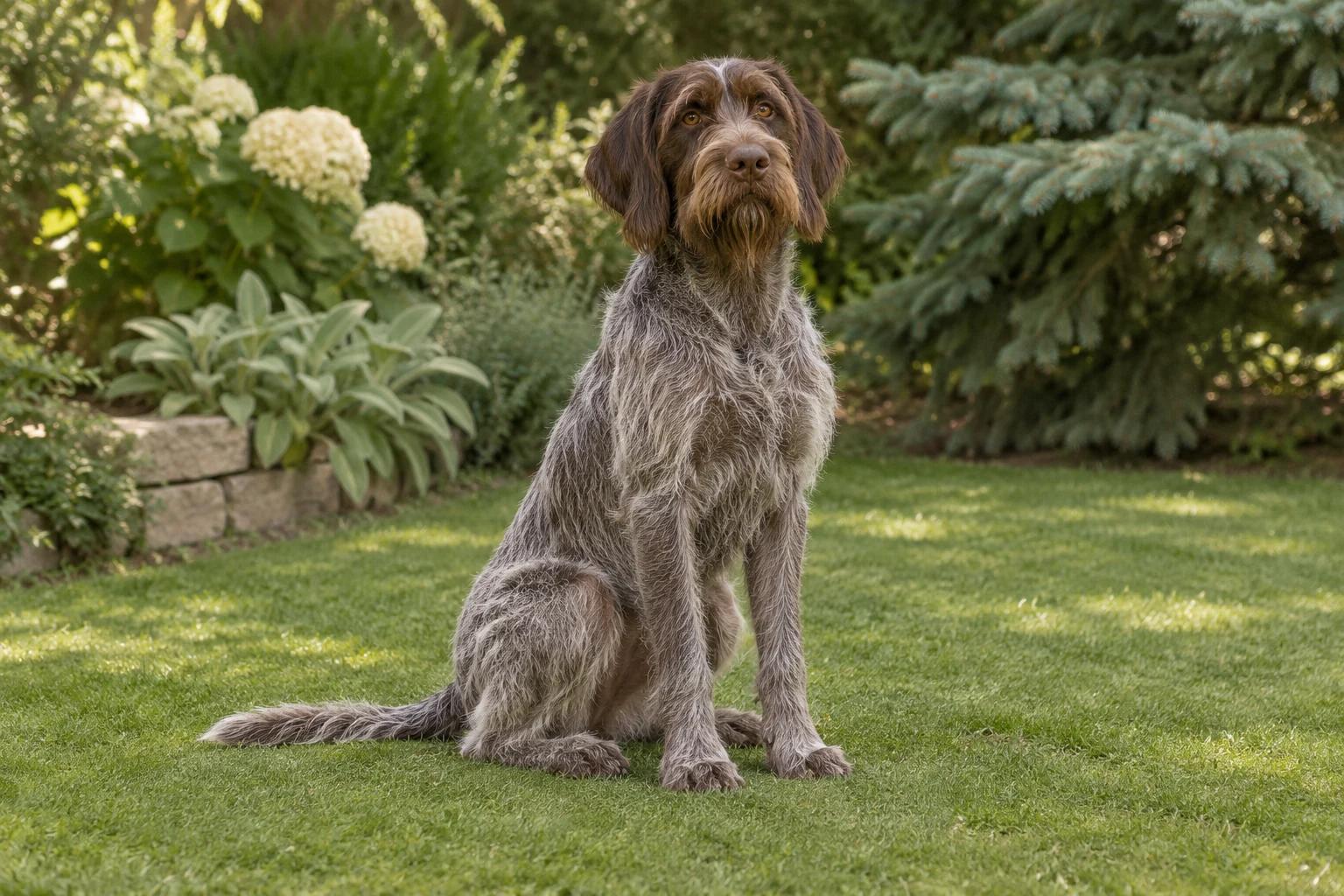
Explore the
Wirehaired Pointing Griffon
Background, care, and everyday considerations.
View breed profile →Wirehaired Pointing Griffon exercise needs involve more than providing a place to move. The current Wirehaired Pointing Griffon profile describes an active dog with a strong appetite for mental engagement as well as physical activity. A useful routine considers what the dog is doing during an outing, not merely whether it has left the house. Different activities offer different kinds of participation, and not every outing has to look identical.
Wirehaired Pointing Griffon exercise needs reflect several working tasks
The American Wirehaired Pointing Griffon Association's hunt information describes a dog developed to work with a person on foot. The work combines searching, pointing and retrieving, including work in water and varied terrain. This is a collection of tasks rather than a single exercise repeated at maximum speed.
That distinction helps explain why a Griffon's working background cannot be represented by distance alone. Searching requires attending to information in the environment. Cooperation involves keeping the person part of the activity. Retrieving adds an object-related task. Water changes the physical setting again. These are different components, even when they occur during the same outing.
The association describes organized opportunities to learn about working activities and evaluations that consider separate abilities. Watching a club training day can make these distinctions visible: the dog that is searching is not doing the same thing as the dog being directed toward a retrieve. For a newcomer, guided instruction provides a clearer introduction than trying to recreate an entire working exercise from a short description or an impressive video.
Build the walk around the individual dog
PDSA's exercise guidance bases activity on age, fitness, health and preferences. Increase a new activity gradually rather than assuming enthusiasm establishes readiness for a demanding outing. Ask your veterinarian for individual guidance when you are unsure what is appropriate.
A Wirehaired Pointing Griffon daily walk can contain different experiences: purposeful walking on one section and slower exploration on another. PDSA distinguishes brisk movement from meandering opportunities to sniff.
For longer outings, consider the actual ground and route, including difficult slopes or scrambling, rather than treating every mile as equivalent. Check conditions, carry water and allow breaks. Play is an addition to walking rather than a complete replacement for it. Choose suitable dog toys instead of sticks, and keep their condition under review. A varied routine should remain manageable for the particular dog, not become an escalating attempt to make every day more demanding than the last.
Handle exploration with a long line carefully
Battersea's long-line guide attaches the line to a harness rather than a collar. It recommends managing the line with both hands, releasing length in a controlled way and avoiding a sudden stop at the end. The extra distance is useful only when the person can manage it safely.
For a Griffon exploring an open area, begin with usable space around both of you. A crowded path, a tangle of obstacles or people stepping across the line changes the exercise. Pay attention to where the line lies as well as where the dog is heading. More line is not automatically more useful freedom.
Feed out length gradually instead of presenting the dog with the entire line at once. Keep the handling smooth, and avoid allowing slack to become an unmanaged loop around feet. This is an active handling skill, not simply a longer version of clipping on a short lead and forgetting about it. Choose a setting in which you can concentrate on both the dog and the equipment.
Introduce water as a lesson, not an assumption
The AKC swimming guide recommends a properly fitted canine flotation device and a gradual introduction. Start with shallow water and let the dog become comfortable with wet feet. Never throw or pull a dog into the water to make it learn.
For a Griffon new to swimming, interest in the water's edge is not the same thing as experience beyond standing depth. Allow the dog to enter willingly and progress only while comfortable. If the experience becomes overwhelming, return to shallower water or dry land rather than persisting farther out.
Teach the exit as deliberately as the entry. The dog needs to recognize the route to shore or a suitable ramp, not just how to move through water. Stay close enough to guide that learning and maintain supervision. A breed's outdoor reputation does not remove the need for an introduction to this particular place. The first session can be about understanding the setting rather than completing a swim or retrieving something from deep water.
Match the Griffon's physical presence to the outing
The current adult reference is 35–50 pounds for females and 50–70 pounds for males. Heights are 20–22 inches for females and 22–24 inches for males. Those sex-qualified figures are useful when picturing the dog beside you: this is neither a pocket-sized passenger nor a giant whose breed label alone describes the amount of space required.
In practical terms, your companion will share narrow access points, pass other path users and occupy space beside you during pauses. The handler's own comfort with that physical presence matters. A route that looks convenient on a map can feel quite different when two people and their dogs must pass at a tight entrance. Choose places where shared movement is comfortable instead of relying on friendliness to solve every spatial problem.
Wirehaired Pointing Griffon activity level should be considered alongside the close companionship described in the profile. Going somewhere together is a different commitment from merely possessing an outdoor area. For the separate question of household suitability, read our Griffon nonhunting-home article. The dog quiz helps place that commitment among your broader preferences.
FAQ
How much exercise does a Wirehaired Pointing Griffon need?
There is no single duration suitable for every Griffon. Ask your veterinarian for individual guidance.
Does a large garden answer the whole ownership question?
No. The current profile describes a companion that values involvement with its people. Available outdoor space and time spent together are different parts of what a household offers.
Are female and male Griffons the same physical scale?
The current profile lists different adult reference ranges for the sexes. Use the individual dog's actual measurements when planning access and equipment, rather than treating the broad breed range as one standard-sized animal.
Sources behind this article
- AWPGA hunt activities ↗
- PDSA exercising your dog ↗
- Battersea long-line handling ↗
- AKC teaching swimming ↗
Article source checked: November 16, 2026. Source checked 2026-11-16
Keep reading

Afghan Hound Exercise Needs: Build a Workable Active Day
Read article →