Tornjak Size: Adult Weight, Height and Build
Understand Tornjak size with sex-qualified adult weights, the current height range, balanced build and sensible growth context.
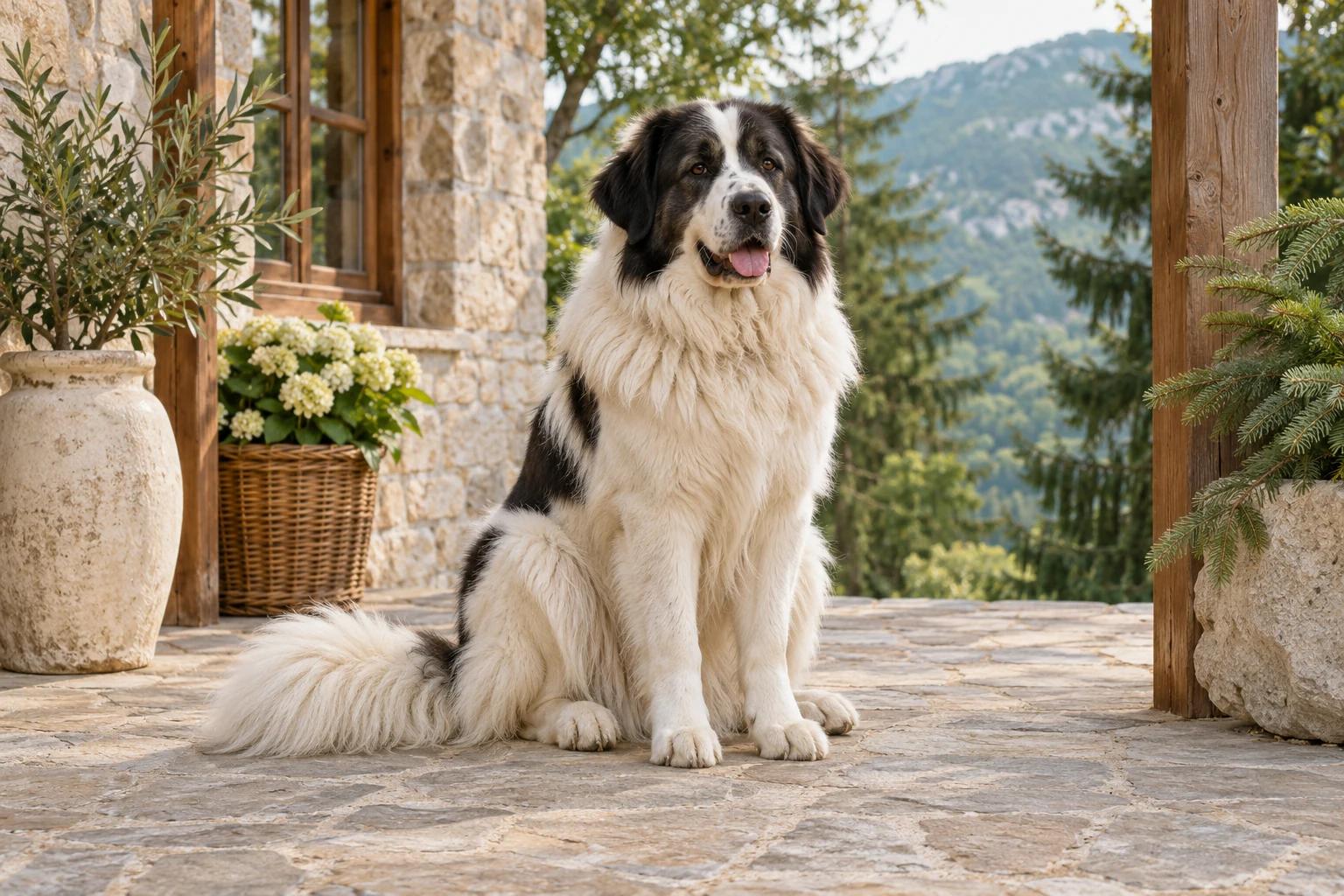
Tornjak size is substantial, but the most useful answer is not a single maximum weight. The current Tornjak profile lists adult females at 62–88 pounds and males at 77–110 pounds, with an overall height reference of 23–28 inches. Those figures describe a range of adults. They do not give every puppy a target to reach or make the heaviest individual the most representative example of the breed.
Tornjak size includes proportion, not just mass
The FCI standard describes an almost square dog, with body length exceeding height by no more than eight percent. Bone should be substantial without becoming coarse or excessively heavy. The chest is broad, deep and oval rather than barrel-shaped, reaching at least to the elbows. FCI Tornjak standard.
These details explain why a Tornjak's build cannot be judged from a scale reading alone. Two adults of similar weight may present differently when their height, body length and condition differ. The standard's emphasis is on a balanced, mobile dog, not simply an accumulation of bulk.
Its back is described as short and straight, with a firm topline in motion. The characteristic trot combines reach with drive from the hindquarters. Watching an adult move naturally can therefore reveal something that a static photograph cannot: how its dimensions work together.
The practical reading is to consider mass alongside outline and movement. A heavily coated silhouette may look imposing, but coat volume should not be confused with the underlying body's structure or with a reason to seek additional weight.
Growth needs are not adult feeding needs
VCA's guidance explains that large and giant puppies have nutritional needs specific to growth. It distinguishes food appropriate for that stage from ordinary adult maintenance food, and advises checking the nutritional adequacy statement rather than relying only on a package's appearance. VCA large and giant breed nutrition.
For a Tornjak puppy, this makes the expected adult size relevant before the dog actually weighs as much as an adult. The question is not simply how much food a large-looking youngster can finish. It is whether the diet and amount suit the individual stage of development.
VCA also cautions that energy requirements vary between dogs and that feeding guides are starting references. Review the puppy's food and condition with the veterinary team rather than converting the breed's upper weight figure into a portion calculation.
Keep that distinction clear when comparing dogs from the same litter. A larger current weight does not automatically establish that one puppy is being fed more appropriately. The useful assessment concerns the individual animal, not a competition to approach the adult maximum first.
Faster growth is not the goal
The Purina Institute distinguishes optimal growth from rapid growth in large and giant puppies. Excess energy can promote undesirable speed of development and excess body weight, adding demands to an immature skeleton. Purina Institute: optimal large-breed growth.
For a developing Tornjak, that is a reason not to treat size as a race. The breed's eventual scale can be impressive without making rapid gains an achievement in themselves. A puppy that is still changing should not be encouraged toward a heavier appearance just because another dog of the same age looks bigger.
The institute also notes that large dogs can continue their growth phase beyond the first birthday. That is general large-breed context, not an exact Tornjak completion date. Your veterinarian can help interpret the particular dog's progress and nutritional needs.
Avoid turning an adult reference range into a month-by-month prediction. Growth is a developmental process, and a single photograph or weigh-in does not describe the whole trajectory. The aim is appropriate development for the individual, not reaching an impressive number on somebody else's timetable.
Read the female and male ranges separately
The current Tornjak weight references overlap from 77 to 88 pounds. That means an adult female can weigh more than an adult male while both fall within the displayed ranges. Sex gives useful context, but it does not let you rank two individuals without knowing their actual dimensions.
The overall 62–110-pound range spans 48 pounds. Quoting only its midpoint would conceal that variation; quoting only 110 pounds would make the upper male reference sound universal. Neither shortcut answers the practical question as accurately as retaining both sex-qualified ranges.
Tornjak height is listed as an overall 23–28-inch reference on the current profile. Use that as a height range, not as a second weight category. A tall adult is not automatically at the upper end of the weight range, and a dog near the lower height reference is not automatically a female.
If you are meeting an adult, ask for its measured weight and height rather than estimating from the photograph. If you are considering a puppy, the parents' dimensions are useful context, but the puppy remains an individual rather than a miniature copy of either parent.
Put the dimensions beside the daily commitment
The same current profile identifies a double coat and substantial shedding. Those features affect the impression the dog makes as well as the ownership commitment. A Tornjak is not simply a certain number of pounds occupying a room; the coat is also part of daily life with that body.
The profile also emphasizes watchfulness and the need for careful consideration of other-dog compatibility. Choosing the lower end of the adult weight range does not remove those behavioral questions. A smaller female is still a Tornjak, not a different kind of companion because she weighs less than a large male.
When asking how big do Tornjaks get, keep the physical answer precise and the ownership answer broader. Adult dimensions help establish scale, but they do not predict how a particular dog behaves in the home. The dog match quiz can help consider both. For the separate historical subject, see the Tornjak recovery account.
FAQ
What is the current adult Tornjak weight range?
Females are listed at 62–88 pounds and males at 77–110 pounds. Retaining the sex qualifiers is more informative than treating the overall 62–110-pound span as one uniform adult size.
Can a female Tornjak be heavier than a male?
Yes. The current adult ranges overlap between 77 and 88 pounds. Sex alone does not determine which of two individual adults will weigh more.
What height does the current breed profile list?
It lists an overall adult height reference of 23–28 inches. That range describes adult scale, not a guarantee of a particular puppy's final measurement.
Sources behind this article
- FCI Tornjak standard ↗
- VCA large and giant breed nutrition ↗
- Purina Institute: optimal large-breed growth ↗
Article source checked: November 16, 2026. Source checked 2026-11-16
Keep reading
Tornjak Temperament: Watchfulness and Everyday Life
Read article →