Swedish Vallhund Exercise Needs: Purposeful Daily Activity
Understand Swedish Vallhund exercise needs through purposeful movement, ball-pushing games, tracking and an individual approach to daily outings.
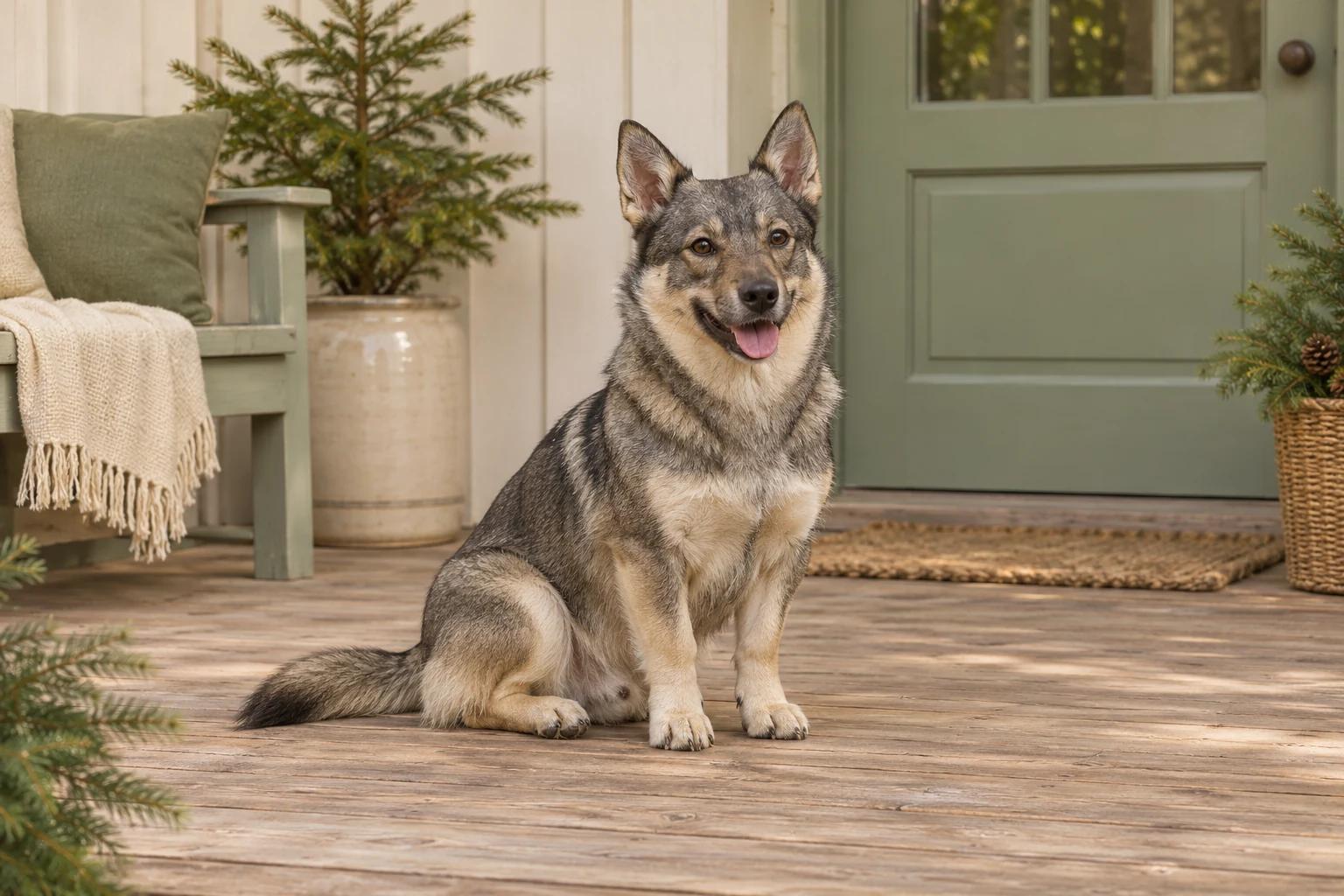
Swedish vallhund exercise needs deserve more attention than the dog's compact height might suggest. The Swedish Vallhund profile places both activity and mental engagement at 4/5. Those references describe an involved ownership commitment, not a calculation that converts directly into a fixed number of minutes. The useful starting point is a daily life that includes movement and learning, rather than assuming a short-legged companion will be satisfied by whichever routine happens to fit the smallest dog in the neighborhood.
Swedish Vallhund exercise needs reflect an active working background
The Swedish Kennel Club describes the Vallhund as an energetic family and sporting dog, with cattle-herding work still part of its background in Sweden. Its account emphasizes an interest in different activities and a readiness to learn. Swedish Kennel Club: Swedish Vallhund.
That context supports choosing purposeful activities, not simply adding speed to every outing. A dog engaged in a task is doing something different from a dog moving aimlessly until the clock runs out. For a modern companion, an appropriate activity can provide a job without requiring access to livestock.
It is equally important not to confuse heritage with an already trained skill. A Vallhund is not ready to manage cattle merely because its breed has done so, and a sporting description does not establish that every individual enjoys the same game. Consider what the dog willingly engages with, then build experience. The historical role explains why a busy partnership can appeal; it is not a demand to reproduce farm work in an unsuitable setting. The aim is to offer something meaningful to this dog, not to prove that it matches every enthusiastic sentence in a breed description.
Try controlled ball pushing rather than uncontrolled chasing
The AKC's Treibball guide describes a herding-inspired activity in which dogs push large balls toward a goal. Its beginner progression transfers an established nose target onto a ball, first held still and then gradually lowered before the dog learns to move it. AKC: Treibball games.
For a Vallhund, this offers a concrete problem: move this object in a useful direction. It is not the same as throwing a ball repeatedly and relying on excitement to supply the exercise. Start with one suitable ball and reward small successful pushes before expecting a sequence across the garden.
Introduce the goal without pressure, then begin with the ball close enough that success requires little movement. Increase distance gradually. If the dog is worried by the equipment, the task is not ready to become harder. A qualified instructor can help develop the game beyond the first steps. Keep the focus on controlled movement and communication, rather than assuming that a herding breed should immediately understand what a large inflatable ball is for. Learning the task is part of the activity, not an obstacle to reaching the exciting part.
Tracking offers a different kind of outdoor concentration
AKC tracking involves following a person's scent trail to locate an article left along or at the end of it. The handler follows on a long leash while the dog works out the route. More advanced forms introduce older tracks, additional changes of direction or varied surfaces. AKC: getting started in tracking.
For an owner considering a Swedish vallhund daily walk, this illustrates how outdoor activity can have a specific sensory task rather than being judged only by distance. The dog is not simply matching the handler's pace or watching a hand signal.
Formal tracking is a learned partnership, not an invitation to turn a beginner loose to search for strangers. Find experienced instruction and an appropriate practice area if the activity interests you. Competition track lengths and ages describe tests, not a sensible first lesson or a daily exercise target. A young or inexperienced dog needs a starting point suited to its own abilities. This option may appeal to people who enjoy watching the dog's decisions unfold, but interest in the outdoors does not oblige every Vallhund owner to pursue a title.
Adjust the outing to the dog in front of you
Battersea emphasizes that exercise depends on age, health, fitness and personality. Keep the plan flexible rather than treating a planned route as an obligation regardless of the individual dog’s comfort. Battersea: exercise needs.
This is the practical answer to how much exercise does a swedish vallhund need: an individual plan, not an obligation to meet another dog's distance. A busy young adult and an older companion may need different outings despite sharing the same breed name. Seek veterinary advice for a significant change in stamina or movement, and do not interpret reluctance as a training challenge before considering discomfort.
Walks also offer new smells and surroundings. Allowing time to investigate can add interest without making every route longer or faster. Restlessness does not automatically prove that more exercise is the answer; Battersea notes that discomfort, insufficient rest or excessive activity can also affect behavior. Look at the whole picture before increasing demands. If the dog does not recover promptly after stopping, ask a veterinarian for advice rather than trying to solve the problem with another training game.
Put the activity reference beside the physical reference
The current Swedish vallhund activity level is toward the higher end of the profile scale, while adult weight is listed at 20–35 pounds. Neither figure cancels the other. Compact size describes the animal's dimensions; activity describes a different part of the ownership commitment.
Male height is listed at 12.5–13.75 inches and female height at 11.5–12.75. The profile supplies no separate male and female weight intervals. These adult references are useful when picturing the companion, but they do not establish the abilities of an individual puppy or adult.
Use the breed quiz to consider whether an involved daily relationship fits your preferences. The Vallhund history article addresses the separate question of origins, rather than prescribing today's routine.
Frequently asked questions
Does the Vallhund's height make it a low-activity dog?
No. Its current profile places activity and mental engagement at 4/5 despite its compact adult height. Dimensions alone are not a shortcut to estimating the daily commitment.
Does 4/5 specify an exact number of walking minutes?
No. It is a broad reference on a five-point scale, not a time prescription. It should help a prospective owner recognize an active commitment without pretending to measure every dog's day.
What adult size should I picture when planning ownership?
The current weight reference is 20–35 pounds. Male height is 12.5–13.75 inches and female height 11.5–12.75. Those ranges describe adults, not a promise about a puppy's final dimensions or future performance.
Sources behind this article
- Swedish Kennel Club: Swedish Vallhund ↗
- AKC: Treibball games ↗
- AKC: getting started in tracking ↗
- Battersea: exercise needs ↗
Article source checked: November 16, 2026. Source checked 2026-11-16
Keep reading

Afghan Hound Exercise Needs: Build a Workable Active Day
Read article →