Saint Bernard vs Great Dane: Size and Everyday Life
Compare Saint Bernard and Great Dane size, anatomy, working backgrounds and everyday activity before choosing a giant companion.
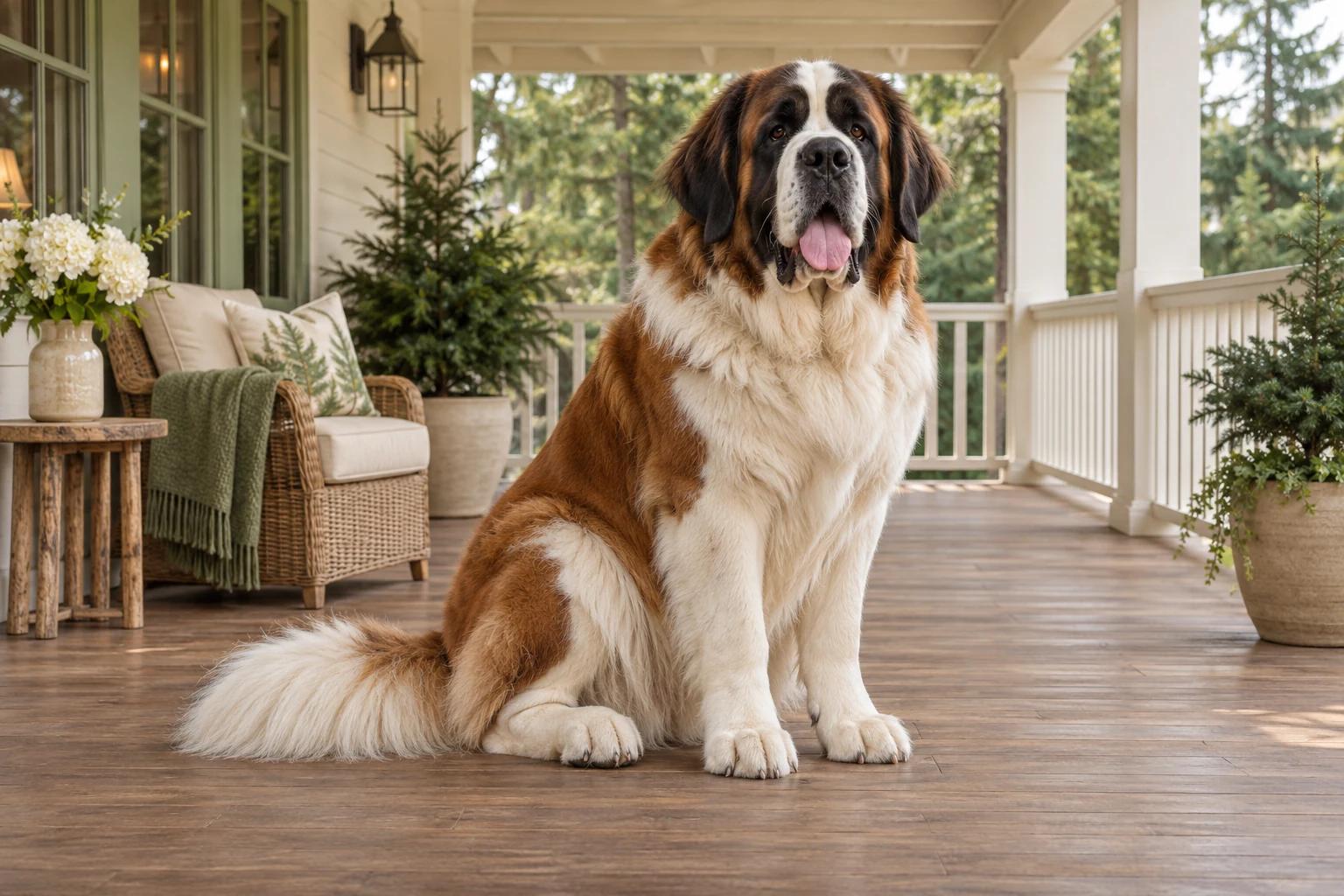
Saint bernard vs great dane is not a choice between two interchangeable giant dogs. The Saint Bernard and Great Dane profiles show overlapping adult weights but different height and communication references. Start with those distinctions rather than deciding that whichever breed looks bigger in a photograph must be the more demanding companion.
Saint Bernard vs Great Dane: the Saint's powerful outline
The Saint Bernard's AKC standard describes a broad skull, a short muzzle that does not taper, and a very muscular neck that can appear relatively short. Its broad back and substantial shoulders create a different silhouette from a dog whose impression depends more on long lines. The chest is well arched, the belly only slightly drawn up, and the feet broad with strong toes. AKC: Saint Bernard standard.
Look at the whole outline, not only the familiar facial mask. A photograph of the head alone tells you little about the dog's chest, limbs or proportions. The standard also discourages excessive wrinkles and an overdeveloped dewlap: the desired appearance is not a competition for the most exaggerated face or throat.
These are descriptions of breed type, not a diagnosis or a guarantee about temperament. A powerful-looking dog can have an individual history that matters much more to daily handling than its resemblance to a show-ring ideal. When meeting a Saint, keep visual recognition separate from learning how that particular dog behaves.
The Dane has a different frame and head
The Great Dane standard calls for a near-square outline, allowing females somewhat more body length. The neck is long, muscular and well arched, flowing into the shoulders. The head is rectangular, with straight, parallel upper lines of skull and muzzle; the muzzle and backskull are equal in length. This is a useful anatomical difference between saint bernard and great dane, not simply a difference in coat pattern. AKC: Great Dane standard.
The Dane's chest reaches the elbow, with a clearly defined abdominal tuck-up. Its standard emphasizes balance, avoiding both coarseness and insufficient substance. Long, easy strides are part of the intended movement, with reach and rear drive working together rather than a bouncing body.
Do not confuse an elegant outline with physical delicacy or a small ownership commitment. Equally, the breed's impressive appearance is not an argument for maximizing height at the expense of the individual. Compare the dog's actual build and movement rather than selecting a puppy because an advertisement predicts an exceptional adult.
The Saint's background is Alpine, not decorative
The Saint Bernard Club of America traces the breed's story to the hospice at the Great Saint Bernard Pass between Italy and Switzerland. Dogs accompanied the monks and became associated with finding and assisting travelers in dangerous mountain conditions. The club distinguishes documented history from uncertain details about the breed's origins. Saint Bernard club: breed history.
That context matters when the Saint is presented merely as a sleepy, oversized mascot. Its identity includes work alongside people. It does not mean that an untrained modern companion has rescue skills or should be taken into hazardous terrain to demonstrate an inherited talent.
Historical stories also need proportion. A famous individual dog's achievements are not a forecast for every puppy, and romantic accounts do not replace instruction, fitness or suitable conditions. For a prospective owner, the practical value of the history is understanding the breed's association with cooperative work, not expecting a household pet to reproduce a legend without preparation.
A Great Dane still needs engagement
VCA describes Great Danes as learners who can be sensitive as well as persistent in their preferences. It identifies obedience work as mental exercise, alongside everyday physical activity. That is a better starting point than treating a calm indoor appearance as evidence that the dog needs little interaction. VCA: Great Dane.
For someone choosing a giant companion, the distinction is between a dog resting after its needs have been met and a dog expected to do nothing indefinitely. Learning provides a shared task, not simply a way to demonstrate control over a large animal. Consider whether you enjoy teaching and participating, rather than only the picture of a dog reclining beside you.
VCA also notes the short-coated Dane's limited tolerance for very cold weather. A large body does not automatically make a dog an all-weather outdoor companion. This is particularly relevant if your attraction to a giant breed is tied to a winter outdoor lifestyle. Individual comfort still matters more than a dramatic photograph in snow.
Compare the current size and activity references
The current Saint profile lists adult weight at 120–180 lb, with females 120–140 lb and males 140–180 lb. The Dane profile lists 110–175 lb, with females 110–140 lb and males 140–175 lb. There is substantial overlap. The Dane's height references are higher: 30–32 in for males and 28–30 in for females, compared with 28–30 in and 26–28 in respectively for Saints.
For everyday activity, consider each dog’s actual experience rather than choosing a giant breed by an apparent energy ranking. Ask what the adult currently enjoys and whether its routine fits the activities you want to share. Neither a photograph nor a general breed label tells you how that individual will approach an outing. The breed quiz helps connect that comparison with the type of interaction you want.
The existing Saint coat-and-cleanup article covers that separate ownership question; it should not become the only basis for choosing between these dogs.
Frequently asked questions
In a Great Dane vs Saint Bernard comparison, which is heavier?
The current profile ranges overlap considerably. Saint males have a higher lower reference, but the overall upper limits are close. Do not use the breed label to predict which of two individual adults will weigh more.
Should I choose a Saint Bernard or Great Dane for less activity?
Do not choose between them on that assumption alone. Meet the individual dogs and discuss their established routines with their caregivers. Either choice includes daily engagement, rather than a promise of a companion who needs little of your time.
Which breed is quieter?
The Saint's vocal reference is one and the Dane's three. Neither rating predicts every dog's barking or explains its cause. Low vocal tendency also does not imply low watchfulness: both profiles rate watchfulness highly.
Sources behind this article
- AKC: Saint Bernard standard ↗
- AKC: Great Dane standard ↗
- Saint Bernard club: breed history ↗
- VCA: Great Dane ↗
- AKC sex-qualified adult reference — adult-weight reference ↗
- Barry Foundation Swiss origin reference — adult-weight reference ↗
Article source checked: November 16, 2026. Source checked 2026-11-16Article source checked: November 18, 2026. Source checked 2026-11-18
Keep reading

Affenpinscher vs Brussels Griffon: Everyday Differences
Read article →