Spanish Mastiff Temperament: Company and Watchfulness
Explore Spanish Mastiff temperament, family interest, watchfulness and social preferences, with practical ways to understand individual behavior.
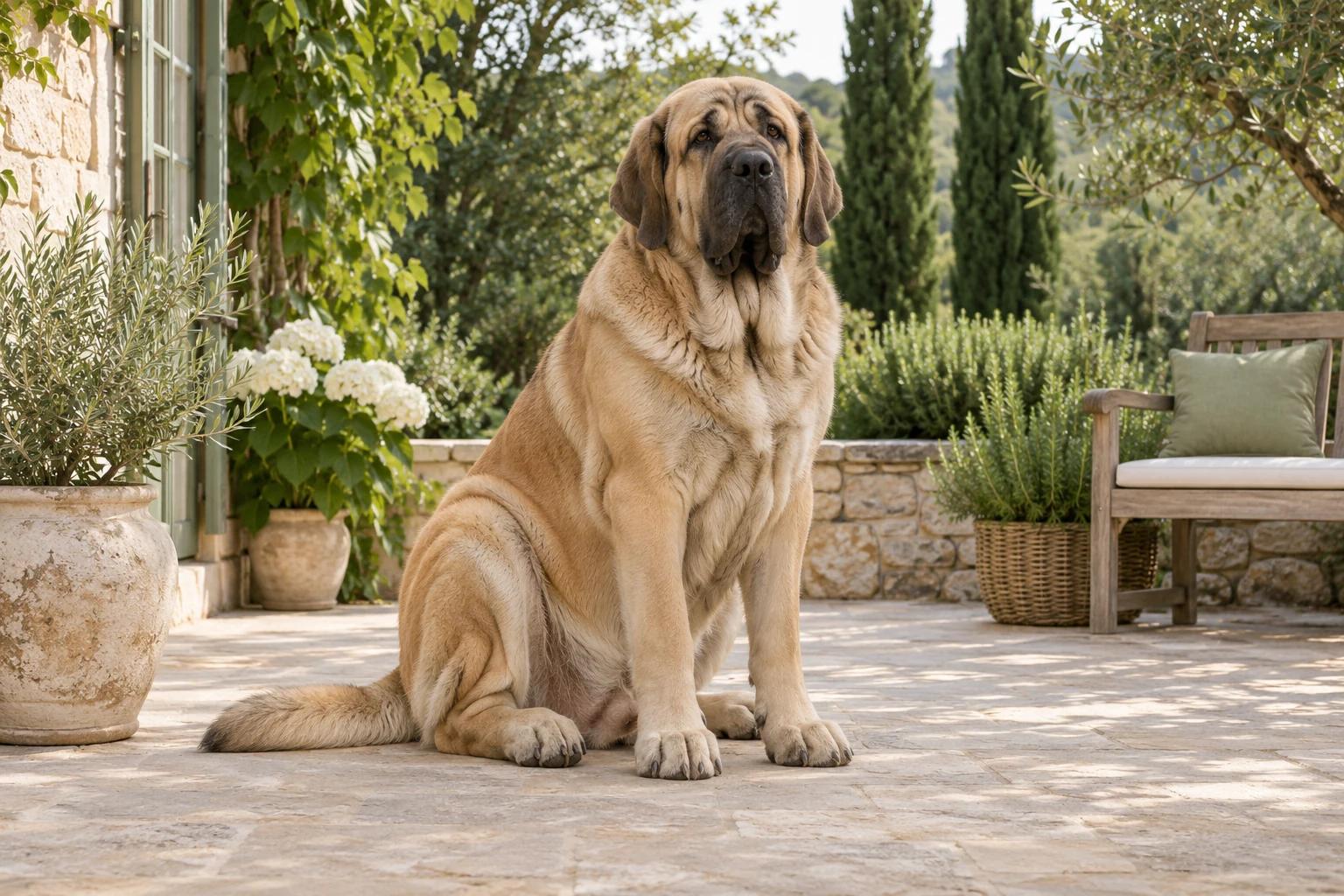
Spanish mastiff temperament combines strong family interest with pronounced watchfulness in the My Breed Atlas profile. Those qualities describe different relationships: affection toward familiar people does not mean equal enthusiasm for everybody encountered outside the household. The profile's moderate new-people rating is an important counterweight to its very high family rating.
Spanish Mastiff temperament in the standard
The UKC describes a kind, noble temperament alongside determination in guarding. These are broad breed ideals, not an individual behavioral assessment.
When unfamiliar visitors are difficult
For a Spanish Mastiff who struggles with guests, the aim is comfortable coexistence, not a compulsory greeting. Battersea recommends a familiar separate space before arrival, with visitors kept away from that area. This lets the owner admit a guest without a face-to-face meeting at the entrance. Battersea: stranger issues.
Once everyone is settled, an already calm dog may choose to join, but the visitor should ignore them rather than reaching, talking or staring. The owner rewards calm behavior. Having the stranger offer food can create conflict: the dog may want the food without wanting closeness. A dog who remains in their separate space should not be coaxed into the social gathering.
If tension or persistent barking develops, return to the comfortable separate area rather than prolonging the encounter. With this breed's high watchfulness, treating a crowded party as practice would be a poor starting point. Severe reactions need individual help from a qualified behavior professional; this outline is not a treatment plan for aggression. Success can be a quiet evening with separation, not a petting session.
Family affection is not permission for rough contact
RSPCA guidance explains that children's close facial contact, hugging and unpredictable movement can be difficult for dogs. A Spanish Mastiff's family rating must not become permission for children to climb on the dog or pull its ears. Adult supervision is essential whenever children and dogs are together; familiarity does not replace it. RSPCA: dogs and children.
Leave dogs undisturbed while eating, resting or enjoying a possession. For this household, that means the dog's resting space should not double as a children's play surface. A child should not crawl across the dog to retrieve something on the other side, even if that route looks shorter than walking around.
Provide a quiet place the dog can use without being followed, and teach children to respect it. Adults need to make that separation work rather than leaving the dog to enforce boundaries. The useful question is not whether the breed is a 'gentle giant', but whether people can consistently offer considerate interactions. Neither affection nor a breed label guarantees safety around children.
Find the kind of affection this dog actually wants
The Ontario SPCA describes a simple pause during petting: offer about three strokes or three seconds, then stop. If the dog actively seeks more contact, another brief period can follow. If they move away, do not follow them to resume. Continue checking rather than treating the first approach as permission for unlimited touch. Ontario SPCA: three-pet rule.
This is useful for an affectionate Spanish Mastiff because closeness and stroking are not necessarily the same request. A dog may approach the sofa and then choose to lie beside it. The pause helps distinguish an invitation to continue from a human assumption that every nearby dog wants more handling.
Allow the dog to approach rather than thrusting a hand toward them. Stop and reconsider if discomfort increases, and seek professional help when interactions are difficult. The exercise is about offering a choice, not testing how much a dog will tolerate. It also gives family members a concrete alternative to prolonged hugging: brief contact, a pause, and attention to what the dog does next.
Quiet does not mean unobservant
The Spanish Mastiff profile pairs very high watchfulness with a low vocal rating. These are not contradictory scores. Watchfulness concerns attention to surroundings; vocal tendency concerns sound. A household seeking a relatively quiet companion should still consider whether it wants a dog for whom watching the environment is a prominent trait.
Likewise, a person seeking a highly vocal alarm dog should not read the watchfulness rating as a promise of frequent barking. The two scales answer different questions. For this breed, the combination matters more than either score alone: choosing solely on noise could hide the more significant question of how much environmental awareness you want in a companion.
Companionship without nonstop games
Playfulness is rated lower than family affection, while activity and mental engagement sit in the middle. A Spanish Mastiff need not be an enthusiastic toy-game partner to be interested in its people. Someone who measures affection by how often a dog brings a ball may miss the distinction between sociability and play drive.
Conversely, moderate activity is not a description of a decorative house dog. Consider all three dimensions when using the breed matching quiz: desired company, appetite for play and preferred activity level. The seasonal livestock journeys article explores a different aspect of the breed's background; present-day household compatibility needs its own assessment.
Frequently asked questions
Is the Spanish Mastiff personality very playful?
The Atlas profile gives playfulness a relatively low rating, despite strong family affection. That makes the breed a different prospect from a companion selected chiefly for frequent, exuberant games. Individual preferences still matter, but the profile does not suggest equating family attachment with a constant appetite for play.
Which Spanish Mastiff characteristics matter for a social household?
Read family affection and openness to new people separately. The former is very high; the latter is moderate. A home full of familiar household members is not the same social situation as one with a rotating stream of unfamiliar people. That distinction is more informative than calling the breed simply friendly.
Does Spanish Mastiff behavior suit someone wanting little interaction?
Strong family interest makes that a questionable match on paper. Low vocal tendency and relatively low playfulness can look undemanding when considered alone, but neither cancels the companionship dimension. Someone primarily attracted by quietness should examine whether they also want the level of family involvement represented in the profile.
Sources behind this article
- UKC: Spanish Mastiff standard ↗
- Battersea: stranger issues ↗
- RSPCA: dogs and children ↗
- Ontario SPCA: three-pet rule ↗
Article source checked: November 16, 2026. Source checked 2026-11-16
Keep reading

Airedale Terrier Temperament: What Everyday Life Can Feel Like
Read article →