Spanish Mastiff Exercise: Movement and Daily Activity
Plan Spanish Mastiff exercise around the individual dog, with suitable activity choices, a useful turning cue and practical winter-walk care.
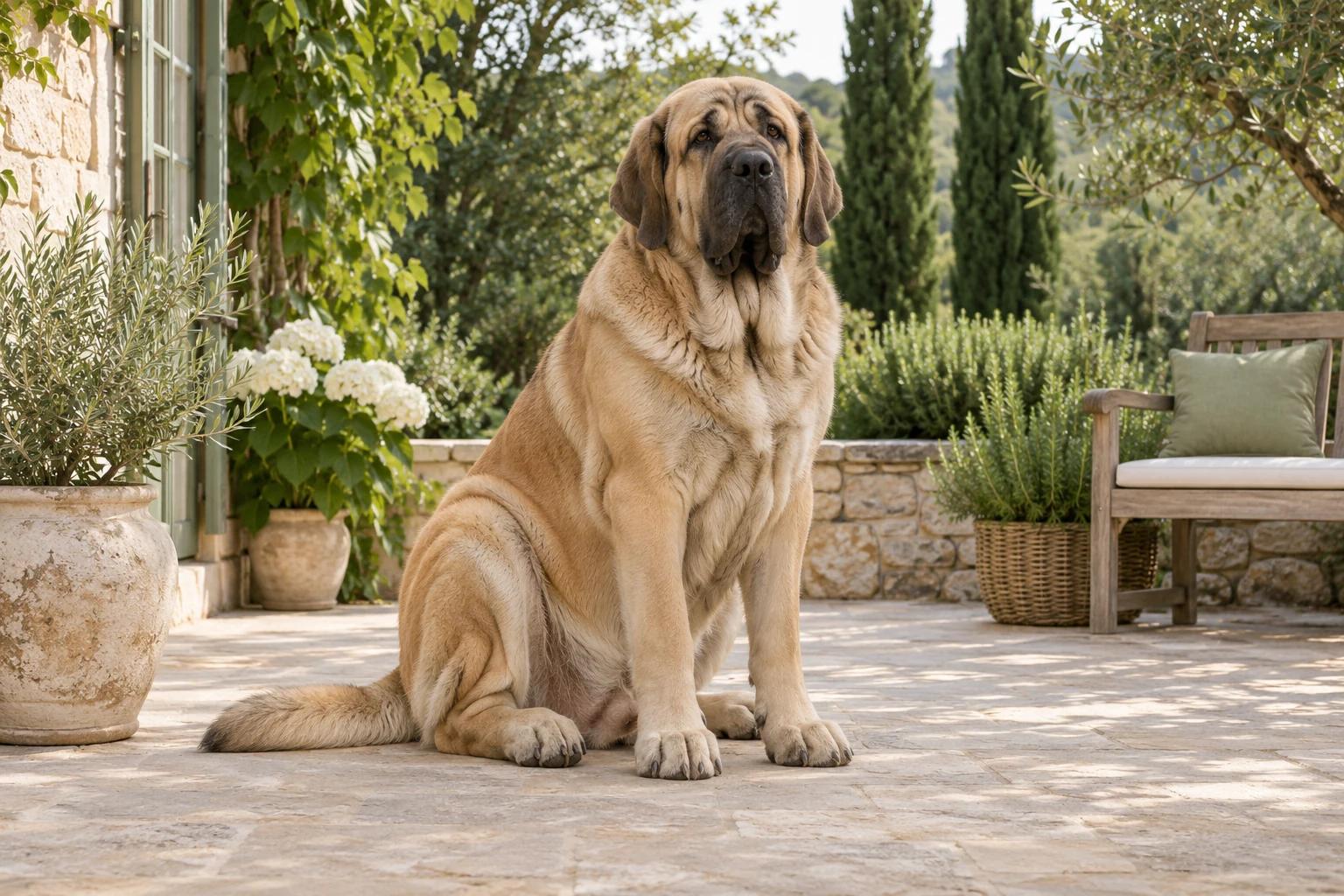
Spanish mastiff exercise belongs in a balanced daily life, even though this is not a breed whose My Breed Atlas profile suggests constant play. Activity and mental engagement both sit in the middle of the reference scale. The practical aim is appropriate involvement, not either endless exertion or almost no movement.
The Spanish Mastiff profile helps place those tendencies alongside watchfulness and family interest. Read the combination rather than deciding an exercise plan from the dog's impressive appearance alone.
Spanish Mastiff exercise and the body underneath
UKC describes a robust body that remains supple, with powerful, harmonious movement. Substantial build is not the same as a requirement to be immobile. Nor does that description establish an individual dog's fitness. Watch the actual dog move and discuss concerns with your veterinarian rather than equating size with either exceptional stamina or inevitable inactivity.
Choose activities by demand, not spectacle
AKC's discussion of sports for giant breeds distinguishes less physically demanding options, such as scent work and suitable obedience or trick foundations, from higher-impact pursuits. It advises an individual assessment, particularly before activities involving greater physical demands. AKC: sports for giant breeds.
For a Spanish Mastiff owner, an introductory lesson can therefore focus on an achievable skill rather than height, speed or dramatic effort. You do not need to turn the dog into a jumping athlete to give it purposeful work. Ask the instructor what movements are actually involved; an activity's general name does not tell you the demands of every exercise or level.
AKC notes that some higher levels of obedience and rally include jumping. Do not assume the label makes every version suitable for your dog. Discuss the intended work with your vet, especially while the dog is growing or when health concerns affect movement. The breed's substantial body makes a thoughtful choice worthwhile, but it does not exclude enjoyable learning. Participation should be appropriate to this individual rather than a demonstration of what giant dogs can theoretically accomplish.
Teach an easy change of direction
Battersea's “this way” exercise begins with comfortable walking beside the handler on a loose lead. Once that is established, use a reward to guide a slow turn, mark the dog's successful following and reward it. Add the verbal cue when the movement is becoming familiar, then gradually replace the food lure with an empty-hand signal. Battersea: teaching this way.
For a Spanish Mastiff, choose enough open space for both bodies to turn without crowding. Practice in a quiet setting before adding distractions. A broad, comfortable turn is more useful than a tight pivot performed to imitate a smaller dog's demonstration.
Battersea advises against pulling the dog back into position. Reset and make the task easier instead. This is preparation for ordinary changes of direction, not a way to wrestle a giant dog past something it cannot cope with. If you cannot manage the dog safely on a walk, seek qualified help and avoid challenging encounters while a suitable plan is developed. The cue is learned cooperation, not an emergency physical restraint.
Adapt the outing to winter conditions
Cornell emphasizes that cold tolerance varies and that even well-coated dogs have limits. Watch for shivering, paw lifting, reluctance to continue or other signs of discomfort, and return to warmth rather than extending the outing to satisfy a number. Cornell: winter safety.
A spanish mastiff daily walk also needs a usable surface. Avoid frozen ponds and lakes; apparent solidity does not establish that ice can support a dog. In slippery conditions, choose a route where you and your companion can remain steady rather than treating a difficult path as extra conditioning.
Cornell recommends removing salt and de-icing material from paws and other exposed areas after winter walks. This gives the end of the outing a practical purpose beyond reaching the front door. Check for material caught around the feet and contact your vet if you find soreness or have concerns about mobility. Large size is not protection from cold surfaces or chemical residues. Adjust the outing to the weather and the individual, rather than relying on an outdoor-looking coat as a guarantee.
How much exercise does a spanish mastiff need?
A reference activity rating cannot prescribe minutes for every dog. My Breed Atlas places the spanish mastiff activity level at three out of five, with playfulness at two. This combination is more informative than assuming that every dog needs the same style of play to enjoy an active day.
A prospective owner who wants nonstop retrieving games may be looking for a different pattern of interaction. A person interested in sharing ordinary outings and modest learning may find this profile more appealing. Neither preference establishes what one dog will enjoy, but it helps you ask useful questions about the actual companion rather than relying on a breed photograph.
Mental engagement also scores three. A day containing movement but no opportunity to participate with people does not address the entire profile. Conversely, involvement does not require a constant succession of novel challenges. Consider the balance of physical activity, interaction and quiet company that attracts you to this breed in the first place.
Watchfulness remains part of the picture
The Spanish Mastiff's watchfulness rating is five, while vocal tendency is one. This distinction matters on outings: a lower reference for barking does not imply that the dog takes no interest in what is happening around it. Quietness alone is not a complete description of an outdoor experience.
Family affection is also five. The breed should not be chosen on the premise that physical space alone supplies a relationship. If your plan depends on a dog occupying a large area while you have little everyday involvement, the profile's strong family-interest reference deserves another look.
The dog breed quiz can help you compare those preferences with other breeds. For separate background, read the Spanish Mastiff history article. Historical work is not an exercise prescription for the dog living with you today.
Frequently asked questions
Does lower playfulness mean no activity?
No. The profile rates playfulness at two but activity at three. These describe different tendencies. A dog need not seek constant games for ordinary physical activity to remain part of its life.
Is a quiet outing necessarily an uneventful one for the dog?
Not necessarily. The Spanish Mastiff's watchfulness reference is high even though vocal tendency is low. Silence alone does not tell you how much attention the dog is paying to its surroundings.
Is outdoor space the main requirement?
Space is only one consideration. The profile also records strong family interest and moderate mental engagement. Decide whether you want an involved companion, not simply whether your property has room for a large dog.
Sources behind this article
- UKC: Spanish Mastiff standard ↗
- AKC: sports for giant breeds ↗
- Battersea: teaching this way ↗
- Cornell: winter safety ↗
Article source checked: November 16, 2026. Source checked 2026-11-16
Keep reading

Afghan Hound Exercise Needs: Build a Workable Active Day
Read article →