Shih Poo Temperament: Company, Greetings and Play
Understand Shih Poo temperament through individual behavior, calm greetings, comfortable time apart and play that suits your dog.
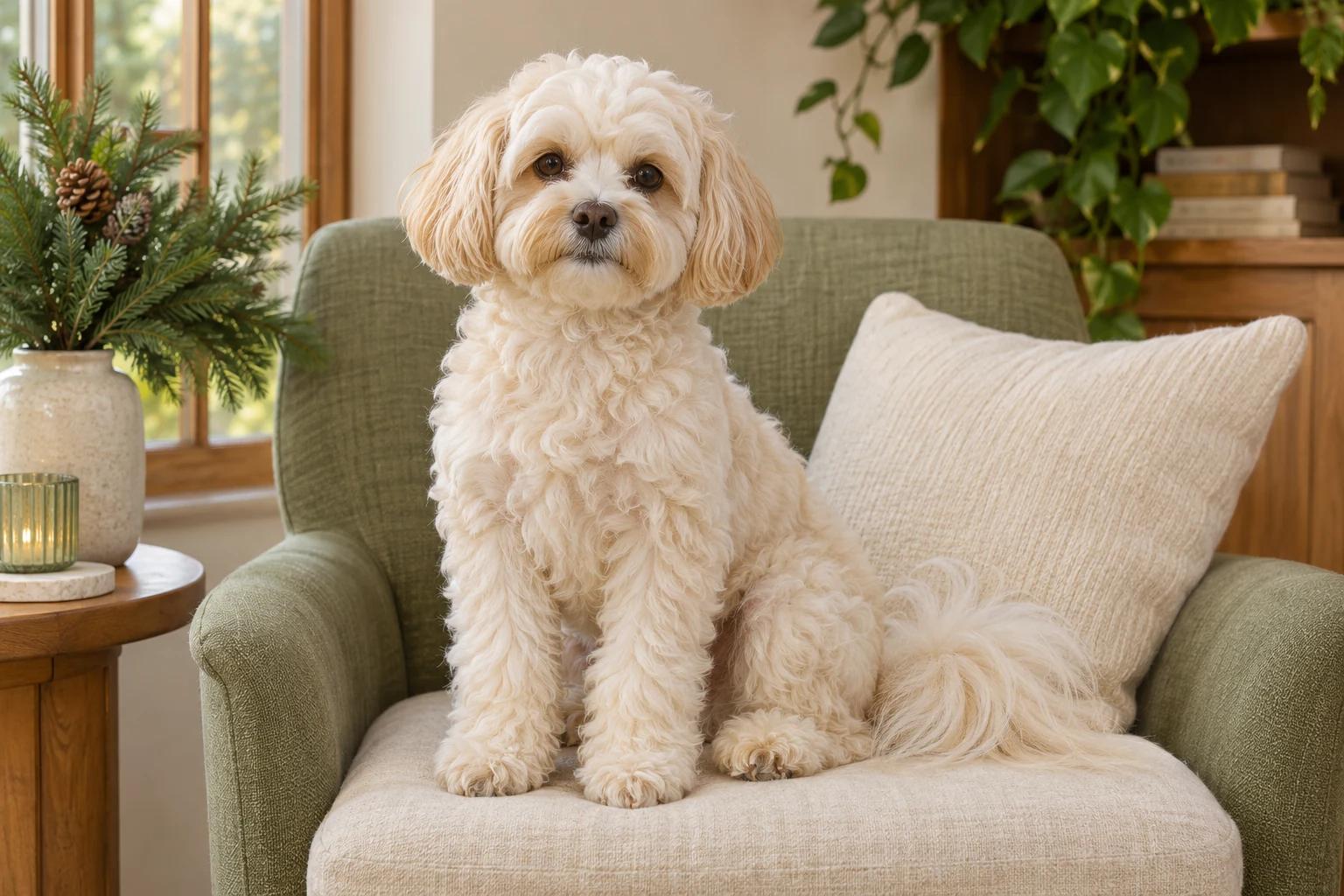
Shih Poo temperament deserves a closer look at everyday interactions. A more useful approach asks how this individual spends time with people, greets visitors, plays and copes when someone leaves. The Shih-poo profile describes a companion-oriented cross with Shih Tzu and Poodle ancestry. That is a starting point for understanding the dog, not a replacement for learning its preferences and teaching the everyday skills your home requires.
Shih Poo temperament is an individual question
Research by Morrill and colleagues examined owner-reported behavior and genetic data from purebred and mixed-breed dogs. It found inherited influences on behavior but also substantial variation that breed labels did not explain. This was not a study establishing a single Shih-poo personality or a formula for combining the behavior of two parents.
For your Shih-poo, the practical lesson is to separate ancestry from observation. A claim that the dog has one parent's cleverness and the other's calmness sounds precise, but it does not tell you how that dog handles a visitor, a game or a new place. Ask for concrete examples involving the individual.
When considering a puppy, discuss the experiences it has actually had rather than asking someone to promise its finished adult character. With an adult, observe ordinary interactions and ask about life outside the meeting.
Teach a greeting that keeps paws down
The AKC's greeting guide explains that attention can reinforce jumping and recommends teaching an alternative, such as keeping all four feet on the floor. Managing arrivals while that skill develops helps prevent repeated practice of the behavior you do not want.
For a Shih-poo eager to reach a visitor, arrange a practice greeting with someone who will follow your instructions. Reward the feet staying down before the dog has launched upward. Keep the first approach brief and controlled rather than waiting until an exciting arrival is already underway. A lead held by an adult or an appropriate gate can help manage the space.
Do not turn pushing the dog away into a wrestling game. Show the visitor what earns attention and make the alternative achievable. The goal is not to suppress sociability; it is to provide a comfortable way to express it. A small dog still benefits from a greeting routine that does not require people to catch it, dodge it or repeatedly fend it off.
Build comfort with time apart
Dogs Trust's time-alone guidance recommends gradual practice while you are still at home, followed by carefully increased absences. Watch the dog's response and reduce the challenge if it becomes worried. A comfortable resting area and a suitable positive activity can support the process, but they do not replace observing whether the dog is coping.
For a Shih-poo that likes to stay close, begin before an unavoidable long absence. Practice a manageable separation rather than suddenly expecting the dog to understand an entire workday alone. A gate may allow a small amount of distance without making you disappear immediately; choose an arrangement the individual can handle.
Avoid reading persistent distress as a deliberate attempt to control you. If the dog cannot settle during very small steps, seek professional support rather than repeatedly extending the absence and hoping it will give up. The important measure is comfortable behavior, not simply a longer time on the clock. A routine should develop from what the dog can manage now.
Discover what play means to your dog
VCA's play guidance emphasizes preferences, skills and avoiding games that produce excessive arousal. Some dogs prefer people to canine playmates; others enjoy particular toys or searching games. Play should be enjoyable for the participant, not just entertaining for the person watching.
For a Shih-poo, begin with a simple invitation and see whether the dog joins. One option described by VCA is hide-and-seek: one person briefly occupies the dog while another hides nearby and calls. Make the first hiding place easy enough to find. You can share an activity without expecting high jumps or a fast chase around furniture.
Watch the transition out of the game as well as the energetic middle. If the dog becomes too excited to disengage, simplify the activity and seek help with a more suitable approach. Age, development and physical condition affect what is appropriate. Ask the veterinary team before introducing demanding exercise, and stop if the dog seems uncomfortable rather than treating persistence as proof of a playful personality.
Describe Shih Poo characteristics precisely
If you want help understanding Shih Poo behavior, bring a specific question: “What happened when the visitor stood up?” is more useful than “Is my dog stubborn?” Write the sequence in ordinary language, including what the people did. Avoid deciding the explanation before someone has assessed the situation.
The dog matching quiz helps prospective owners consider the relationship they want. The existing Shih-poo treat-calorie article covers the separate food-accounting side of training. Here, the priority is understanding participation, company and communication rather than assigning every action to the cross's name.
Frequently asked questions
Can a parent breed predict a Shih-poo personality exactly?
No. Ancestry provides context, but individual behavior cannot be calculated by combining two parent descriptions.
Is jumping the only way to welcome an affectionate Shih-poo?
No. Teach and reward a greeting with four paws down so attention does not depend on jumping.
Should time alone increase even when the dog becomes worried?
No. Reduce the challenge and seek support if needed. Progress should follow comfortable coping, not a compulsory timetable.
Sources behind this article
- Morrill and colleagues: Canine ancestry and behavior ↗
- AKC: Teaching polite greetings ↗
- Dogs Trust: Learning to spend time alone ↗
- VCA: Play and exercise ↗
Article source checked: November 16, 2026. Source checked 2026-11-16
Keep reading

Airedale Terrier Temperament: What Everyday Life Can Feel Like
Read article →