Sheepadoodle vs Aussiedoodle: Build, Play and Daily Fit
Compare Sheepadoodle and Aussiedoodle build, movement and learning interests, then assess the individual dog beyond an appealing coat.
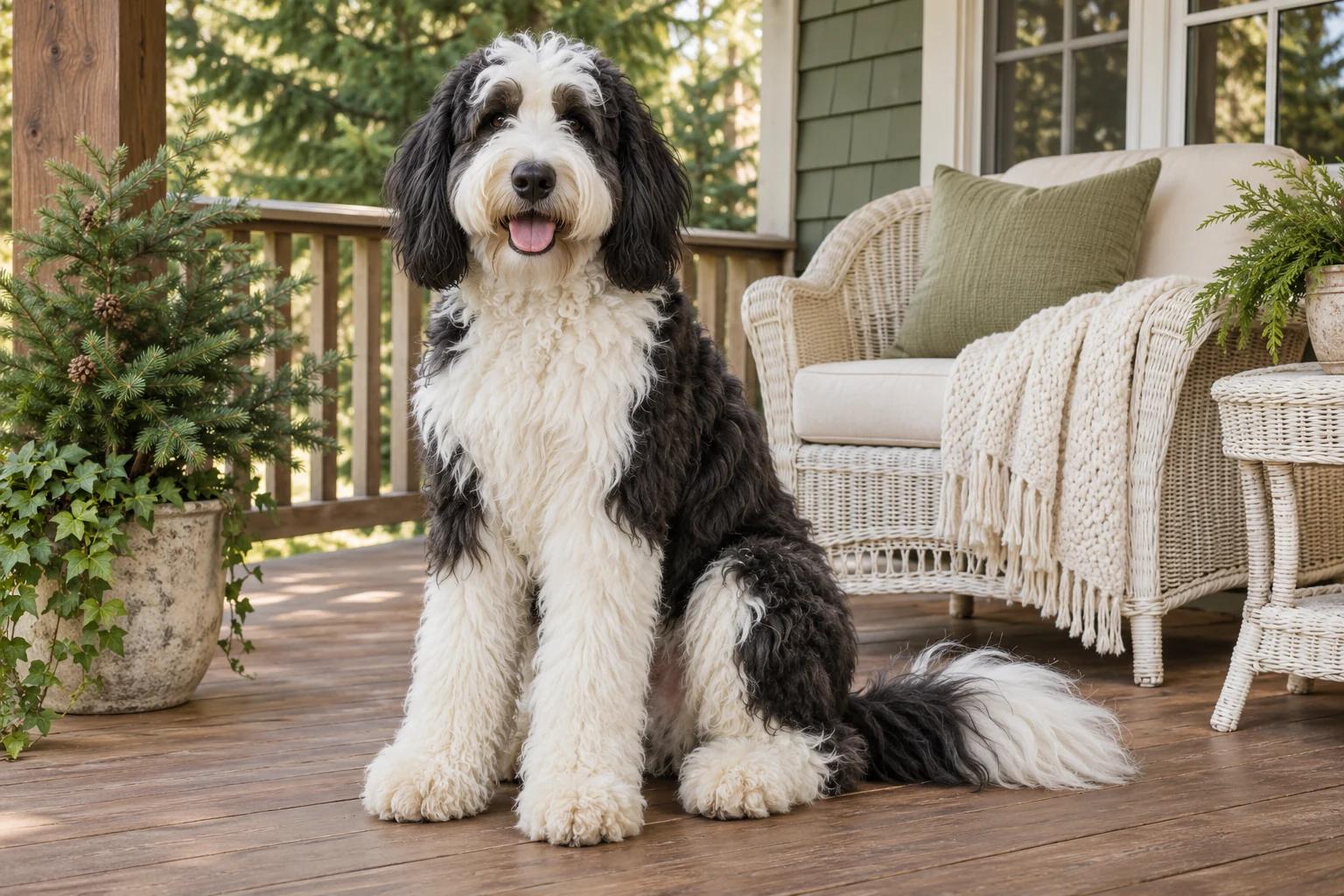
A Sheepadoodle vs Aussiedoodle choice involves build, movement and shared activities. Compare complete adult dogs rather than choosing between two appealing faces.
Explore the Sheepadoodle profile and Aussiedoodle profile. If you are sorting out similarly spelled names, the parent-breed naming guide addresses that separately. This comparison concentrates on practical differences rather than repeating the naming issue.
Sheepadoodle vs Aussiedoodle: compare dogs, not recipes
VCA's explanation of designer dogs notes that crossing breeds does not reliably produce a consistent selection of desired traits. The inherited combination can vary. Parent descriptions therefore suggest questions to investigate; they do not give you a finished specification for every puppy.
The Old English Sheepdog influence: substance and reach
The AKC Old English Sheepdog standard describes a square, muscular, substantial dog with a deep body and powerful, ground-covering movement. Its outline is compact rather than leggy, and its abundant coat can obscure the body beneath. These are parental characteristics, not a required Sheepadoodle shape.
When meeting a Sheepadoodle, look beyond the rounded haircut. Watch from the side as the dog walks at an ordinary pace. Then look at the space occupied when it stands beside its keeper. These views tell you more about practical handling than a close-up portrait of the face.
Consider your favourite activities at that scale. Can you comfortably share a narrow trail, pass through your hallway and arrange a resting place beside your desk? You do not need a show assessment. You need an honest understanding of the physical dog that will accompany you, including when the coat makes it look smaller or larger than it really is.
The Australian Shepherd influence: movement and attention
The AKC Australian Shepherd standard describes an agile, attentive working dog with herding and guarding instincts, a body slightly longer than tall and the ability to change direction readily. It also allows some reserve in initial meetings. Again, these descriptions concern the parent breed, not a guarantee about an Aussiedoodle.
Use that background to ask about the dog's response to movement. What happens when someone jogs past, when another dog begins running or when a game suddenly changes direction? Ask the keeper to describe ordinary situations rather than deliberately provoking a chase during your visit.
For someone who enjoys teaching precise turns and coordinated games, movement can be part of the attraction. For someone seeking an uncomplicated spectator at busy activities, it deserves closer investigation. The point is not to rank enthusiasm as good or bad, but to recognise whether the dog's interests match what you enjoy providing.
Shared Poodle ancestry does not mean identical bodies
The AKC Poodle standard distinguishes Standard, Miniature and Toy varieties by height, while describing an active, intelligent dog with balanced proportions. Its curly coat is dense. The actual Poodle background matters when you are comparing crosses; the word “Poodle” alone does not describe one fixed physical scale.
Ask which variety is involved, then meet or obtain reliable information about the particular parents. Avoid ordering equipment around a generic doodle silhouette. The dog you meet may have a different chest, leg length or overall outline from another dog carrying the same cross name.
Likewise, do not assume that two similar haircuts mean the dogs move alike. Watch their feet and bodies rather than just the bouncing coat. A comparison becomes clearer when you consider movement and build together instead of treating a photograph as a complete description.
Watch an ordinary game from beginning to end
For a Sheepadoodle or Aussiedoodle, a short demonstration of familiar play can be revealing. Ask the keeper to choose an activity the dog already knows. Observe the opening invitation, the activity itself and what happens when the person finishes. Do not introduce an exciting unfamiliar game simply to see what will happen.
A toy game contains several separate choices. The dog may pursue the object, carry it, bring it closer or prefer to keep it. You may enjoy one of those patterns more than another. Notice whether you want to participate in the game as it actually unfolds, rather than only admiring the most photogenic moment.
Discuss the less exciting parts too. What does the dog do while the keeper puts the toy away? What activity usually follows? These questions give you a realistic picture of shared time without turning one demonstration into a temperament verdict.
Make the comparison in the places you use
An Aussiedoodle vs Sheepadoodle decision can look different in a spacious garden and a narrow entrance hall. Imagine the dog beside you at the boot of your car, on the landing and in the place where you put on outdoor shoes. Check the usable space, not just the total size of your home.
If you already have a dog, consider that dog's preferences separately. A matching coat or similar nickname does not answer whether two individuals will enjoy sharing space. Arrange introductions with the guidance of the people responsible for the dogs rather than making collection day their first encounter.
The difference between Sheepadoodle and Aussiedoodle is best used to sharpen your questions, not to erase individual variation. Use the dog match quiz to examine your own preferences, then meet dogs with those preferences in mind.
Frequently asked questions
What should I ask to see during a visit?
Ask for an ordinary walk, a familiar activity and some time when nothing special is happening. Leave the choice of safe demonstrations to the keeper. Seeing a dog across those situations is more informative than requesting a string of impressive tricks.
Should I choose based on the puppy's colour?
Colour can be a preference, but it does not answer the practical questions of living together. Give more weight to the dog you meet, the care you can provide and the quality of information available about its everyday life.
What if both dogs seem equally appealing?
Compare the actual opportunities to learn about each dog. A visit with honest discussion of unfinished skills can be more useful than an idealised description. Choose the relationship you can realistically support, not the most polished sales presentation.
Sources behind this article
- VCA: Designer dogs ↗
- AKC: Old English Sheepdog standard ↗
- AKC: Australian Shepherd standard ↗
- AKC: Poodle standard ↗
Article source checked: November 16, 2026. Source checked 2026-11-16
Keep reading

Affenpinscher vs Brussels Griffon: Everyday Differences
Read article →