Russian Toy vs Papillon: Small Dogs, Distinct Outlines
Compare Russian Toy and Papillon dogs by build, coat, character and everyday care, without assuming that a small dog means a small commitment.
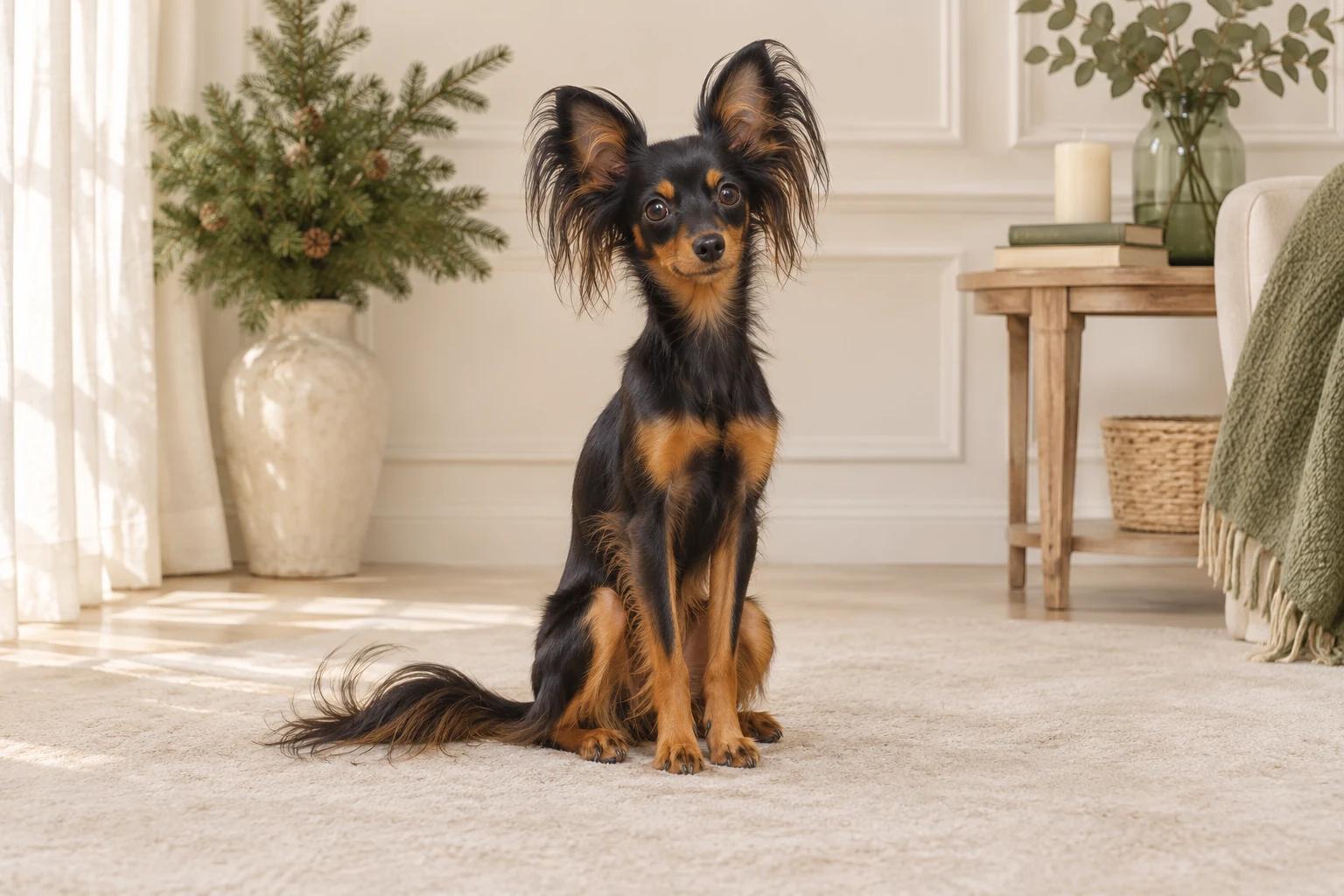
A Russian Toy vs Papillon comparison should consider the whole dog, not just an attractive head photograph. Look at build, care and the company you enjoy.
Neither is simply a decorative dog that happens to fit on a lap. Choose with the whole day in mind: walking, learning, ordinary care and the way people and animals move through your home.
Russian Toy vs Papillon: Look at the whole dog
The Russian Toy Club of America standard describes a long-legged, fine-boned dog with a square build. Smooth and long-coated varieties exist.
The Papillon standard describes a body slightly longer than tall, a level back and a flowing tail plume carried over the body. The long coat is fine and silky, with a chest frill and furnishings on the limbs. White with colored patches is characteristic. Its ideal temperament is happy, alert and friendly.
The Russian Toy has a spare, leggy silhouette; the Papillon coat creates a flowing outline.
Similar height does not mean identical shape
Both standards give the same height range. Photographs alone are unreliable size comparisons.
Choose equipment from the actual dog and manufacturer measurements. A shared height range does not establish the same harness fit.
The difference between Russian Toy and Papillon coats
Identify the Russian Toy coat variety before comparing care. See the separate body-coat and ear-fringe article for longhaired appearance.
Ask to watch ordinary coat care on the dog you meet. Where does the owner spend time? What does the dog accept readily, and which areas need more patience? Those questions connect appearance with an actual task instead of treating long hair as either automatically difficult or automatically effortless.
The Papillon Club of America explicitly notes that Papillons shed. Its ownership advice also emphasizes close companionship, mental engagement and consistent, non-forced training. A pretty coat and a clever reputation do not remove the need to participate in the dog's life.
What would care look like in your home?
Picture the place where you would work beside the dog. Can you see clearly and keep tools within reach? Is the surface steady? Would you be able to do the routine without other pets pushing into the space?
The most useful comparison is not the number of accessories a breed seems to require. It is whether you can comfortably perform the ordinary care that this individual already needs. A demonstration is more informative than a promise that grooming will be easy.
A friendly description is not a meeting guarantee
In a Papillon vs Russian Toy decision, avoid turning temperament adjectives into a pass-or-fail greeting test. A dog meeting you in an unfamiliar place may behave differently from the same dog at home with its usual person.
Ask what happens after the first greeting. Does the dog join a familiar activity, rest nearby, investigate the room or seek more contact? The answer tells you about a sequence of everyday choices rather than one dramatic moment.
Likewise, do not assume that reserve is a defect or that an eager approach means unrestricted handling is welcome. You are looking for a relationship you can enjoy, not a dog that performs sociability for every visitor.
Training interest should be something you want to share
Would you enjoy teaching a small practical task, such as approaching you indoors, rather than expecting it already learned?
Enjoying a finished skill is different from enjoying the teaching behind it.
Ask for a demonstration of a familiar skill. Watch how the caregiver helps, not just the result.
Small bodies change the household picture
The Papillon club cautions that substantial size differences between household animals require close supervision and thoughtful management. An affectionate larger dog can still create a physical problem during exuberant movement. Compatibility is not determined solely by whether the dogs appear friendly at first.
Consider narrow doorways, furniture movement and busy entrances from the smaller dog's position. A path that seems clear at human height may be crowded with feet, bags and objects below. Arrange the environment so the dog can move without continually weaving through avoidable obstacles.
This is not an argument for treating either breed as incapable. It is a reason to scale the surroundings sensibly while still offering ordinary opportunities to explore and learn.
When visiting either dog, bring a realistic question from your own home: “Where would the dog wait while I unload shopping?” The answer might involve moving a bed, closing a doorway or changing where bags are put down. This tests your proposed arrangement rather than asking the dog to prove it can tolerate every accident.
Russian Toy or Papillon: Make the choice concrete
Compare the Russian Toy profile and Papillon profile, then use the dog match quiz to clarify your preferences. Bring those preferences back to the particular dog's history and present behavior.
Choose the companion whose everyday life you can picture accurately. If your interest rests mainly on a face, coat or reputation, spend more time with the practical details before deciding. A small dog is still a full participant in the household.
FAQ
Is one breed always taller than the other?
No. Compare actual individuals rather than ranking the breeds by height.
Can I choose only by coat length?
Coat care matters, but it is only one part of daily life. Include interaction, teaching, household movement and the individual's established needs in the decision.
Does a friendly first greeting prove a good match?
No. It is one observation in one setting. Ask about normal behavior and spend enough time to understand more than the opening moment.
Sources behind this article
- Russian Toy Club of America: Standard ↗
- AKC: Papillon standard ↗
- Papillon Club of America: Is a Papillon right for you ↗
Article source checked: November 16, 2026. Source checked 2026-11-16
Keep reading

Affenpinscher vs Brussels Griffon: Everyday Differences
Read article →