Rottweiler vs Bullmastiff: Build, Care and Daily Life
Compare Rottweilers and Bullmastiffs through their build, coat, temperament and practical needs, without treating guardian labels as guarantees.
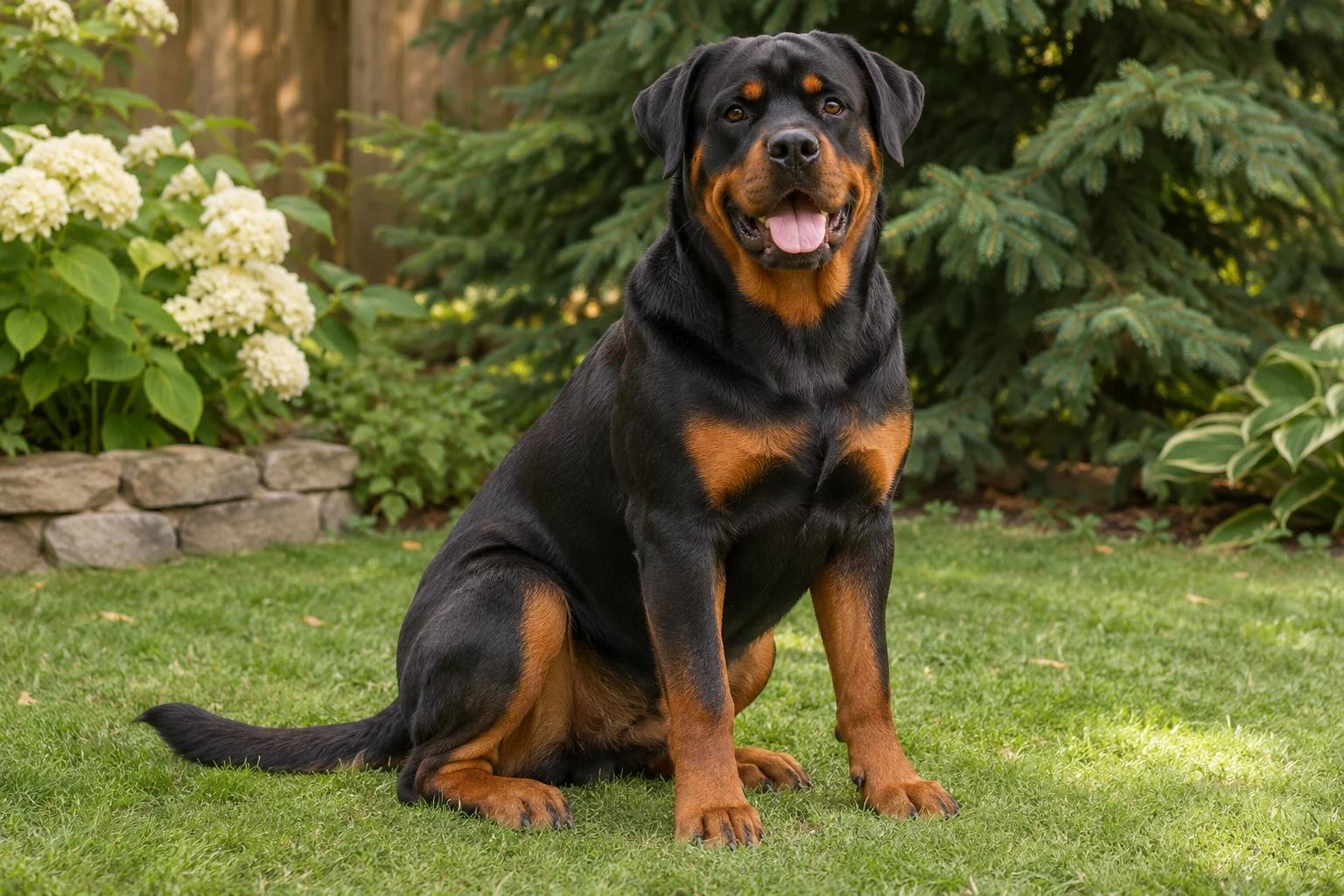
A Rottweiler vs Bullmastiff comparison is not a contest to find the stronger protector. Both are substantial working breeds, and either brings practical responsibilities that extend well beyond an impressive appearance. The useful question is which individual dog's movement, interaction and care you can manage comfortably every day.
Their outlines are recognizably different. So are their histories and the way breed standards describe their character. Those distinctions help you ask better questions, but they cannot tell you that an unknown dog will suit your household.
Rottweiler vs Bullmastiff: What you can see
The Rottweiler standard describes a compact, powerful dog slightly longer than tall, with a broad head, almond-shaped dark eyes and triangular hanging ears. Its black coat has clearly placed rust-to-mahogany markings. The ideal temperament combines confidence with some reserve toward unfamiliar people and willingness to work.
The Bullmastiff standard describes a nearly square, powerfully built but active dog. Its broad skull, shorter muzzle and close-carried ears create a different face from the Rottweiler's. The coat is short and dense, in red, fawn or brindle. Confidence and a comparatively docile disposition appear together in its temperament description.
Neither description means that a pet should be made heavier to look more impressive. Shape, musculature and extra weight are not interchangeable. When looking at adults, consider how they move and occupy space rather than rewarding the most exaggerated outline.
The practical meaning of a broad dog
Picture turning beside a parked car, passing through a narrow gate or finding space while another person opens a door. These are ordinary movements, but they become more noticeable with a dog whose body fills much of the available route.
Walk through the actual spaces you use before choosing equipment. A wide bed may fit the room yet obstruct the path beside it. A vehicle may have generous interior space but a difficult entrance. Comparing these physical details is more useful than deciding that one breed merely looks bigger in a photograph.
Size ranges overlap more than photographs suggest
The published standards put male Rottweilers at 24–27 inches and females at 22–25 inches at the shoulder. Bullmastiffs are listed at 25–27 inches for males and 24–26 inches for females. A difference between Rottweiler and Bullmastiff individuals can therefore be smaller than a breed-to-breed picture suggests.
The Bullmastiff standard lists 110–130 pounds for males and 100–120 for females. Do not use those figures as targets for feeding, or assume that the heaviest adult is the best representative. If body condition is unclear, ask your veterinarian rather than drawing a conclusion from a breed range.
For a prospective owner, the more immediate question is whether the particular adult can be handled safely in the situations you expect. Meet dogs of different ages where possible. A composed mature dog does not show you every challenge of raising an adolescent of similar eventual size.
Company and training are part of the commitment
The American Rottweiler Club stresses that socialization, manners and training are essential, alongside intellectual and physical activity and involvement in family life. It specifically cautions against leaving a Rottweiler in a yard with nothing meaningful to do.
Apply that point to your interest in the breed: do you enjoy teaching and participating, or mainly the idea of owning a formidable-looking dog? The answer matters more than a flattering description of loyalty. A garden is a place, not an activity or a relationship.
For either candidate, ask someone who knows the dog to demonstrate an ordinary transition: starting a walk, returning indoors or resting while the person sits down. Observe the interaction between dog and handler. You are looking for a realistic picture of shared life, not a performance staged to show how intimidating the dog can appear.
Do not audition a dog for guarding
Do not ask a stranger to provoke a reaction or stage a confrontation to test protection. That tells you little about whether everyday handling and household life will work, and it creates an unnecessary risk.
Instead, ask about actual experiences: how the dog responds to a delivery, whether it can move away from a busy doorway, and what support has already helped. Specific examples distinguish an established skill from an owner's hopeful interpretation.
Coat care and the appearance of easy maintenance
Both breeds have comparatively short coats, but a short coat does not eliminate loose hair, dirt or the need for hands-on care. In a Bullmastiff vs Rottweiler decision, ask to see the actual grooming tool and an ordinary session rather than accepting “easy coat” as a complete answer.
Think about where grooming would happen. A person working beside a substantial dog needs room to change sides without stepping over it. A washable surface and sensible access may matter more than a cabinet full of tools. The most convenient setup is one you can use without turning every session into furniture rearrangement.
Ask separately about bathing access and the dog's comfort with it. A home bath that works for a small puppy may be awkward for the adult. Planning for that physical change is not overthinking; it prevents a predictable problem.
Rottweiler or Bullmastiff: Choose the life, not the label
Start with the Rottweiler profile and Bullmastiff profile, then compare them with your actual experience of the dogs. The dog match quiz can organize preferences, but it cannot assess an individual dog's behavior for you.
For readers interested in the Rottweiler's working activities, the separate carting first-visit guide explains that particular sport. You do not need to pursue it to appreciate the breed, and it should not be treated as a substitute for everyday compatibility.
Choose the dog whose ordinary needs you want to meet: the walks you can manage, the teaching you enjoy and the body that fits your daily spaces. An impressive reputation is a poor replacement for those practical answers.
FAQ
Is either breed automatically a safe family protector?
No. A breed label cannot establish safety or predict how an individual will respond in a difficult situation. Choose companionship and manageable behavior rather than seeking a protection guarantee.
Can a Rottweiler and Bullmastiff be similar in height?
Yes. Their published height ranges overlap. Meet the actual dog rather than relying on a side-by-side internet image.
Does a short coat mean little overall work?
No. Coat length says nothing about the full commitment to handling, activity, learning and companionship. Consider the whole day, not just the brush.
Sources behind this article
- AKC: Rottweiler standard ↗
- AKC: Bullmastiff standard ↗
- American Rottweiler Club: Finding a Rottweiler ↗
Article source checked: November 16, 2026. Source checked 2026-11-16
Keep reading

Affenpinscher vs Brussels Griffon: Everyday Differences
Read article →