Poodle standard size: planning for the whole dog
Understand Standard Poodle height and weight, then plan resting space, transport and equipment around the individual dog.
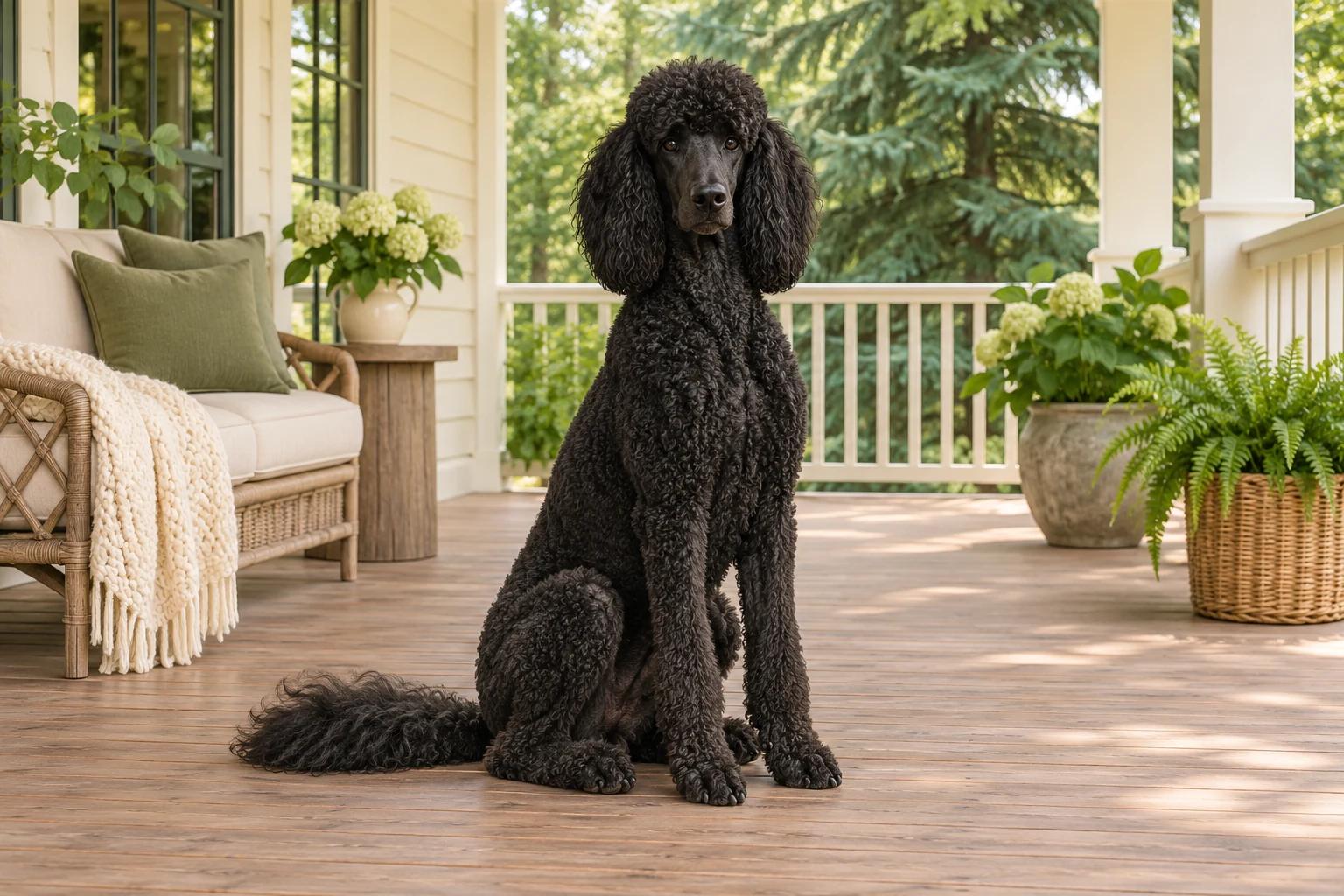
Poodle standard size can be surprisingly hard to picture from a groomed portrait. Long legs, a tall hairstyle, and the camera angle all affect the impression. For practical planning, start with measured height and weight, then consider the space a dog uses when moving, resting, and travelling with you.
This is not about finding the largest or smallest possible Standard. It is about knowing what fits your household and which questions remain unanswered before you bring a dog home.
Poodle standard size: a threshold, not a finished picture
The Poodle Club of America's AKC standard places Standard Poodles above 15 inches at the highest point of the shoulders. That lower boundary does not tell you the exact adult dimensions of a particular dog. Poodle standard height should therefore begin a conversation, not end it.
The AKC Poodle overview gives an overall reference weight of 40–70 pounds. The Standard Poodle profile separates its reference figures into 40–50 pounds for females and 60–70 pounds for males. These are descriptive ranges, not a required destination for every individual.
Ask about the dog you are actually considering. For an adult, request current measurements. For a puppy, distinguish today's measurements from an adult estimate and ask what supports that estimate. A confident forecast is still a forecast, even when it is expressed as a single neat number.
Measure the dog for the task, not for a label
A question about poodle standard weight might concern a lifting limit, an equipment rating, or a veterinary discussion. Those are different decisions. Write down the purpose before you collect a number so that you do not use one measurement to answer an unrelated question.
For equipment, follow the maker's instructions. A harness may require chest and neck dimensions; a transport crate may need standing height and body length. The breed's shoulder-height classification is not a substitute for those measurements. Compare the required dimensions with the usable interior space, not merely the product's external size.
Record the date and units. If several household members are shopping, put the information in one shared note rather than exchanging approximate figures from memory. Include the product model you checked. A manufacturer's sizing label can differ from another company's label even when both say large.
If measuring is awkward, ask a knowledgeable professional to demonstrate. Do not force the dog into a rigid pose for the sake of a tidy number. Rechecking calmly is better than building an expensive decision around a hurried estimate.
Look at turning space, not only floor area
A tall dog uses a room differently from a compact bundle of the same apparent footprint. Lay out a prospective resting place and walk your normal route around it. Can someone pass with a laundry basket without stepping into the bed? Does opening a cupboard intrude on the space?
Think about the dog's full resting posture. A tightly curled photograph tells you little about how much room the same animal takes when stretched out. If you can meet an adult dog before bringing it home, watch how it settles and changes position. That observation can guide a bed choice more effectively than a catalog illustration.
Doorways and stairs deserve a practical look too. Where will you attach the lead before opening the front door? Can another person pass without squeezing around the dog? The goal is to remove awkward bottlenecks, not to decide that a house must meet an invented square-footage requirement.
For a shared building, include the lift or stairwell in your walkthrough. Plan where you will wait if another dog or a delivery trolley arrives. Comfortable daily movement depends on the whole route from the resting area to the outdoors.
Plan transport before buying permanent equipment
A vehicle may have ample space once the seats are folded but not when passengers and luggage are present. Check the configuration you will actually use. Keep the dog's travel arrangement separate from loose bags rather than assuming everything will fit somehow on departure day.
Consult the restraint or crate manufacturer's fitting and installation instructions. If you are unsure whether a product is suitable, ask the manufacturer or an appropriately knowledgeable professional. A breed name in a sales description is not a verified fit assessment.
Also think about access. How will the dog enter and leave the vehicle? What is your backup plan if it cannot use the usual route? Discuss any mobility concerns with your veterinarian rather than designing a strenuous loading routine around an assumption.
If you expect to travel with a transport provider, check that provider's current requirements when planning the trip. “Standard Poodle” is not itself a travel category, and a breed-average weight cannot confirm eligibility for a particular arrangement.
Growth should not become a size contest
Owners asking “how big do poodle standards get” may hope to predict every future purchase. Some uncertainty is easier to handle by choosing replaceable or adjustable equipment than by demanding precision from a puppy estimate.
Make a purchase list with two columns: needed now and worth deciding later. A comfortable, correctly fitted current harness belongs in the first. A custom built-in bed may belong in the second. Check adjustment ranges and return conditions rather than assuming an expensive item will last through every stage.
Keep weight records for useful conversations with your veterinarian, not for pursuing the top or bottom of a breed range. Feeding and body-condition questions require individual advice. Neither a substantial coat nor a slender-looking silhouette tells you everything you need to know.
Finally, separate physical size from how much involvement you want with a dog. Our Standard Poodle retrieving article explores one possible shared interest. The dog match quiz helps you consider broader routines. Neither replaces meeting the individual and planning for its actual needs.
FAQ
Is there one adult height for every Standard Poodle?
No. The AKC category starts above 15 inches at the shoulder; it is not a prediction of an individual dog's finished height. Ask for current adult measurements or a clearly labeled puppy estimate, depending on the dog you are considering.
Can I choose a crate using weight alone?
No. Check the manufacturer's measuring and fitting instructions, including the usable interior dimensions. Weight ratings and physical fit answer different questions. Consider the actual dog and the installation space instead of relying only on a breed label or a weight range.
What should I buy before a puppy's adult size is known?
Prioritize equipment that fits now and can be reassessed as the dog changes. Check adjustment limits rather than assuming an adjustable product fits indefinitely. Delay expensive permanent items when their usefulness depends on a precise adult measurement you do not yet have.
Sources behind this article
- Poodle Club of America: AKC Breed Standard ↗
- American Kennel Club: Is the Poodle a Good Fit for You? ↗
Article source checked: November 15, 2026. Source checked 2026-11-15
Keep reading
Poodle standard temperament: life between the outings
Read article →