Nenets Laika temperament: initiative and companionship
Explore Nenets Laika temperament through learning, independent choices, introductions and practical questions about a prospective companion.
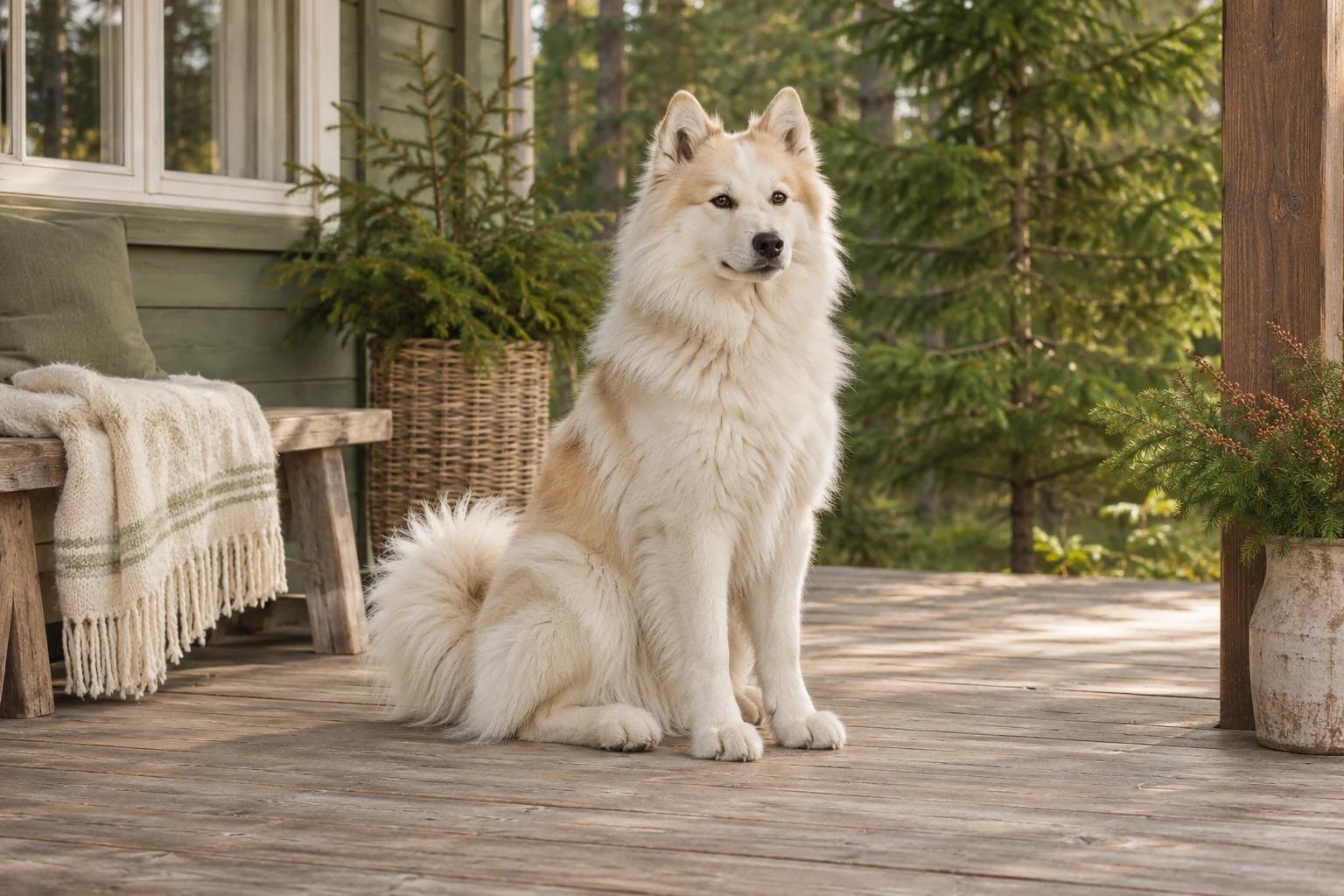
Nenets Laika temperament is worth considering as a relationship between willingness to work with people and the capacity to act with initiative. Those qualities can be appealing together. They also make it important to teach clear household routines rather than assuming an intelligent dog will automatically choose what you had in mind.
Before acquiring one, ask how the individual spends time with familiar people, responds to an unfamiliar situation and behaves when an activity ends. The most useful picture includes ordinary moments, not only an account of impressive working ability.
Nenets Laika temperament: cooperation is not passivity
The RKF’s 2022 breed standard describes learning ability, initiative and independent decision-making, while allowing for distrust of unfamiliar people. These are broad breed descriptions, not promises about a particular dog.
For everyday ownership, begin with the assumption that communication needs to go both ways. You can decide what is allowed in your home while also noticing which activities the dog understands and enjoys. A dog choosing something other than your intended task may need a clearer lesson, a different setting or a break; the moment does not explain its whole personality.
The Nenets Laika profile offers a wider view of care and household tendencies. Use that context to prepare questions about the dog in front of you rather than to fill gaps in its history with expectations.
Give initiative a useful place to go
The AKC’s discussion of choices and autonomy describes simple options such as different resting places and toys, while keeping necessary boundaries. Offering a choice does not mean letting the dog decide whether roads, wildlife or unfamiliar animals are appropriate to approach.
At home, think about decisions that are genuinely available. If either of two resting spots works, let the dog use the one it prefers. If a game can use either of two suitable toys, notice which one draws interest. You learn something about the individual without turning every interaction into a command.
Keep unavailable options clear too. A closed room should not become available only after prolonged scratching at the door because someone eventually gives up. Resolve the household arrangement first, then teach the routine with qualified help if needed.
For a dog described as capable of initiative, this balance is more useful than trying to remove all choices. Your role is to make the acceptable choices understandable and practical in the environment you share.
Ask what “trainable” looks like on an ordinary day
Nenets Laika personality descriptions often emphasize intelligence. Translate that word into observable questions. What cues does the dog know? Where can it perform them? What does the caregiver use as a reward? Which skills are still being taught?
A short demonstration can be revealing without becoming a test. Ask the caregiver to show a familiar task in a familiar place. Notice how they get the dog’s attention, how they respond to a mistake and how the lesson ends. Then ask how they would introduce the same task in a different setting.
Do not expect a new dog to immediately reproduce the old household’s routine. Your rooms, timing and cues may be different. Keep early expectations simple and coordinate with other caregivers so that the dog does not face a different interpretation of the same word from every person.
If teaching appeals to you, choose a few everyday projects rather than an ambitious list. Returning to a resting place, joining a handler before a door opens and cooperating with routine care all have practical value beyond a training session.
Make unfamiliar situations informative, not overwhelming
For a first introduction, ask the person who knows the dog how to proceed. Give it room to observe rather than assuming an immediate greeting is the desired outcome. You can learn about its preferences without reaching for it or insisting that it interact.
Discuss several settings separately. Meeting a visitor at home is not the same as encountering someone on a quiet walk. A dog familiar with a rural routine may have little experience of a crowded lobby; a description of its temperament should include that history.
When considering a placement, explain your own environment accurately. Mention the shared entrance, regular visitors, neighboring animals or travel routine that the dog would encounter. The purpose is to prepare support for real situations, not to ask whether the breed is universally adaptable.
Do not stage startling events to test confidence. Ordinary observation and the caregiver’s examples provide a more useful starting point, and a qualified professional can help assess questions that remain unresolved.
Interpret alert behavior with its setting attached
The My Breed Atlas profile includes alert barking among its reference tendencies. If you are exploring Nenets Laika behavior, ask what usually prompts the dog to vocalize and what happens afterward. A response to an arrival is different from repeated barking during a long period alone.
Use concrete descriptions when discussing a concern. Note where the dog was, what changed and how the people responded. “Barked when the stairwell door closed” is easier to work with than “is noisy.” It points to a situation that can be assessed without making a global judgment about the dog.
If the behavior is persistent or difficult to manage, seek appropriate training support. Sudden changes deserve a veterinary conversation. Avoid treating every concern as proof of an independent temperament, since that label does not identify what the dog needs.
Look at company and separation together
A companion relationship includes time together and time when people are occupied elsewhere. Ask about both. Does the dog usually share a room while the caregiver works? What arrangements exist when the house is empty? Has someone actually observed those periods, or is the answer an assumption?
Tell the breeder or rescue your real schedule. If you work outside the home, identify daytime help before placement. If you work at home, consider meetings, errands and future days away rather than assuming constant availability will continue indefinitely.
A useful handover includes familiar routines, the dog’s preferred activities and the situations still being worked on. Keep that information accessible to everyone providing care. Consistent knowledge among people is more valuable than a confident breed label.
Choose the relationship, not the reputation
Nenets Laika characteristics can sound attractive on paper, but ownership is made of repeated choices: going out, practising a skill, arranging care and listening when the dog finds something difficult. Decide whether you want that involvement before focusing on rarity or northern heritage.
The dog match quiz can help you clarify what you want from a companion. For a separate part of the breed picture, read how Nenets Laika height figures should be interpreted. Neither a size statistic nor a temperament adjective replaces getting to know an individual dog and its history.
FAQ
Are Nenets Laikas independent or trainable?
The RKF standard describes both learning ability and independent initiative. Those qualities are not opposites. A companion still needs clear teaching, appropriate opportunities to make choices and household arrangements that are consistent between caregivers.
Will a Nenets Laika welcome every visitor?
That should not be assumed. The breed standard allows for distrust of unfamiliar people, and individual experience matters. Ask how the dog prefers to be introduced and allow space to observe rather than requiring immediate interaction with each visitor.
What should I ask about an adult Nenets Laika?
Ask for examples of familiar routines, known cues, introductions, alert barking, settling and time apart. Find out which situations the dog has actually experienced. Specific history helps you plan more effectively than broad descriptions such as intelligent, loyal or adaptable.
Sources behind this article
- Russian Kynological Federation: Nenets Reindeer Herding Laika Standard, 2022 ↗
- American Kennel Club: Choices and Autonomy for Dogs ↗
Article source checked: November 15, 2026. Source checked 2026-11-15
Keep reading
Nenets Laika size: weight, build and room at home
Read article →