Karelian Bear Dog vs Akita: Size and Daily Life
Compare Karelian Bear Dog and American-type Akita size, handling, travel, coat care and household planning.
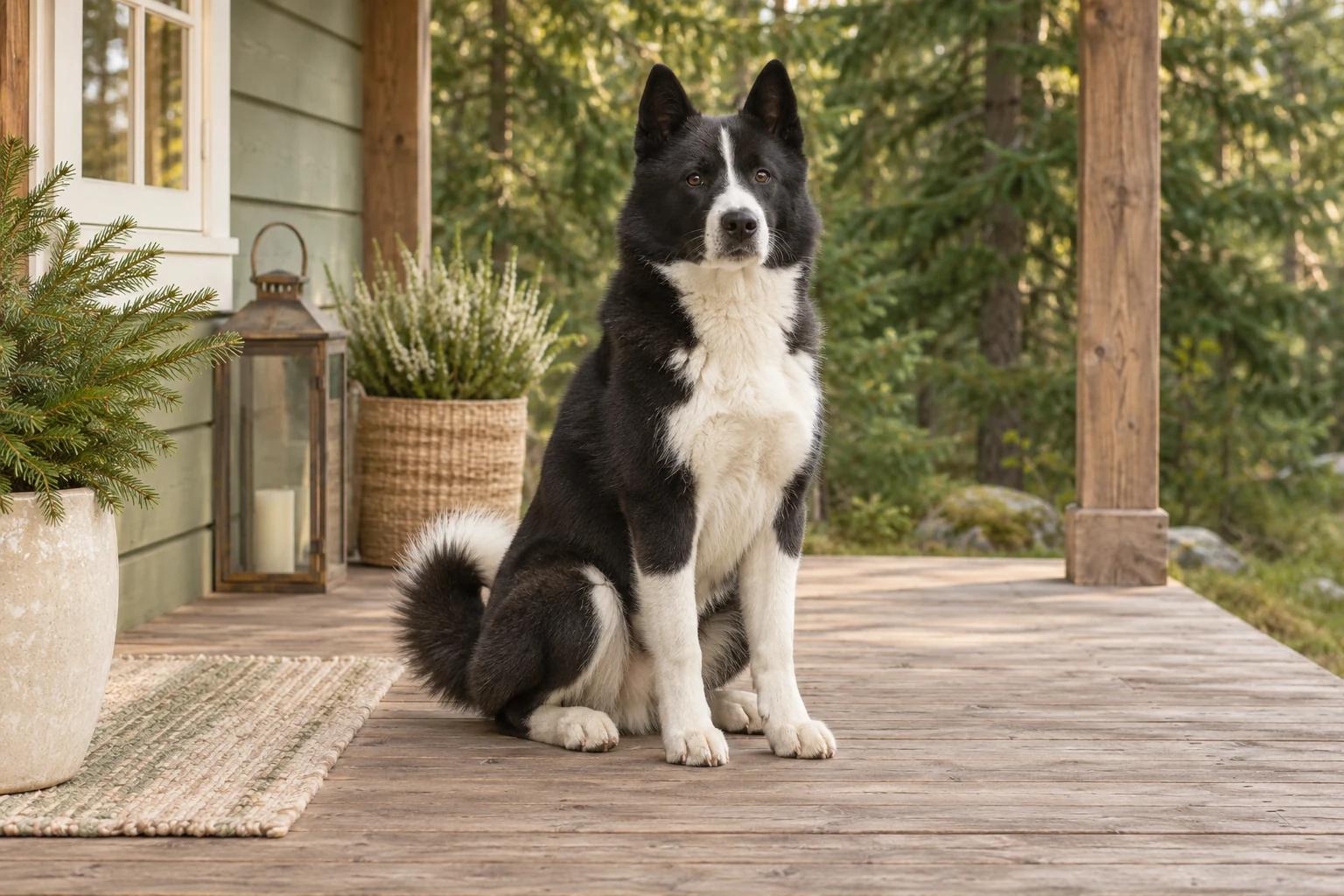
Karelian Bear Dog vs Akita is a comparison in which physical scale should enter the conversation early. Both have upright ears, substantial coats and a confident-looking outline, but the Akita discussed here is the larger American-type Akita, not the separately named Japanese Akitainu. Beyond appearance, the decision depends on handling, household arrangements and what you expect from a companion.
Read the Karelian Bear Dog profile alongside the Akita profile, then picture each dog in the spaces you actually use. A striking silhouette does not tell you whether the dog fits your car, your walking routine or your plans for visitors.
Karelian Bear Dog vs Akita: start with scale
The UKC describes the Karelian as a medium-sized hunting spitz, with a body only slightly longer than tall. Its Akita standard describes a large, heavily boned dog and gives adult heights of 26–28 inches for males and 24–26 inches for females. The Akita is therefore a substantially different physical proposition, even before you compare individual dogs. UKC Karelian Bear Dog standard, UKC Akita standard.
Think of size as a sequence of daily movements. Can the dog turn where you put on its equipment? Can you pass its bed without squeezing around furniture? Is there room to open a car crate while another vehicle is parked nearby? A larger footprint affects these ordinary moments even when the dog is resting.
The smaller of these two breeds is not automatically an easier dog to manage. A Karelian still requires a handler who can organize outings, equipment and introductions. Choosing it merely because an Akita looks too large leaves most of the ownership decision unfinished.
Separate the breed name from the job you want
The Karelian's hunting background and the Akita's imposing appearance can encourage dramatic expectations. Decide instead what you want the dog to do in daily life. Perhaps you want company on familiar trails, participation in training or a companion for a quieter household. Put those ordinary goals into words before contacting a breeder or rescue.
Do not select either dog as a substitute for a security plan. Ask how visitors enter, where the dog waits and how the caregiver handles unexpected arrivals. A controllable household routine is more useful than a description of courage.
For the Karelian's original work, see our separate article on what its traditional hunting role involves. Understanding that background is worthwhile, but it does not establish competence for another task or tell you how an individual behaves at home.
Walking routes reveal practical differences
Try an accompanied walk with each prospective adult dog where its caregiver normally goes. Pay attention to the practical work the person does: choosing a path, changing direction, waiting for space and preparing equipment. Ask them to explain decisions you might not notice.
With an Akita, consider the physical room you need to turn and pass other walkers. A narrow gate or crowded entrance may require more preparation than the open path beyond it. With a Karelian, ask particularly about the dog's response to wildlife and how the caregiver manages routes with animal activity. Neither discussion requires deliberately arranging a difficult encounter.
Your own weekday route is the best planning tool. Walk it at the usual hour without a dog and identify places where you can pause or turn away. If every exit leads straight into a crowded shared corridor, include that fact in conversations with caregivers. Do not describe an ideal countryside routine when your actual mornings happen on a busy pavement.
Akita vs Karelian Bear Dog comparisons often become a contest over which needs more activity. A more useful question is whether you can provide the specific dog's established routine consistently. Ask for a normal week's pattern rather than a single impressive outing.
Other animals and visitors need their own assessment
A household with existing animals should begin with that fact, not add it at the end of the selection process. Give the caregiver the species, number of animals, available rooms and current routines. Ask about the candidate dog's documented experience in comparable circumstances.
Do not accept “socialized” as a complete answer. Find out what happened, where and with whom. Sharing a walk at a distance is different from sharing a living room, and a brief greeting tells you little about feeding or resting in the same home. A qualified professional can help assess and plan introductions where appropriate.
Visitor arrangements deserve equal attention. Who opens the door? Where can the dog be comfortably separated while people arrive? Could a substitute caregiver follow the same arrangement? These questions apply to either breed and help avoid placing all responsibility on a cue that has not been practiced in that situation.
Coat care, travel and backup help
Both standards describe double coats. The Akita's coat stands away from the body, while the Karelian's medium-length coat also has a dense underlayer. Plan for brushing and loose hair rather than expecting a neat outline to mean a hair-free house. UKC Akita standard, UKC Karelian Bear Dog standard.
Ask to see a normal care session. Where does it happen, which tools are used and what does the dog already understand? The relevant comparison is not simply how long the coat looks. It is whether you have the time, space and handling skills for that dog's care.
Before choosing Karelian Bear Dog or Akita, make a backup-care call. Describe the actual breed and size to a potential sitter or boarding provider and ask about their arrangements. Availability should be checked before you need an emergency favor. The larger dog's transport space and equipment may also change which caregiver can help.
Make the choice with evidence, not a winner
The difference between Karelian Bear Dog and Akita is not a simple difficult-versus-easy ranking. The Akita brings a larger body and different space requirements; the Karelian brings its own hunting-dog background and management questions. Your strongest evidence is the individual dog's observed routine and a candid conversation about your home.
Use the breed quiz to sort your priorities, then mark each essential as confirmed, uncertain or incompatible. If an essential remains uncertain, arrange another conversation or visit. You do not need to force a decision merely because both breeds appeal to you visually.
FAQ
Which is larger, an Akita or a Karelian Bear Dog?
The American-type Akita is generally larger. The UKC describes the Akita as large and heavily boned, while it describes the Karelian Bear Dog as medium-sized. Measure an individual dog before choosing travel equipment or allocating space.
Does this comparison include Japanese Akitainu?
This comparison uses the American-type Akita represented by the linked Akita profile and UKC standard. Japanese Akitainu is a separately named breed reference and should not be substituted without checking its own characteristics.
Is the Karelian easier because it is smaller?
Smaller size does not settle ease of ownership. A Karelian still needs a workable walking environment, careful household management and appropriate training. Compare the individual dog's routine with what you can consistently provide.
Sources behind this article
Article source checked: November 15, 2026. Source checked 2026-11-15
Keep reading

Affenpinscher vs Brussels Griffon: Everyday Differences
Read article →