Highlander cat vs American Curl: beyond the ears
Compare Highlander cats and American Curls through current adult weights, physical proportions and distinct accounts of everyday interaction.
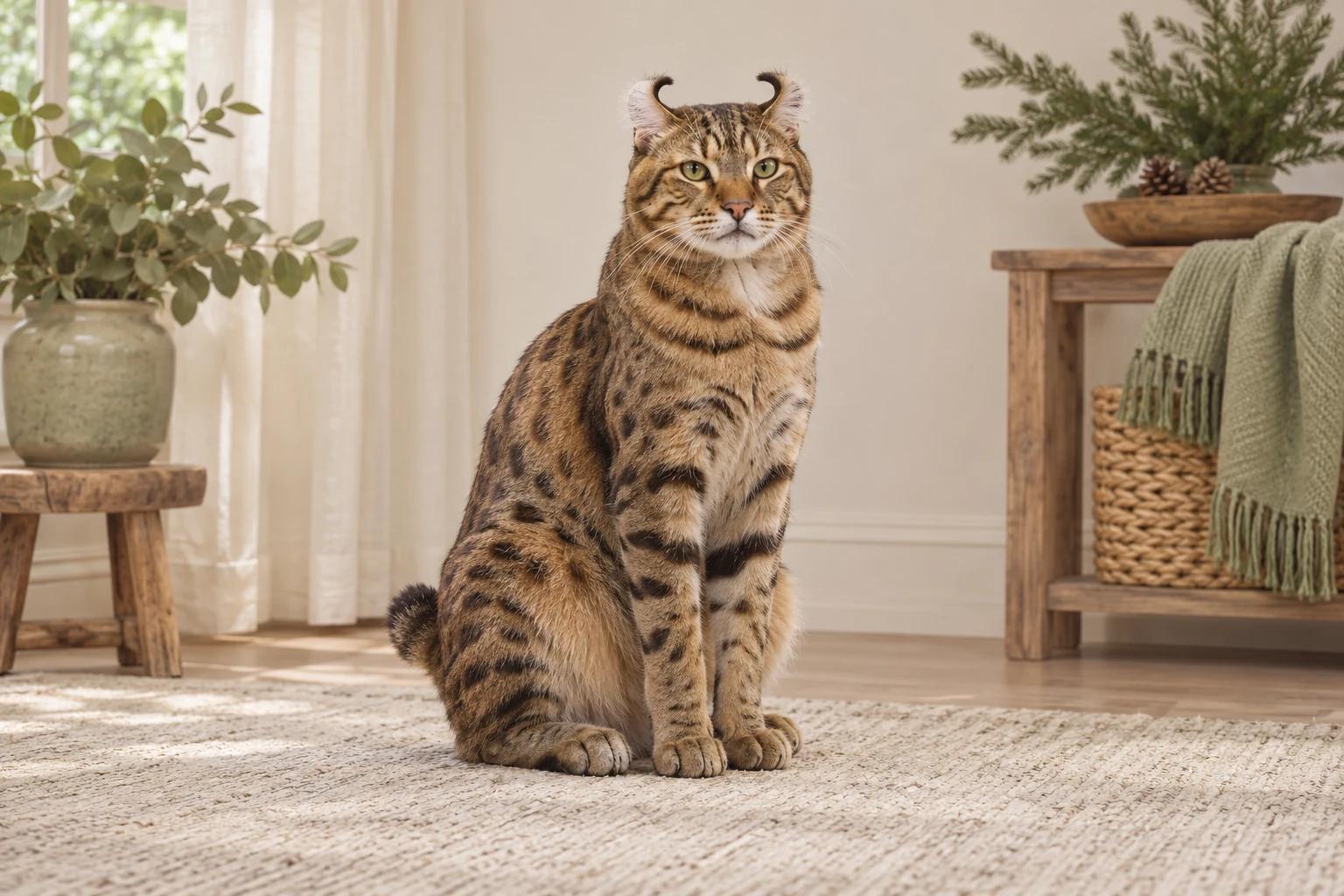
A Highlander cat vs American Curl comparison starts with matching each piece of information to the right breed. The current Highlander profile lists an adult range of 10–20 pounds without a sex breakdown. The American Curl profile lists females at 5–8 pounds and males at 7–10 pounds. Those figures describe different expectations, although the listed ranges meet at ten pounds.
Highlander cat vs American Curl: compare the weight labels fairly
An American Curl vs Highlander cat search can easily produce an oversimplified claim that one is twice the size of the other. That is not what these figures establish. Twenty and ten pounds are upper endpoints, not measured averages. A ten-pound adult appears within both overall ranges. The Highlander's unsexed figure also cannot honestly be divided into female and male subranges without additional evidence.
If you already know the sex of the Curl you are considering, use its corresponding range rather than the combined five-to-ten-pound span. If you are considering an adult of either breed, its actual weight is more useful than assuming it occupies the middle of a published range. These comparisons concern adult weight, not a kitten's current measurements or a deadline for growing into them.
The Highlander's outline is more than an ear curl
TICA's Highlander description and standard describe a substantial, muscular cat with a naturally shortened tail and loose backward curls at the ear tips. The ears remain open and broad at their bases. Its rectangular torso has depth, and the hind legs are longer than the forelegs. Both shorthaired and longhaired forms occur.
The useful difference between Highlander cat and American Curl is therefore a combination of features. Looking at ears alone leaves out the torso, legs and tail. A complete standing view is more informative than treating one shared-looking detail as the whole breed.
The Curl has its own proportions
The CFA American Curl standard describes a moderately muscled, rectangular cat rather than a massive one. Its tail is approximately as long as its body, broad at the base and tapering. That tail is an important part of the Curl's silhouette, not simply an accessory behind the ears.
The head is a modified wedge with smooth transitions. Walnut-shaped eyes and a rounded muzzle complete a different facial arrangement from an ear-only portrait. The backward ear curve is a smooth arc, with rounded, flexible tips. View the head from the front and side to understand how those parts fit together; do not try to reshape the ears by hand.
CFA describes silky, flat-lying coats with minimal undercoat in both lengths. In the longhaired form, a plumed tail changes the visible outline; in the shorthaired form, tail hair is similar in length to body hair. When comparing individual Curls, coat length can therefore alter the appearance of the rear silhouette without changing the underlying tail description. Compare the actual coat form rather than assuming every Curl has the same finish.
Notice how the Curl asks for company
TICA's American Curl account describes quiet cooing, nudging and affectionate head contact as ways the breed may engage with people. It also describes investigating household activities, including unpacking groceries or watching television. This is a portrait of participation, not an instruction to keep touching a cat whenever it comes nearby.
For someone choosing a Highlander cat or American Curl, the useful question is what kind of company the particular Curl seeks. A cat sitting beside the shopping bag is participating differently from one rubbing its head against you. Both can be social moments without being requests to be lifted. Listen as well as look: a soft vocal response may accompany an approach without becoming a long conversation.
TICA also notes a tendency to open doors and cabinets. That gives this description a concrete household implication: check whether an individual Curl has learned a particular handle or cupboard mechanism. A closed door and a securely latched door are not necessarily equivalent. Do not assume that curiosity stops at watching you work.
An adult Curl's daily rhythm matters too
VCA's American Curl profile gives specific examples of attention-seeking: appearing in front of the television and delivering morning greetings through nose contact, head bumps or hair licking. These are breed-account examples, not promises that every Curl follows that schedule.
They suggest a more useful conversation than simply asking whether a cat is affectionate. Does this individual arrive while people watch television? Does it seek contact before the household normally gets up? What does that contact involve? An owner's description of familiar mornings can tell you more than an affectionate label by itself.
VCA also notes that physical maturity can take up to three years. A young adult Curl need not look exactly like an older one, even though neither is a tiny kitten. Keep that developmental description separate from the morning-interaction examples: a cat's age is not evidence that it will copy those behaviors. An adult's established routine is something to learn about directly, rather than infer from its appearance.
Use the cat breed quiz to compare broader household preferences. The Highlander pre-adoption veterinary questions article addresses individual care discussions separately.
Frequently asked questions
Which adult weight ranges belong to these breeds?
Highlanders are listed at 10–20 pounds without sex qualifiers. American Curl females are listed at 5–8 pounds and males at 7–10 pounds.
Does a ten-pound adult weight settle the comparison?
A ten-pound Highlander or American Curl falls within the respective overall profile ranges. Weight alone therefore does not identify which of these two breeds an animal is.
Can the Highlander range be split into male and female figures?
The current Highlander profile supplies an unsexed adult range. The American Curl profile supplies separate female and male figures; those labels should not be transferred to the Highlander.
Sources behind this article
Article source checked: November 16, 2026. Source checked 2026-11-16
Keep reading

Abyssinian vs Somali: Coat, Size and Everyday Company
Read article →