Greyhound Temperament: Quiet Company, Real Questions
Understand Greyhound temperament through greetings, resting, learning, household experience, and practical questions about the individual dog.
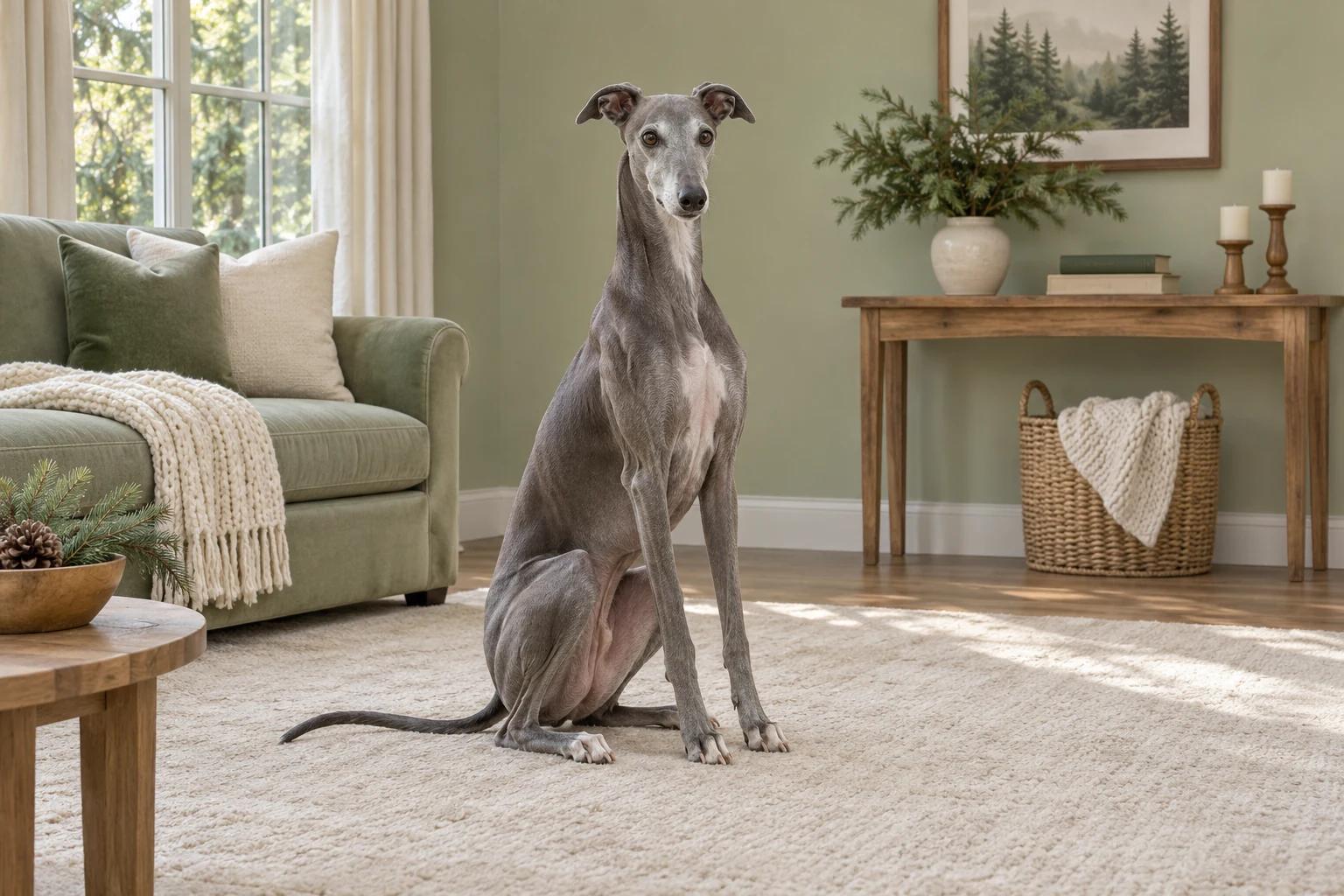
Greyhound temperament cannot be read from a dramatic running photograph or a dog curled on a sofa. Both may show a real moment while leaving out most of the relationship. To understand a Greyhound as a companion, look at how it approaches people, shares space, responds to familiar routines, and manages the environments your household will present.
A useful question is not whether Greyhounds are universally easy. It is whether you enjoy the style of companionship offered by the dog in front of you, and whether you can support the parts of daily life it still needs to learn.
Greyhound temperament beyond the first greeting
The American Kennel Club's introduction describes an independent, gentle companion. The Greyhound Club of America's discussion of showing notes that adult Greyhounds can be reserved rather than demonstrative with unfamiliar people. That context helps explain why an understated meeting should not automatically be interpreted as rejection.
Give the dog room to approach or remain at a comfortable distance. Ask the caregiver what the greeting looks like with someone familiar. If the dog is quiet during your visit, ask whether it is normally relaxed in that setting or whether the situation is unusual.
You are gathering information, not trying to provoke a more expressive performance. A calm conversation beside a dog can be a worthwhile meeting even if there is no exuberant welcome or instant invitation to play.
Greyhound personality and the kind of company you want
Think carefully about what you mean when you say you want an affectionate dog. Do you picture constant contact, a companion resting nearby, or a dog that joins you for activities and then chooses its own space? Being clear about your preference helps you ask better questions.
Watch what happens after an interaction ends. Does the dog settle, invite another activity, or move somewhere else? Ask whether it makes similar choices at home. These observations are more useful than assigning a score for affection.
Prepare a resting area that allows the dog to be near household life without having to participate in every moment. In a narrow room, this may mean moving a chair rather than putting the bed beside the only walking route. Consider where doors open and where bags are dropped when someone comes home.
An individual dog's preferred distance may change as it becomes familiar with the household. Give yourself time to learn that pattern instead of treating the first day's behavior as a final verdict on the relationship.
Separate independence from lack of learning
Independence does not make training pointless. It makes your expectations worth examining. If you imagine a dog constantly asking for the next instruction, discuss that honestly with the caregiver before deciding on a Greyhound.
Choose practical skills with a clear purpose in your home. Moving to a resting place, coming over for lead attachment, and accepting routine handling can be more immediately useful than an elaborate sequence of commands.
Use reward-based instruction and work in settings where the task is understandable. If a lesson is not going well, change one part of it rather than making it longer. A trainer familiar with sighthounds can help you assess motivation and choose a suitable pace without turning the session into a contest.
Keep track of small improvements in real situations. Being able to prepare for an outing with less confusion is meaningful progress. Comparing your dog with a polished demonstration online may tell you little about what your own next step should be.
Greyhound characteristics do not replace a history
Ask about experience, not just temperament adjectives. Has the dog lived in a household like yours? What types of flooring, entrances, traffic, and routines are familiar? What has it actually encountered around other animals?
Do not assume that every Greyhound has raced, or that racing history answers every question about home life. If that background applies, request the information available for that dog. If it does not, avoid building a transition plan around an experience the dog never had.
For any candidate, separate established observations from guesses. A caregiver may know how the dog behaves on a familiar walk but have little information about a busy station. That uncertainty is useful to identify before you make commuting together a central part of your plan.
Ask how support will work after placement. Who should you contact with routine questions? What information should you record if a difficulty appears? A clear support arrangement is more useful than a promise that nothing will go wrong.
Read Greyhound behavior in context
Describe an event plainly before attaching a label. “Remains on the bed while guests arrive” is an observation. It does not by itself establish confidence, indifference, worry, or fatigue. Ask what else was happening and whether the behavior matches the dog's usual pattern.
The same approach helps with outings. A dog that becomes focused on something outside is experiencing a different situation from quiet company in a living room. Do not use pleasant indoor behavior as a guarantee about recall or interactions with other animals. Keep management appropriate to the setting and seek individual guidance.
If you notice a sudden change in participation, tolerance of handling, or usual behavior, consult your veterinarian. A breed description should never be used to explain away possible discomfort. For persistent behavior difficulties, seek a qualified professional who can observe the situation.
Create a first-week plan that leaves room to learn
Start with a small number of predictable routines rather than a crowded social calendar. Identify where the dog will rest, how outings will begin, and who is responsible for each part of care. Keep visitors informed about the plan so the dog does not receive several conflicting invitations at once.
Write down observations that will help you adapt: a preferred resting spot, an easier entrance, a familiar cue, or a situation that needs professional input. The purpose is to notice the individual rather than force every detail into a breed stereotype.
The Greyhound profile connects companionship with wider care needs. For a different perspective on its athletic form, see the Greyhound movement article. The breed quiz can help you compare your expectations before committing to a particular dog.
FAQ
Are Greyhounds aloof?
Some Greyhounds are understated with unfamiliar people, but that does not tell you how they interact with those they know. Ask about the individual dog's ordinary companionship style and give it space during introductions rather than demanding an immediate display of affection.
Can a quiet Greyhound still need training?
A quiet Greyhound still needs to learn your home's practical routines. Teach practical skills with clear, reward-based instruction and appropriate support. A calm appearance and a learned response are different things.
How much can I learn from one meeting?
One meeting with a Greyhound provides a sample of behavior in a particular setting, not a complete personality assessment. Combine it with the caregiver's observations, known history, and discussion of your household. Identify unanswered questions rather than assuming that either an enthusiastic or a reserved greeting predicts everything about life together.
Sources behind this article
Article source checked: November 16, 2026. Source checked 2026-11-16
Keep reading

Airedale Terrier Temperament: What Everyday Life Can Feel Like
Read article →