Great Dane vs Irish Wolfhound: choosing your companion
Compare Great Danes and Irish Wolfhounds through coat care, giant-dog logistics, individual routines and the questions to ask before choosing.
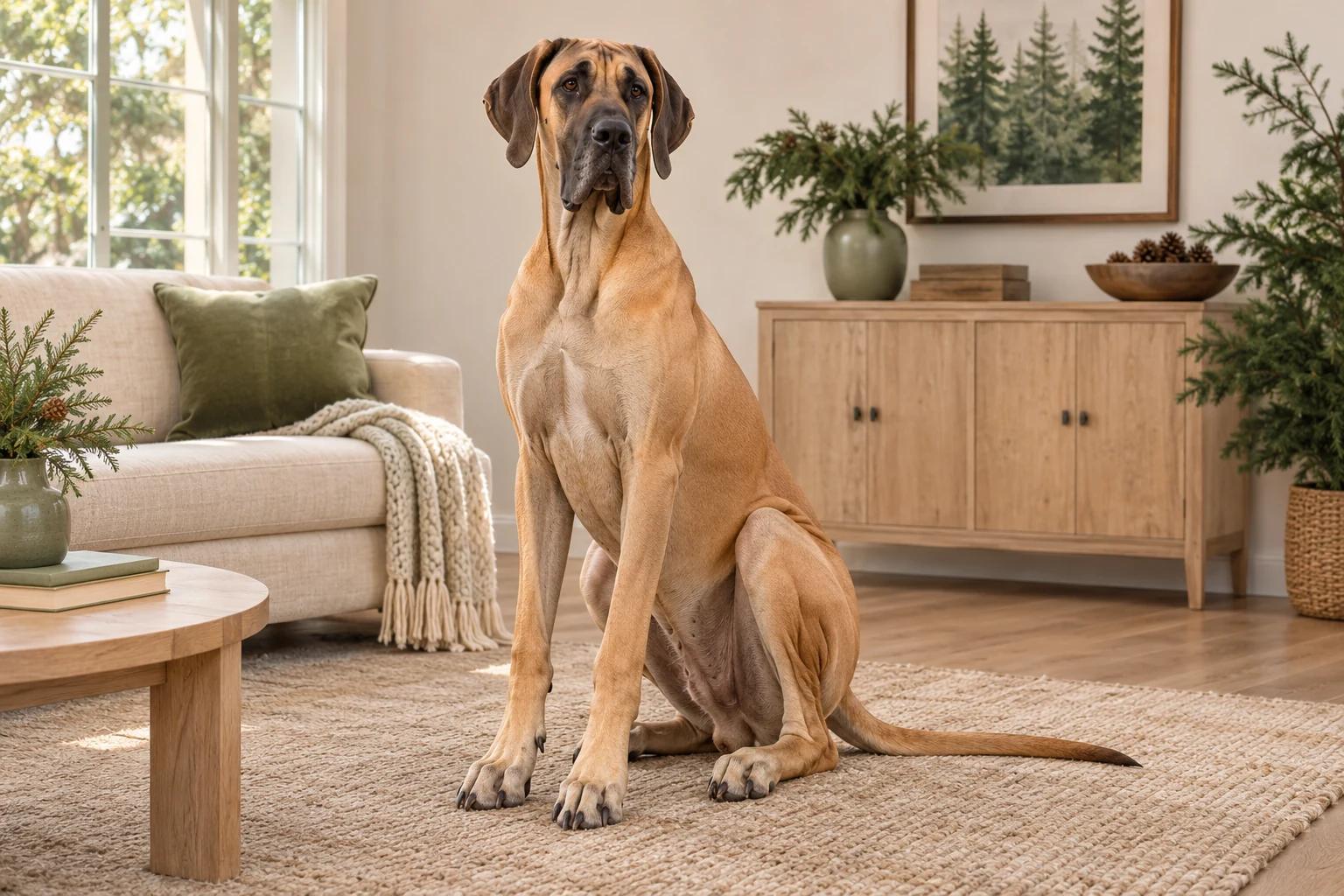
Great Dane vs Irish Wolfhound is a choice between two giant dogs with visibly different coats and outlines, not a contest to find the biggest pet. The Dane's smooth, short coat contrasts with the Wolfhound's rough coat and sighthound form. Beyond that first impression, the most useful comparison is how an individual dog would fit your ordinary routines.
Meet adults where possible and ask each caregiver the same practical questions. That makes your decision less dependent on whichever dog happens to offer the most memorable greeting.
Great Dane vs Irish Wolfhound: start with the real differences
The UKC describes the Great Dane as a very large, short-coated dog with a generally square outline. Its Irish Wolfhound standard describes a rough-coated, Greyhound-like hound. These are meaningful distinctions in appearance, but neither outline tells you exactly how a particular dog will behave at home.
Compare the Great Dane profile with the Irish Wolfhound profile before arranging visits. Write down which questions are still unresolved rather than using a breed label as the answer to everything.
For example, you might prefer a smoother coat but be uncertain about handling a large adolescent. Or you might love the Wolfhound's rough appearance but have little experience maintaining that texture. Those are useful starting points for further research, not reasons to assume one breed is automatically easier.
Do not turn height into a league table
The current My Breed Atlas profiles give these adult references:
| Breed and sex | Shoulder height | Adult weight |
|---|---|---|
| Great Dane male | 30–32 inches | 140–175 pounds |
| Great Dane female | 28–30 inches | 110–140 pounds |
| Irish Wolfhound male | Minimum 32 inches | 120–165 pounds |
| Irish Wolfhound female | Minimum 30 inches | 105–135 pounds |
The Great Dane has higher listed weight endpoints for each sex, but the ranges overlap. The Wolfhound's minimum heights must not be treated as maximums or a closed adult range. Neither set guarantees which of two individual dogs will be taller or heavier.
Height, weight and overall build answer different questions. A taller dog is not necessarily the heavier dog, and a standard's minimum is not a prediction of a typical adult's measurements. Comparing unlike figures can produce a confident-looking but unhelpful ranking.
For practical planning, ask for the measurements of the adults you meet and the equipment they actually use. If you are considering a puppy, ask about its parents and related adults while accepting that its eventual dimensions remain uncertain.
Both options require genuine giant-dog planning. Contact prospective care providers before assuming they can accommodate either one. Ask about the actual service you need, whether that is transport, boarding or help during a workday, rather than requesting a general assurance that large dogs are welcome.
A decision based on fitting just below an equipment limit is fragile when the future adult size is not yet known. Leave room in your research for a different product or arrangement instead of trying to make the breed match a purchase already made.
Coat preference should include the work behind it
The most obvious difference between Great Dane and Irish Wolfhound is often the coat. One has a short smooth surface; the other has a rough texture with conspicuous facial hair. Meet both after an ordinary walk, not only in polished portraits.
Ask each caregiver to show you the tools they use and explain what they do between professional appointments, if any. Find out which tasks are quick, which require practice and which they delegate. Avoid translating short coat into no care, or rough coat into an assumption that the dog must be difficult to maintain.
Both Atlas profiles include shedding in the ownership picture. Think about your tolerance for routine household cleaning separately from your preference for a particular look. The coat you admire in a photograph will also be present beside your desk, in the car and where the dog rests.
If grooming help will be part of your plan, ask a suitable professional about both options before deciding. Your willingness to learn matters more than a generic maintenance label.
Compare the individual's day, not a calmness stereotype
When weighing Irish Wolfhound vs Great Dane, it is tempting to choose whichever is described as calmer. That word can refer to several different things: quiet indoors, relaxed with visitors, slow to react, or content during a particular moment. Ask what the person actually means.
Have each caregiver describe the same sequence: waking, the first outing, time alone, afternoon activity and evening rest. Then ask what changes on a difficult day. A routine with named events is easier to compare with your schedule than a few flattering adjectives.
The Wolfhound's hunting heritage and the Dane's very large companion role give you topics to discuss, not a script for every individual. Ask about distractions outdoors, responses to unfamiliar situations and the skills the dog already knows.
Do not rank these breeds' exercise requirements by a single impression at a visit. Discuss appropriate activity for the specific dog with its caregiver and veterinarian, then decide whether you can provide it consistently.
Training questions that expose practical differences
Ask to see an ordinary skill, such as walking with a caregiver or waiting while equipment is attached. Note the environment and the amount of help provided. A quiet demonstration in a familiar room is useful information, but it is not proof that the skill works in every setting.
Find out which cues the household uses and what happens when the dog is distracted. Ask what training support has helped and which tasks remain unfinished. These questions make room for an honest answer instead of pressuring someone to describe a perfect giant.
For either breed, consider who will handle the dog when you are unavailable. A plan that depends entirely on one person's strength or confidence needs a backup. A reward-based trainer can help you assess everyday handling goals and develop a shared approach.
Our Great Dane home-planning article covers the separate question of physical space and equipment. Do not let a successful room layout substitute for a workable training and care plan.
Great Dane or Irish Wolfhound: make the decision concrete
Write three columns headed preference, evidence and unresolved question. “I prefer the smooth coat” belongs under preference. “I watched this adult settle after an outing” belongs under evidence. “I do not know how it handles time alone” remains an unresolved question until you obtain useful information.
Do this after each visit while the details are fresh. Keep the same questions for both breeds so you are not comparing one person's best story with another person's honest account of a challenge.
Finally, ask whether either option fits your normal life without relying on a series of optimistic assumptions. If both do, individual temperament and circumstances may decide the choice. If neither does, the breed quiz can help you reconsider the qualities you value without forcing a giant-breed decision.
FAQ
Which breed is bigger, the Great Dane or Irish Wolfhound?
The Great Dane's listed adult weights have higher endpoints: males 140–175 pounds and females 110–140, versus Wolfhound males 120–165 and females 105–135. The ranges overlap. Wolfhound minimum heights of 32 inches for males and 30 for females are not upper limits; measure the individual dog rather than assuming a guaranteed height ranking.
Does a Great Dane need less grooming than an Irish Wolfhound?
Their coats need different handling, so compare the actual routines rather than assuming a fixed workload ranking. Ask caregivers or a groomer to demonstrate tools and tasks. A short coat still requires care, and both breeds bring household cleaning considerations.
Can I choose between them mainly on temperament labels?
Labels are only a starting point. Ask about the individual dog's daily routine, outdoor distractions, time alone and training history. Observing ordinary situations gives you more useful evidence than selecting whichever breed description sounds most relaxed.
Sources behind this article
Article source checked: November 15, 2026. Source checked 2026-11-15
Keep reading

Affenpinscher vs Brussels Griffon: Everyday Differences
Read article →