Entlebucher Mountain Dog temperament: life with purpose
Understand Entlebucher Mountain Dog temperament through work, watchfulness, family routines and realistic expectations for an active companion.
Explore the
Entlebucher Mountain Dog
Background, care, and everyday considerations.
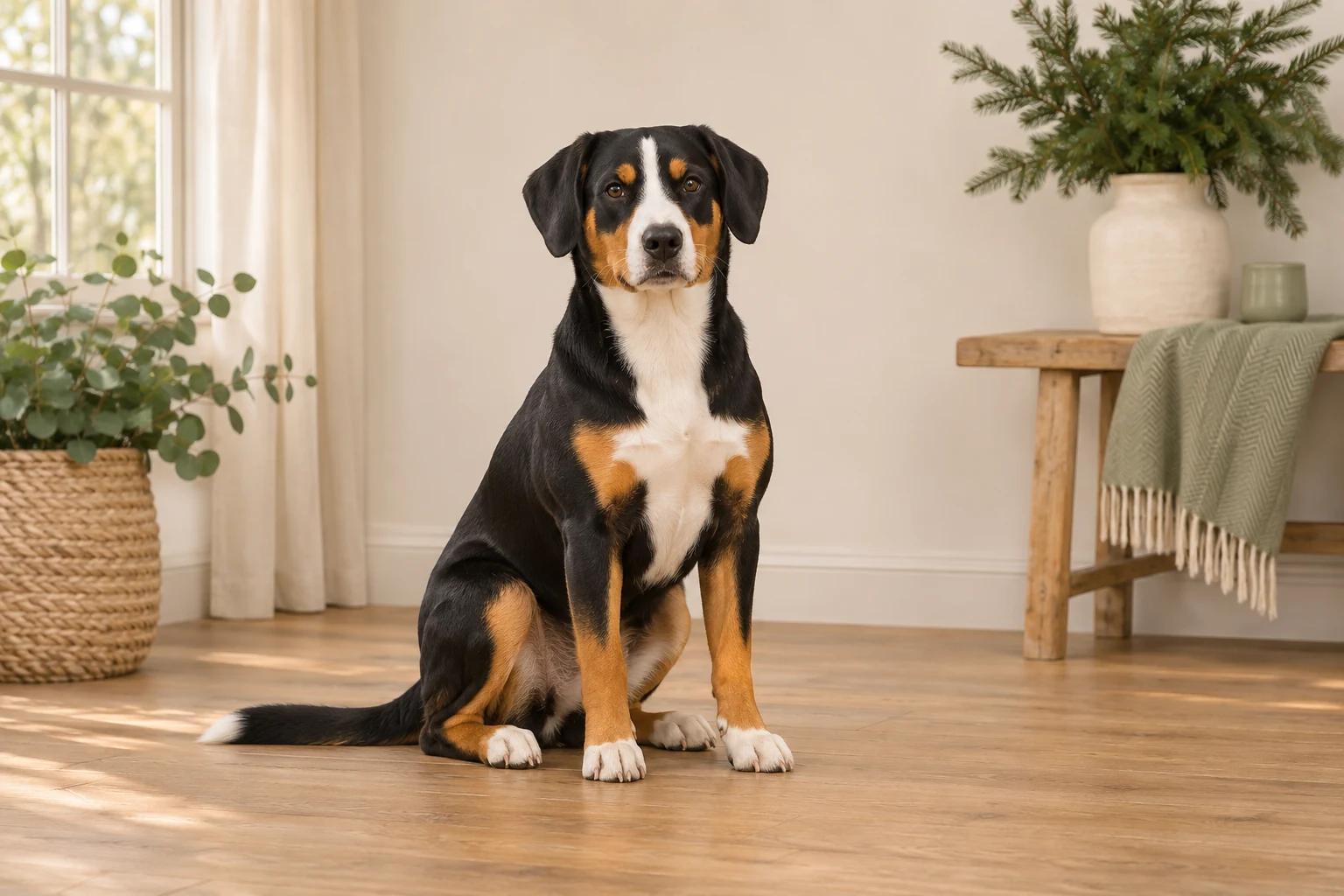
View breed profile →Entlebucher Mountain Dog temperament combines a strong interest in shared activity with a working dog's capacity to make decisions. The appealing tricolor face should not distract from the practical question: do you enjoy teaching, organizing and participating in a dog's day? A home that wants an involved partner is asking a different question from one seeking a mostly self-managing pet.
The AKC describes an energetic cattle-moving dog with independent problem-solving ability. That background is useful context, not an instruction to recreate farm work in your living room. Your job is to give the dog understandable routines and appropriate outlets within the life you actually lead.
Entlebucher Mountain Dog temperament needs a daily role
A role can be modest and repeatable. Your dog might accompany you on a structured outing, search for an appropriate toy or practice moving to a resting spot while you prepare equipment. The important part is that you are involved and the activity has a clear beginning and end.
Do not confuse “needs a job” with “must be busy every waking moment.” If every request for activity starts another exciting game, you have not created a complete daily routine. Put rest and uneventful company into the schedule as deliberately as play.
Think about your preferred interaction style. Do you enjoy noticing small improvements and repeating a lesson in a new setting? Can you remain consistent when the dog offers a different solution from the one you intended? Those questions reveal more about fit than whether you admire intelligent breeds.
Independence changes how you explain the rules
Entlebucher Mountain Dog personality is often described in terms of determination. In practical ownership, avoid converting that word into a contest. If a dog keeps taking the same route to an interesting activity, ask what the arrangement is teaching before assuming they are challenging your authority.
Suppose the dog rushes through the utility room whenever the outdoor lead appears. You can change the setup: store the lead differently, use a barrier and practice a small pause before moving on. The lesson becomes a clear sequence instead of a repeated argument at the doorway.
NEMDA emphasizes consistency in the family's signals and words. Agree on a small vocabulary and what each cue means. If one person says “down” for lying on a mat and another uses it for getting off furniture, the dog receives an unnecessary puzzle. Write the household rules down if that helps everyone follow them.
Watchfulness calls for a visitor plan
The breed standard notes family attachment and possible reserve with strangers. You can respect that without asking the dog to decide who belongs in the house. Prepare visitor management before a crowded occasion makes it urgent.
For example, place a resting area away from the doorway, have a suitable gate ready and tell visitors not to approach the dog immediately. Allow time for observation. The aim is a manageable arrival, not proof that the dog loves every guest on first contact.
An alert response does not need to become a household ritual of repeated barking and shouting. Notice what happens before the noise: approaching footsteps, a window view or the doorbell. A qualified reward-based professional can help you teach an alternative response and adjust the environment if the pattern is difficult to manage.
Do not intentionally provoke suspicion to demonstrate protective ability. Everyday ownership is better served by a dog who has guidance and space than by situations designed to amplify watchfulness.
Assess movement around people and other animals
Entlebucher Mountain Dog characteristics include a working heritage, but a label cannot predict every interaction. Look at the actual dog around ordinary household movement. What happens when someone walks quickly across the room, carries a parcel or opens a gate?
Arrange play in a space where you can stop and reset it without grabbing at an excited dog. If children are present, adults need to supervise and manage access; children should not be responsible for controlling rough or pursuing behavior. A separate quiet space is useful for everyone.
For another resident animal, ask about the prospective dog's previous experiences and plan gradual, managed introductions. Do not turn a generally sociable reputation into permission to place unfamiliar animals together and wait to see what happens.
Give social learning more variety than greetings
A dog can learn about the world without directly interacting with every part of it. Watching people from a comfortable distance, hearing routine household sounds and moving through a quiet new location can all belong in a thoughtful exposure plan.
Ask your veterinarian about suitable outings for a puppy and choose a qualified instructor who can adapt to the dog's responses. More intensity is not automatically more useful. A crowded event may tell you only that the environment was too difficult on that day.
For an adult joining your home, find out which situations are familiar and which are new. Do not assume age equals experience. Begin with manageable versions of the routines you need, then expand as the dog demonstrates comfort and understanding.
Measure a good day by more than tiredness
A useful day includes activity, learning, ordinary company and a chance to settle. Instead of asking only whether the dog is exhausted, ask whether you could move through the day together: leave home, return, accept necessary handling and rest while something else happened.
When Entlebucher Mountain Dog behavior becomes difficult, record the situation rather than assigning a personality label. “Barked when visitors stood up” is more helpful than “dominant.” Note the setting, what happened immediately before and how long recovery took. Seek professional support for distress or unsafe behavior, and consult your veterinarian about sudden changes.
Before committing to the breed, spend time with adults outside a staged introduction. Ask an owner to describe a rainy workday, not only a successful hiking weekend. That is where you will see whether this kind of partnership appeals to you.
Use the Entlebucher Mountain Dog profile for the full care picture. Our natural-tail article addresses a separate appearance question. The breed quiz can help you weigh hands-on involvement against the routine you can sustain.
Sources checked November 15, 2026: AKC breed overview, official standard and NEMDA common questions. Household scenarios are original planning examples.
FAQ
Is an Entlebucher automatically easy to train?
No. Intelligence and working ability do not replace clear teaching. Expect to provide consistent cues, worthwhile rewards and practice in the settings where you need the behavior.
Does an Entlebucher need actual livestock work?
A companion Entlebucher does not need to live on a farm, but needs appropriate outlets and an involved routine. Explore suitable activities with qualified instruction rather than improvising livestock exposure.
Should I encourage protective behavior?
Prioritize calm management and clear guidance rather than provoking watchfulness. Visitor routines, comfortable distance and professional help when needed are more useful for everyday life than testing the dog's response to strangers.
Sources behind this article
- AKC: Entlebucher Mountain Dog ↗
- AKC: Entlebucher Mountain Dog standard ↗
- National Entlebucher Mountain Dog Association: Common Questions ↗
Article source checked: November 15, 2026. Source checked 2026-11-15
Keep reading
Entlebucher Mountain Dog size: height, weight and fit
Read article →