Donskoy vs Peterbald: size, shape and everyday companionship
Compare Donskoy vs Peterbald with current sex-qualified weights, distinct outlines and companionship expectations rather than judging by appearance alone.
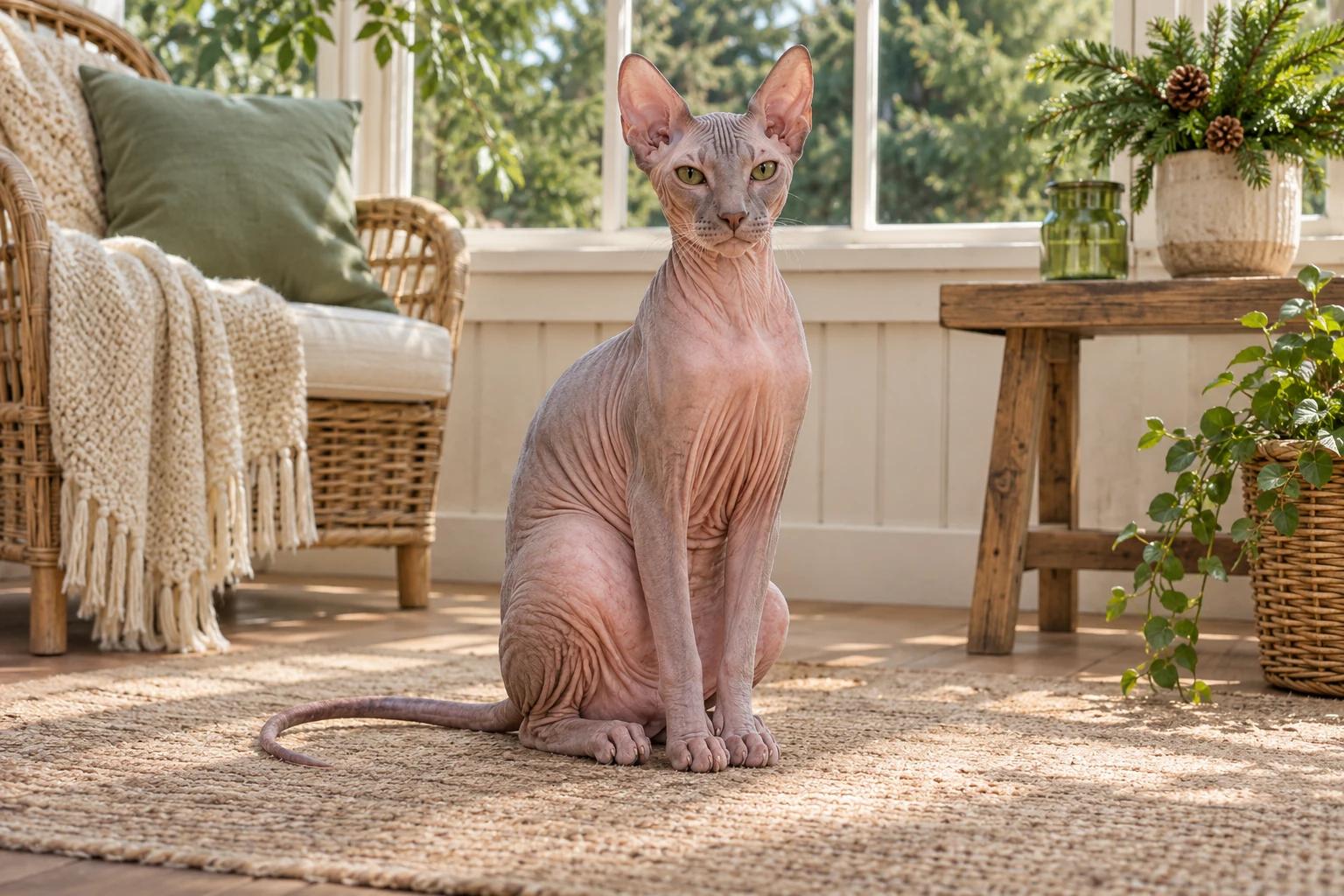
Donskoy vs Peterbald is a comparison worth making beyond a first impression. Two cats can share a similar visual impression without having the same outline or the same place in your household. Start with their adult references, then consider structure and interaction as separate parts of the decision rather than asking one photograph to answer everything.
Donskoy vs Peterbald: read the adult weights by sex
The current Donskoy profile lists 6–12 pounds overall, with females at 6–10 pounds and males at 9–12 pounds. The Peterbald profile lists 5–10 pounds overall, with females at 5–7 pounds and males at 7–10 pounds.
The overall intervals overlap from six to ten pounds. Looking at females, the overlap is six to seven pounds; looking at males, it is nine to ten pounds. Thus, a nine-pound male falls within both male references. Weight alone would not identify which breed you were looking at.
This is also why comparing the largest Donskoy male with the smallest Peterbald female gives a misleading impression of an inevitable breed difference. That comparison combines sex and individual variation with breed. It does not tell you how two same-sex adults will compare.
The upper endpoints are not goals. A Donskoy female does not need to reach ten pounds, and a Peterbald male does not need to match the largest Donskoy reference. Ask your veterinarian to interpret an individual's weight rather than using the interval to decide that it should gain or lose weight.
If you are considering Donskoy or Peterbald kittens, their present measurements are not adult measurements. These references do not provide a formula for multiplying a kitten's current weight into a reliable adult prediction.
The Donskoy: look at the whole outline
LOOF's Donskoy description presents a medium, muscular cat with a solid body, open chest, rounded abdomen and broad rump. The head is wedge-shaped, with prominent cheekbones, almond-shaped eyes and large, high-set ears with rounded ends.
The same account distinguishes bare skin, very short down and a short, curly, harder-textured coat. A Donskoy is therefore not adequately described by assuming every individual has exactly the same coverage. The visible surface is one feature of the animal, not a substitute for its structure.
When comparing individuals, include the torso and head rather than focusing exclusively on a close-up of wrinkles or skin. The relationship between chest, abdomen and hindquarters is part of what the description conveys. A head portrait cannot show all of it.
This is an explanation of the breed's outline, not a method for deciding whether an individual has an appropriate body condition. The rounded abdomen described in a breed account should not become a reason to dismiss a weight question. Appearance and veterinary assessment address different things, even when both concern the same cat.
The Peterbald: length and a different line
TICA's Peterbald account describes a long, tubular body, a long slender neck and legs, small oval feet and a long, whip-like tail. The head forms a triangular wedge, with large ears and a developed chin. These are relationships of shape, not simply a lower number on the scale.
The coat can range from hairless through altered textures to an ordinary coat. TICA also notes that coverage can change over time. A kitten's current appearance should not be treated as a promise of an identical adult surface.
For the difference between Donskoy and Peterbald, this means looking at more than apparent hairlessness. The Peterbald description emphasizes a continuous impression of length through body, neck, legs and tail. That outline is not captured by asking which cat looks “more bald.”
Nor should slender be read as fragile or as an instruction to make the cat lighter. TICA describes a muscular animal. A visual description of proportions is not a home weight-management plan, and the adult weight references remain distinct from the shape vocabulary. Keep them distinct.
Decide whether the Peterbald's company suits you
LOOF's Peterbald account emphasizes demonstrative, vocal, energetic company. Read those qualities as an ownership consideration rather than as a competition in which the most conspicuous cat must be the best choice.
If you enjoy a companion that frequently seeks involvement, that description may be appealing. If your ideal interaction is occasional company while you work undisturbed, it raises a different question. Affection is not measured only by how much activity or conversation a person welcomes into every part of the day.
Consider the kind of involvement you actually enjoy: sharing an activity, answering vocal approaches or being the regular focus of attention. These can be pleasures, but they are still parts of living together. Admiring the appearance does not establish that you want that particular social experience.
LOOF's description is a breed account, not an individual guarantee. It should help you decide what to observe when meeting a Peterbald, not tell you to dismiss a quieter individual or assume every encounter will look the same. The useful choice is a match between the cat's actual behavior and your preferred relationship, rather than the strongest adjective in a profile.
Keep the remaining decision practical
A Peterbald vs Donskoy comparison need not produce a winner in every category. The cat match quiz can help organize your ownership preferences, while the individual cat supplies information that a breed comparison cannot.
Keep procedural care separate from choosing between breeds. The guide to planning a Donskoy's bathing routine with a veterinary team addresses that individual discussion; this comparison does not prescribe washing products or a schedule.
Frequently asked questions
Do the two breeds' male weight references overlap?
Current male Donskoy and Peterbald weight references overlap from nine to ten pounds. Weight alone cannot identify an individual within that overlap.
Are Donskoys always completely bare?
Donskoys are not always bare: some have down or textured coats.
Does a Peterbald kitten's coat always remain unchanged?
Peterbald coat coverage can change during development, according to TICA.
Sources behind this article
Article source checked: November 16, 2026. Source checked 2026-11-16
Keep reading

Abyssinian vs Somali: Coat, Size and Everyday Company
Read article →