Colorpoint Shorthair vs Oriental Shorthair: a practical comparison
Compare Colorpoint Shorthair vs Oriental Shorthair weights, color terminology, breed history and everyday play without assuming identical individuals.
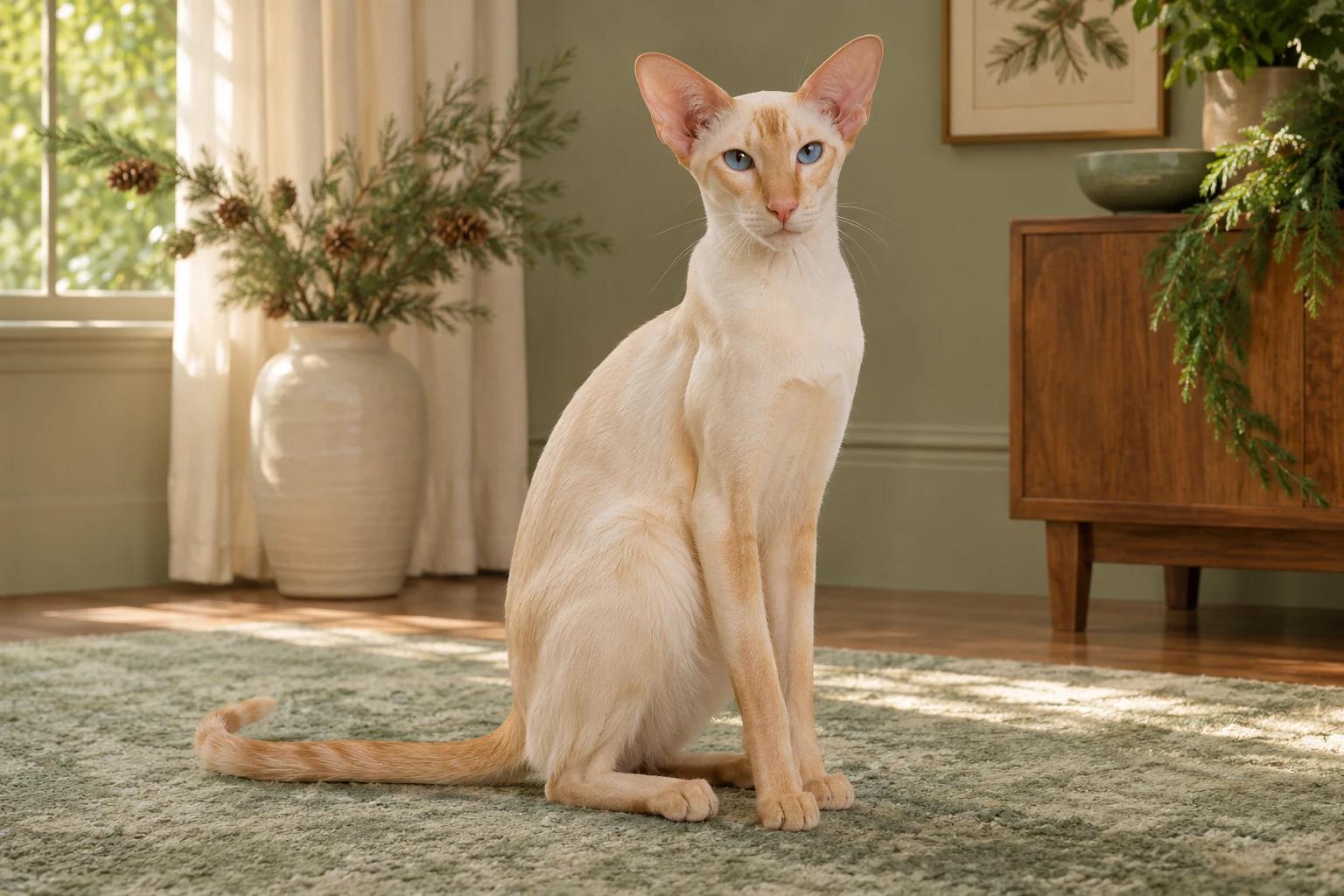
Colorpoint Shorthair vs Oriental Shorthair is not a choice between two interchangeable names. Current adult weight references overlap, but coat terminology and breed histories answer different questions. Start with the cat you are considering rather than assuming that a striking color tells you everything about its eventual size or daily life.
Colorpoint Shorthair vs Oriental Shorthair: compare the current weights
The current Colorpoint Shorthair profile lists an adult reference of 5–9 pounds, without separate male and female intervals. The Oriental Shorthair profile lists 5–12 pounds overall, with females at 5–8 pounds and males at 8–12 pounds.
A seven-pound adult falls inside both overall references and within the Oriental female interval. An eleven-pound adult is inside the Oriental reference but above the displayed Colorpoint interval. These examples explain the numbers; they do not establish a diagnosis or identify a cat's breed from its weight.
The shared lower endpoint also does not mean that the two breeds have the same typical weight. A range gives endpoints, not the number of animals clustered near each one. No average can be calculated from these references alone. Nor should the Oriental male interval be assigned to male Colorpoints simply because both breeds appear in the same comparison.
For an individual adult, use its actual measurement and veterinary advice rather than selecting a target from the largest number on either profile. If you are meeting kittens, their current weights are not adult measurements. The relevant question is what the recorded figure describes, not which advertisement prints the more impressive number.
What the Colorpoint name adds
CFA's Colorpoint Shorthair account describes the expansion beyond the four traditional Siamese point colors. Its current color classes include solid points, lynx points and particolors. Lynx points carry tabby markings; the term does not mean that the cat has a wild lynx ancestor. Red and cream appear in the solid-point class, while tortie combinations belong among the particolors. These are distinctions within a breed's appearance, not separate personality categories.
Oriental describes more than one coat length
CFA's Oriental history explains that the shorthair achieved championship status in 1977, while the longhair was accepted in 1988. The name then became Oriental, with the two coat lengths shown in separate divisions. A page headed simply “Oriental” can therefore discuss both forms; this comparison concerns the shorthair.
That distinction prevents a practical reading error. A reference to a plumed tail or longer silky fur elsewhere in an Oriental description should not automatically be assigned to every Oriental Shorthair. Check which coat-length division the passage is discussing before using it to picture the animal.
CFA also describes the breed's development through European work followed by expansion of the color range in the United States. The broad palette is part of that history, not evidence that every color label denotes a separate breed. When reading an Oriental Shorthair vs Colorpoint Shorthair listing, separate the breed name, coat length and color description. Each adds information, but none replaces the others. A long color name can be precise without being a new breed name.
Points describe pigment distribution
The UC Davis Veterinary Genetics Laboratory explains colorpoint restriction through temperature-sensitive pigment production. Pigment is more restricted in warmer areas and more evident at cooler extremities such as the face, ears, paws and tail. Its explanation distinguishes the Siamese-type pattern from the less restricted Burmese-type pattern, with mink intermediate between them.
This makes “point” more understandable than treating it as another word for any spot or patch. It concerns where pigment is expressed, rather than merely whether a cat has more than one visible color. The laboratory's account also explains that full-colored cats can carry a colorpoint variant without displaying the restricted pattern themselves.
For a prospective owner, this is background for reading a description, not a recommendation to order testing. A pigment result does not measure sociability, adult weight or the quality of an individual companion. Nor does learning the mechanism make a photograph sufficient to reconstruct a pedigree. Use the explanation to understand the terms attached to a cat, while leaving questions about its actual registered identity to the documents and issuing organization.
Think about play, not a quiet-looking portrait
The GCCF Oriental profile describes a continuing interest in play, cupboard investigation and high places. It mentions fetching and cardboard boxes among familiar activities. That offers a more useful picture of an Oriental's day than a still photograph of an elegantly posed animal.
A person choosing this breed should be interested in the activity itself, not just the outline of the cat. Ask what the individual does with its favorite toy: chasing, carrying and returning are distinct actions. A cat that carries something away is not necessarily performing the retrieve you imagined.
The profile also emphasizes conversation and involvement with people. This is not a measured claim that an Oriental will be louder than a Colorpoint, or that either cat will behave identically across homes. It is a reason to consider interaction as part of the choice instead of treating a coat preference as the whole decision. The important fit is between the particular animal's established behavior and the kind of company you want, without turning a breed description into a competitive personality score.
For the separate issue of a loud event at home, read helping a Colorpoint Shorthair through household noise. The cat match quiz can help organize your broader preferences.
Frequently asked questions
Is a Colorpoint Shorthair or Oriental Shorthair always heavier?
Neither a Colorpoint Shorthair nor an Oriental Shorthair is always heavier. Their current overall weight references overlap from five to nine pounds. Upper endpoints cannot predict which of two individual adults will weigh more.
What is the difference between Colorpoint Shorthair and Oriental Shorthair weight information?
The current Colorpoint Shorthair weight reference is unsexed at five to nine pounds. The Oriental Shorthair reference also provides female and male intervals. Do not invent matching sex-specific figures for the Colorpoint.
Can I use the midpoint as a target weight?
A Colorpoint Shorthair or Oriental Shorthair weight-range midpoint is not an individual target. It is arithmetic, not an assessment. Discuss the appropriate weight for your cat with your veterinarian.
Sources behind this article
Article source checked: November 16, 2026. Source checked 2026-11-16
Keep reading

Abyssinian vs Somali: Coat, Size and Everyday Company
Read article →