Chausie cat size: adult weight, outline and measurements
Explore Chausie cat size, the current adult weight reference, body proportions and the differences between weight, height and carrier dimensions.
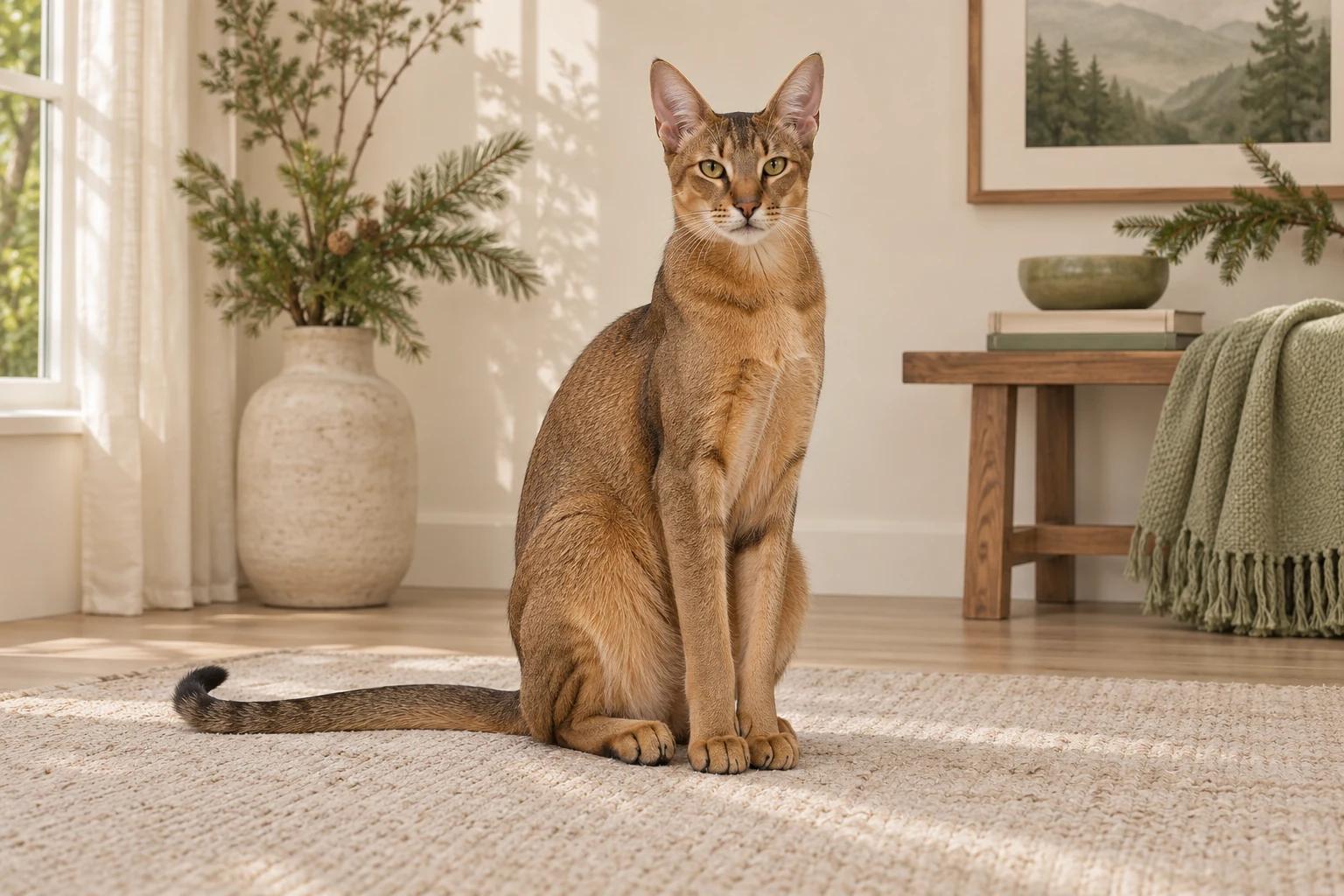
Chausie cat size involves more than a number on a scale. Start with the current adult weight reference, then distinguish the animal's outline from its actual dimensions. Those are related descriptions, but none can substitute automatically for the others.
Chausie cat size: the current adult reference
The current Chausie breed profile gives an adult weight reference of 15–25 pounds, approximately 6.8–11.3 kilograms. It is an unsexed interval, so it should not be split into invented male and female ranges.
A midpoint of twenty pounds is simply the arithmetic center of those endpoints. It is not a measured breed average, a target for every adult or a prediction for a particular kitten. Similarly, the ten-pound distance between endpoints describes the displayed interval, not the amount every cat will gain during growth.
When comparing Chausie cat weight records, check the units first. A figure of nine kilograms is about 19.8 pounds, not nine pounds. Unit conversion can explain an apparent discrepancy without any change in the animal. Keep the date and whether the figure belongs to a kitten or an adult attached to the measurement.
For an individual cat's appropriate weight, ask your veterinarian rather than treating the top of the breed interval as an achievement. The reference helps describe the breed; it does not prescribe how much a particular animal ought to weigh.
The outline has length without a bulky silhouette
TICA's Chausie standard describes a long, rectangular torso, deep chest and flat sides, with long legs and medium boning. The feet are oval and the tail somewhat shorter than the usual feline proportion. These details explain the elongated outline more precisely than “big cat.” They describe proportions, not a numerical shoulder height or a reason to pursue a higher scale reading.
Weight includes more than the frame
A feline body-composition review by Iwazaki and Mori explains why total body weight alone cannot distinguish muscle, fat and other components. Its measurement discussion is useful for interpreting the word “size,” but it is not a Chausie growth chart. The underlying cat data described in the review should not be turned into a new adult breed range.
Two equal scale readings need not describe identical bodies. Conversely, a change in weight does not tell you, by itself, which component changed. That is why a breed's reference interval cannot replace an individual veterinary assessment or establish that a heavier animal has a larger skeletal frame.
The review also discusses the difficulty of consistent physical measurements in cats, including posture. A body that is crouching is not positioned like one standing normally. Avoid treating a casual measurement as a precise clinical result or trying to apply research equations at home. The useful takeaway is narrower: weight, body composition and linear dimensions answer different questions. Keep those questions separate instead of asking one scale reading to resolve all three.
A photograph is not an automatic ruler
Paton and colleagues' camera-measurement study developed a method using camera information, distance and calibration to estimate cat dimensions. It involved feral cats, not a study defining Chausie cat height. The researchers first tested their approach with known silhouettes before applying it to photographed animals.
That background matters when someone offers a dramatic picture as proof of size. The number of pixels occupied by a cat does not supply its physical length unless the geometry is known. An animal closer to the camera can occupy more of the image without being larger than another animal farther away.
Angle matters too. A cat photographed obliquely does not present the same visible length as a clean side view; the paper discusses foreshortening as a source of difficulty. A photograph beside furniture is therefore useful for seeing an animal, but not automatically for deriving an exact measurement. Ask for a real dimension rather than calculating one from a picture whose distances and perspective are unknown. This is a distinction about measurement quality, not a reason to dismiss photographs altogether.
Carrier height and shoulder height are different measurements
The IATA container requirements define several dimensions separately, including nose-to-tail-base length, the widest part of the body and height to the top of the head or ears, whichever is higher. That last measurement is not shoulder height. Labeling both simply “height” can lead to a practical misunderstanding.
The document also distinguishes the animal's dimensions from the internal dimensions needed in a container. Bedding reduces usable space. An outside product measurement therefore cannot be assumed to describe the clear space available to the cat after the container is prepared.
For an owner comparing equipment, establish which measurement the manufacturer gives and which part of the animal it must accommodate. Do not choose solely from a weight label when the actual fit depends on length, width and height. These dimensional distinctions are useful beyond reading a breed description, but this article does not approve a container for a particular journey. Airline acceptance and the complete applicable transport requirements remain separate checks; a correct measurement alone does not settle them.
Read the Chausie weekday care schedule for care arrangements rather than measurements. The cat match quiz considers your preferences alongside the breed profile.
Frequently asked questions
How big do Chausie cats get?
The current adult Chausie weight reference is 15–25 pounds, about 6.8–11.3 kilograms. It is an unsexed breed interval, not a prediction that every kitten will reach its upper endpoint.
Is twenty pounds the average Chausie weight?
Twenty pounds is the mathematical midpoint of the current Chausie weight range, not an established breed average. Establishing an average would require measurements from an appropriate sample of cats.
Does a nine-kilogram Chausie fall within the reference?
A nine-kilogram Chausie weighs approximately 19.8 pounds, within the current 15–25-pound adult reference. That arithmetic does not determine the appropriate weight for an individual animal.
Sources behind this article
- TICA Chausie breed and standard ↗
- Iwazaki and Mori: feline body composition and skeletal muscle ↗
- Paton and colleagues: camera-based measurements of cats ↗
- IATA Live Animals Regulations: container requirement 1 ↗
Article source checked: November 16, 2026. Source checked 2026-11-16
Keep reading
Chausie cat temperament: curiosity, company and interaction
Read article →