Bavarian Mountain Hound vs Hanoverian Hound: practical differences
Compare Bavarian and Hanoverian hounds by size, activity, coat care and handler relationships without treating ancestry as individual ability.
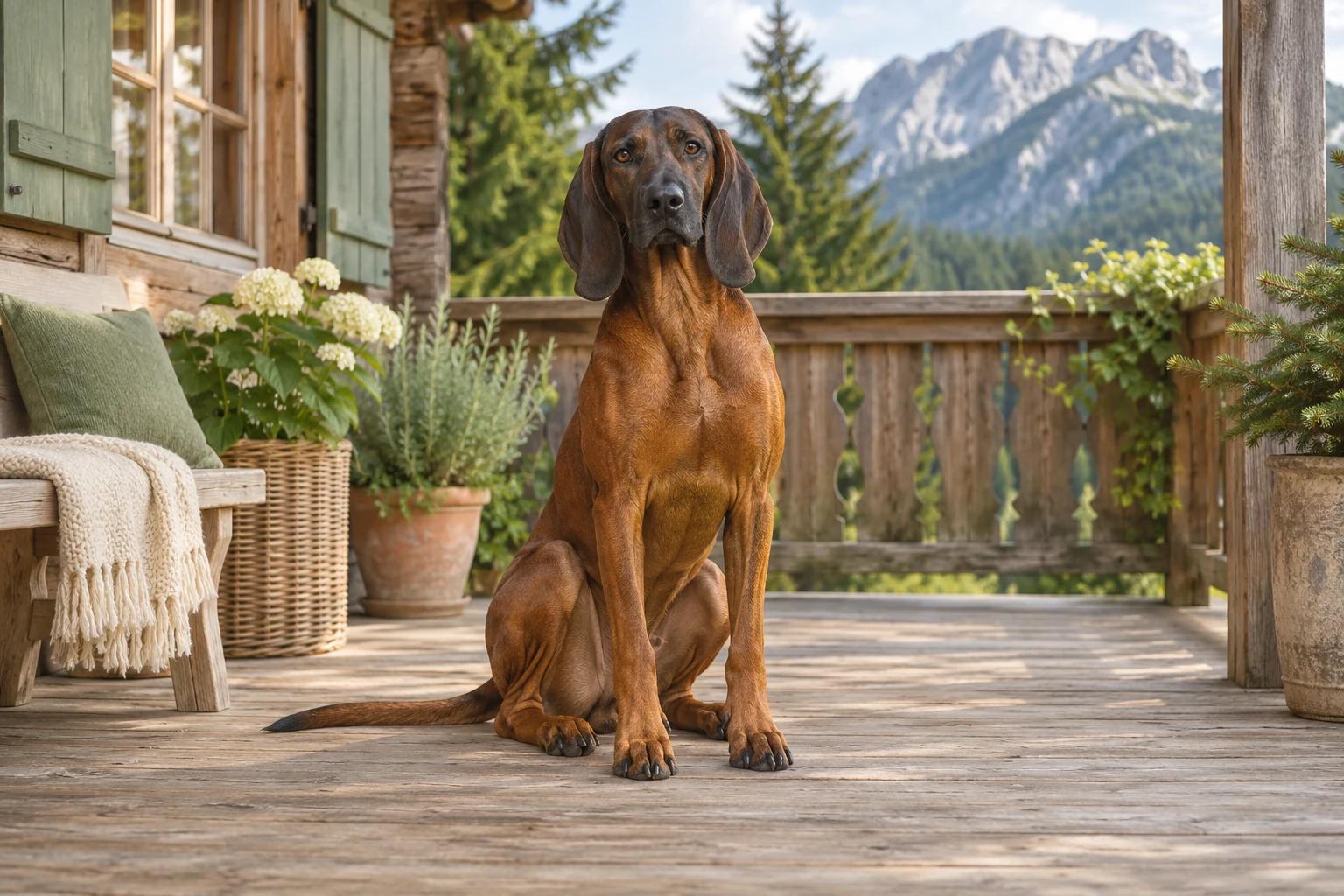
Explore the
Bavarian Mountain Scent Hound
Background, care, and everyday considerations.
View breed profile →Bavarian Mountain Hound vs Hanoverian Hound is a comparison that deserves more than a glance at similar coloring and long ears. The breeds have related working contexts, but the current My Breed Atlas weight ranges overlap, although the Hanoverian range extends higher.
Use the Bavarian Mountain Scent Hound profile and Hanoverian Scenthound profile as your starting references. Then consider the individual dogs and the practical arrangements you would need, rather than choosing entirely from their shared scent-hound identity.
Bavarian Mountain Hound vs Hanoverian Hound: compare size first
The site records these adult reference ranges:
| Detail | Bavarian Mountain Scent Hound | Hanoverian Scenthound |
|---|---|---|
| Height | 17–20.5 inches | 19–21 inches |
| Weight | 37–66 pounds | 55–88 pounds |
| Coat | Short and smooth | Short and smooth |
| Activity tendency | Higher | Higher |
| Learning profile | Relatively responsive | Relatively responsive |
Both height and weight overlap in these reference ranges. Individual measurements therefore matter when planning transport, equipment and the physical arrangements around everyday care. Do not choose a carrier, restraint or resting space from shoulder height alone.
If you are considering an adult, obtain its actual measurements. If you are planning for a puppy, allow for growth without assuming it will land at one precise point in a range. A breed figure is a planning aid, not an individual forecast.
Test the practical arrangement before choosing
Look at your vehicle access, available floor space and any situation where the dog may need assistance. Could your usual caregiver manage the equipment and arrangement too? A plan that depends entirely on one person's physical ability may need a backup.
This is not an argument that the smaller individual is automatically the easier choice. It is a reason to separate size from other commitments so the more compact dog is not mistakenly assumed to need little activity or involvement.
A handler relationship matters for both breeds
The American Kennel Club's Bavarian overview describes an owner-focused dog that can be reserved with strangers. Its Hanoverian overview describes sensitivity with the handler and concentration in tracking.
These descriptions suggest useful questions rather than fixed outcomes. How does this dog communicate with its current caregiver? What does it already know? How does it approach a new person, and what helps the interaction remain comfortable?
Avoid making a comparison visit into a contest to see which dog greets you most quickly. A reserved greeting tells you little by itself about the relationship you might develop. Observe the whole interaction and ask about ordinary behavior over time.
When searching Hanoverian Scenthound vs Bavarian Mountain Hound, keep individual experience in view. A dog accustomed to a particular working or household arrangement may need thoughtful preparation for a different one, regardless of breed.
Activity is a shared commitment, not an identical prescription
Both profiles place activity toward the higher end of the reference scale. That means neither should be selected on the assumption that a calm description translates into an inactive lifestyle.
The detailed activity notes are not identical, however. Do not use the shared rating to assign the same fixed schedule to both dogs. Age, current condition and individual experience also affect what is appropriate.
Think about the opportunities you can provide consistently. Are suitable outings accessible during the week? Do you have time for learning as well as movement? Can you support the practical work around an activity, including travel and waiting?
Talk with your veterinarian about appropriate physical activity for the individual. Breed history can explain context, but it does not establish a personal exercise plan.
Separate your interests from the dog's experience
If you hope to explore a particular activity, discuss that goal with someone who knows the dog and with a suitable instructor. Interest in a breed is not the same as readiness for every task associated with it.
A beginner household may need instruction in handling and organization as much as the dog needs training. Be honest about both sides of the partnership when asking for advice.
Similar coats do not remove routine care
Both site profiles list short, smooth coats and regular shedding. Their everyday notes describe brushing once or twice a week. Those similarities may make coat care less decisive than size or activity, but they do not mean maintenance disappears.
Ask about the actual dog's response to brushing, nail care and handling. Tools and schedules are only part of the routine; cooperation and a comfortable setup matter too.
For either breed, think about how care will be arranged without relying on an improvised lift. The Hanoverian range has a higher upper endpoint, but it does not establish which of two individual dogs will be heavier. Equipment should fit the individual, not a photograph of the breed.
If you notice a change in skin, coat or comfort, talk with your veterinarian rather than assuming it is simply a breed characteristic.
Compare everyday behavior without overstating differences
The live profiles do not justify declaring one breed universally more affectionate, quieter or easier to live with. Ask about the particular dog's communication, resting habits and previous household experience.
For example, a description of sharing a room does not tell you whether a dog is comfortable with long periods alone. A high learning rating does not prove that it understands your household's cues. Treat those as separate questions.
If other animals already live with you, discuss their needs and the candidate dog's history in detail. Shared ancestry or a sociability rating cannot establish compatibility between particular individuals.
The Bavarian breed society's ownership guidance encourages prospective owners to meet the breed and consider the continuing commitment. Apply that practical approach to either choice: learn from people who know the dogs, then compare what you discover with your actual plans.
Which differences should decide your shortlist?
The difference between Bavarian Mountain Hound and Hanoverian Scenthound ownership begins with size, but should not end there. Compare the individual dog's experience, your activity plans, access to instruction and the care arrangements you can maintain.
Our existing article explains why the Bavarian became a mountain specialist. That history is useful background, not proof that a particular puppy has working ability or that one breed is universally preferable.
Use the dog match quiz to organize your priorities. Choosing Bavarian or Hanoverian Hound should be a decision about a real dog and a workable life together, not a verdict based on a name or a dramatic photograph.
FAQ
Is the Hanoverian Hound larger than the Bavarian Mountain Hound?
The site's Hanoverian weight range extends higher, at 55–88 pounds compared with 37–66 pounds for the Bavarian, but the ranges overlap. Their height ranges also overlap. Check individual measurements when planning equipment and transport.
Are both breeds active despite calm temperament descriptions?
Yes. Both My Breed Atlas profiles record higher activity tendencies. Calm does not mean inactive or low involvement. An appropriate routine should reflect the individual dog rather than a fixed workout assigned from the breed name.
Do they have similar grooming needs?
Both profiles list short, smooth coats with regular shedding and a usual brushing plan of once or twice a week. Individual handling and care needs still differ. Ask for a practical demonstration and professional guidance where needed.
Does choosing either breed guarantee tracking ability?
No. Breed background is not proof of an individual's training or competence. A structured working task requires suitable instruction and assessment. Discuss your intended activity before assuming a dog is prepared for it.
Sources behind this article
- American Kennel Club: Bavarian Mountain Scent Hound ↗
- American Kennel Club: Hanoverian Scenthound ↗
- Bavarian Mountain Hound Society of GB: Purchasing a BMH ↗
- FCI standard weights — adult-weight reference ↗
Article source checked: November 14, 2026. Source checked 2026-11-14Article source checked: November 18, 2026. Source checked 2026-11-18
Keep reading

Affenpinscher vs Brussels Griffon: Everyday Differences
Read article →