An American Hairless Terrier can have a coat
Understand the breed's coated counterpart, the recessive SGK3 hairlessness trait and the limits of a coat test, without borrowing genetic assumptions from other hairless breeds.
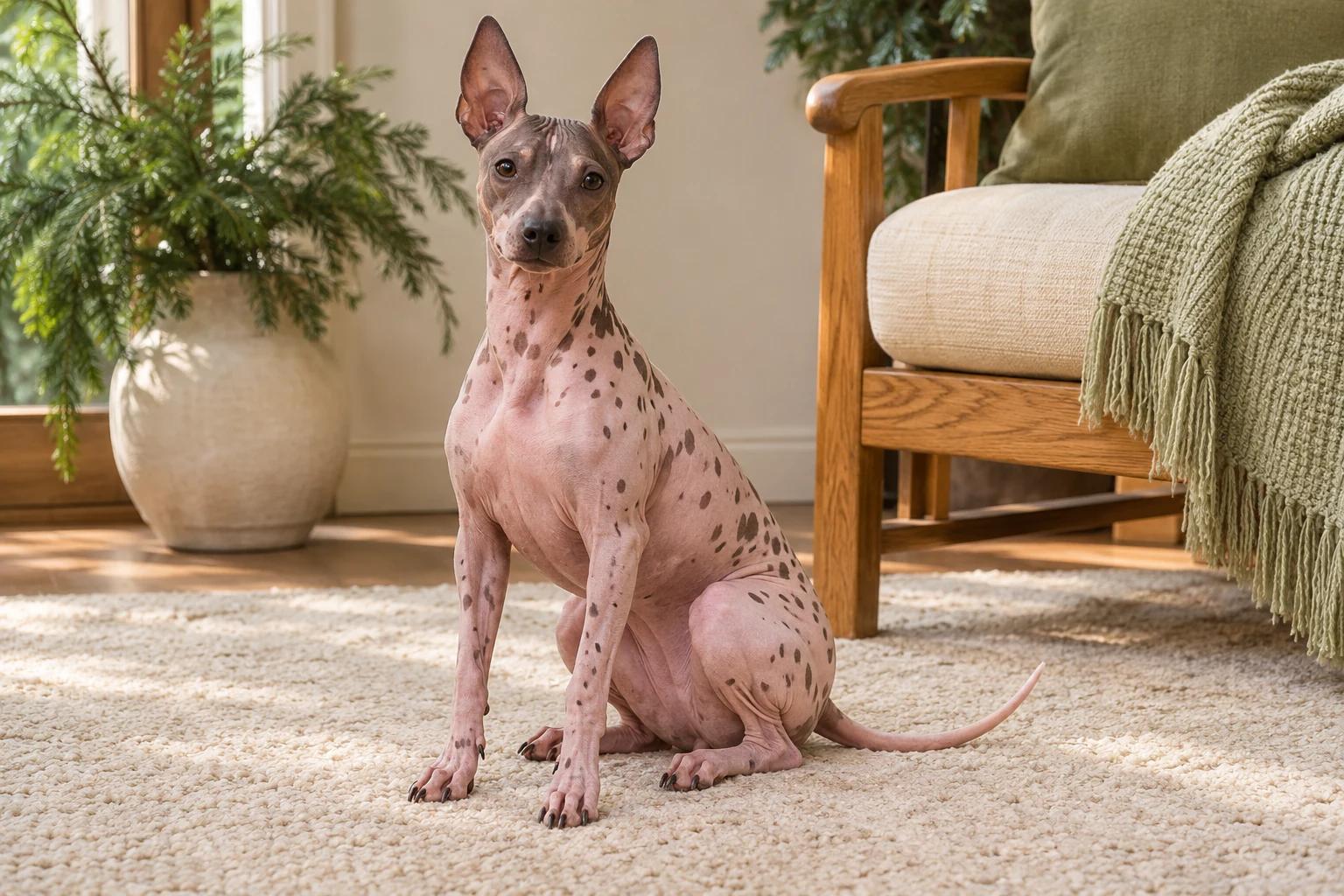
Explore the
American Hairless Terrier
Background, care, and everyday considerations.
View breed profile →The breed name is not a description of every member
The AKC American Hairless Terrier standard includes both hairless and coated dogs. It describes the coated counterpart as having short, smooth, dense hair. Seeing a coat is therefore not, by itself, a contradiction of the breed name or proof that a dog has been identified incorrectly.
The standard also notes that hairless puppies begin with a temporary birth coat. That developmental detail is different from the permanent coated variety. When looking at photographs, age and context matter; the word hairless should not lead a reader to assume that every puppy must look like a mature hairless adult from birth.
This hairlessness has its own genetic explanation
UC Davis's Veterinary Genetics Laboratory identifies a recessive SGK3 variant associated with American Hairless Terrier hairlessness. Its test distinguishes coated dogs without the variant, coated carriers with one copy and hairless dogs with two copies. A coat alone does not distinguish the first two categories.
The laboratory explicitly separates this test from the dominant hairlessness variant found in Chinese Cresteds, Xoloitzcuintles and Peruvian Inca Orchids. A result or inheritance explanation for one form should not be assumed to apply to the other. The shared appearance of reduced hair does not make every hairless breed genetically interchangeable.
Ask which question a report actually answers
For an illustrative example, a description may call a dog a coated carrier without supplying a laboratory report. Ask what evidence supports carrier status and which test was used. Keep the dog's identity and the complete interpretation with the result; do not replace them with a photograph that happens to show a smooth coat.
A hairlessness test addresses that trait, not the dog's entire health, verified pedigree or suitability for a household. It is also not a breeding recommendation. If a report is unclear, ask the laboratory or a veterinary adviser to interpret it. Recognizing both varieties lets an owner appreciate the breed accurately while keeping appearance, genetic status and individual care as separate questions.
Sources behind this article
Article source checked: October 20, 2026. Source checked 2026-10-20
Keep reading
American Hairless Terrier Care: A Practical Daily Plan
Read article →