Yorkipoo vs Morkie
Compare Yorkipoo vs Morkie ancestry, current adult size, coat care and everyday activity without treating cross names as promises about a puppy.
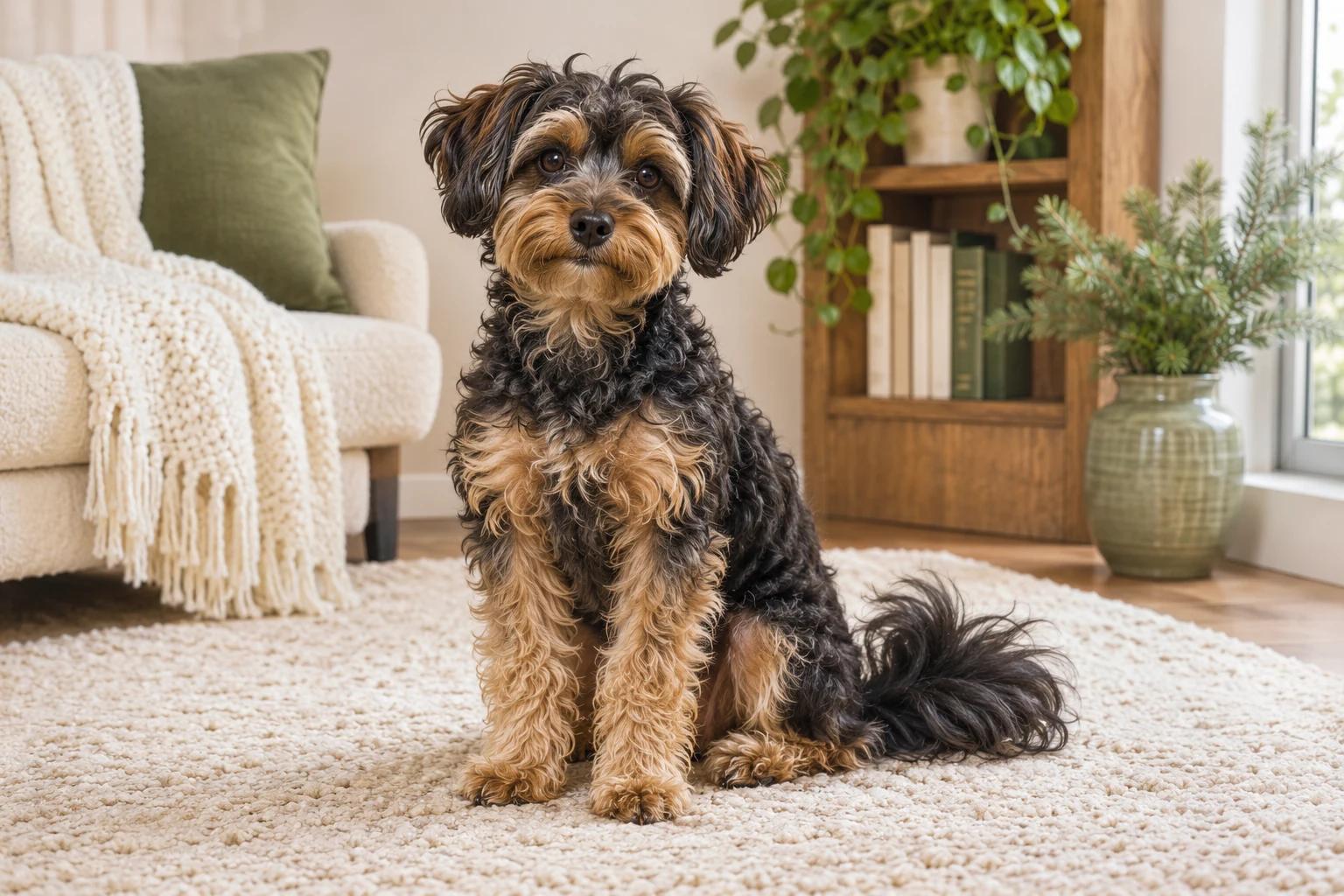
Yorkipoo vs Morkie begins with one shared ancestor and one important difference. The Yorkipoo profile describes Yorkshire Terrier and Poodle ancestry; the Morkie profile describes Maltese and Yorkshire Terrier ancestry. Both are designer crosses. Neither name is a complete specification for adult size, coat texture or personality, and neither tells you the precise ancestry of a particular litter without further information.
Yorkipoo vs Morkie: the shared Yorkshire Terrier background
The AKC Yorkshire Terrier standard describes a compact toy terrier with a short, level back and small upright ears. Its full coat is straight, fine and silky rather than wavy, with a distinctive blue-and-tan adult pattern. Those details explain part of the background shared by both crosses.
They do not turn either cross into a Yorkshire Terrier with a different haircut. A Yorkipoo or Morkie is not judged against the Yorkshire Terrier's show description, and the parent's permitted appearance is not a guarantee that every offspring will reproduce it.
The useful lesson is to distinguish ancestry from identification by photograph. A silky-looking puppy does not prove a particular pedigree, and a different ear carriage does not tell you the exact proportions of its ancestry. Look at the actual parent information rather than reverse-engineering a family tree from a face. The Yorkshire Terrier standard describes the parent breed; it is not a separate standard for either cross.
What the Poodle side contributes to the comparison
VCA's Toy Poodle account describes an affectionate, responsive companion that enjoys learning tricks, retrieving small objects and using games for mental exercise. It recommends reward-based teaching through food, games or praise. This is useful parent-breed context for a Yorkipoo discussion, not a promise that every puppy will have the same interests or learn at the same speed.
The account also describes the Poodle's curly, dense coat and the need for regular brushing, combing and clipping. A decorative appearance does not imply that care happens automatically. For a Yorkipoo with a curlier covering, the practical question is how that individual coat is maintained, not whether the word Poodle appears in its ancestry.
Keep the distinction between the two subjects clear. An enjoyable trick lesson tells you about an activity the dog likes; it does not tell you how much coat maintenance you can omit. Likewise, a short haircut changes presentation, not the need to understand and meet the dog's learning and companionship needs.
What the Maltese side adds
VCA's Maltese account describes both affectionate lap companionship and exuberant play. It also notes curiosity, quick learning and the value of food or games in reward-based teaching. That is a useful corrective to the idea that Maltese ancestry means a permanently still ornament.
The Maltese's long, flat, silky coat requires regular combing. Some owners choose a shorter professional style for easier maintenance. Again, that describes a parent breed rather than specifying the exact covering of every Morkie.
When thinking about this side of the comparison, separate quiet contact from the rest of the day. A dog can enjoy sitting with someone and also enjoy a game or an outing. Calling it a lap companion does not answer every question about its interests. The parent account gives you possibilities to investigate in the actual dog, not a reason to assume that a Morkie will always be calmer than a Yorkipoo or that either cross can be understood from a single personality label.
Adult size ranges overlap rather than forming a simple ranking
The current Yorkipoo profile lists 4–15 pounds for both females and males, with a height reference of 7–15 inches. The current Morkie profile lists 6–10 pounds for both females and males, with about 9 inches as a reported typical height. The word “about” matters: it is not a precise height promised for every adult.
Those figures make the Morkie vs Yorkipoo size question more interesting than “Which is bigger?” The Yorkipoo reference is broader and includes weights both below and above the Morkie range. An individual Yorkipoo therefore need not be larger than an individual Morkie. Compare the actual dogs, and for a puppy ask about the adults behind that litter.
The parent variety also matters to the conversation: the existing Yorkipoo article identifies Toy or Miniature Poodle ancestry. Do not assume that every advertisement uses the same Poodle variety. First crosses, backcrosses and later generations can differ in ancestry proportions. The cross name alone does not answer those questions.
Compare coats and ordinary activity, not imagined perfection
The current Yorkipoo profile describes wavy or curly hair, daily brushing and professional grooming as part of the care plan. The current Morkie profile describes silky hair with daily brushing or combing; a shorter haircut can make maintenance easier. Both choices involve active coat care. Neither is an option for someone hoping that small size removes the grooming commitment.
The Yorkipoo profile also combines daily exercise with mental games. The Morkie profile describes short walks and games as part of moderate activity. These descriptions give you useful activities to discuss without turning editorial ratings into a precise ranking of two individual dogs.
If you are choosing a Yorkipoo or Morkie, consider which real adult or litter you are evaluating. Is the coat currently wavy, curly or silky? What is its present care routine? Which games does the dog actually enjoy? These questions connect the cross descriptions to observable features rather than requiring a puppy to match an imagined blend of its parents.
The difference between Yorkipoo and Morkie ownership is therefore partly ancestry and partly the particular dog. The dog quiz can help you consider the broader commitment. For a separate puppy-development topic, read our Yorkipoo baby-teeth article.
FAQ
Which parent breed do Yorkipoos and Morkies share?
Both have Yorkshire Terrier ancestry. The Yorkipoo combines that background with Poodle ancestry, while the Morkie combines it with Maltese ancestry. Ask about the actual parents and generation rather than assuming every cross has identical proportions.
Is a Yorkipoo always larger than a Morkie?
No. The current adult references overlap: Yorkipoos are listed at 4–15 pounds and Morkies at 6–10 pounds, with the same weight range shown for each sex within each cross.
Does either cross remove the need for regular grooming?
No. Both current profiles describe frequent coat care. The Yorkipoo reference includes wavy or curly hair, while the Morkie reference describes a silky coat. The individual's texture and chosen length determine the practical routine.
Sources behind this article
- AKC Yorkshire Terrier standard ↗
- VCA Toy Poodle ↗
- VCA Maltese ↗
- Dogzone adult reference excluding tiny specimens — adult-weight reference ↗
- PetMD approximate full-grown reference — adult-weight reference ↗
Article source checked: November 16, 2026. Source checked 2026-11-16Article source checked: November 18, 2026. Source checked 2026-11-18
Keep reading

Affenpinscher vs Brussels Griffon: Everyday Differences
Read article →