Whoodle vs Schnoodle
Compare Whoodle vs Schnoodle ancestry, adult size, coat structure and practical care without treating a cross name as a puppy prediction.
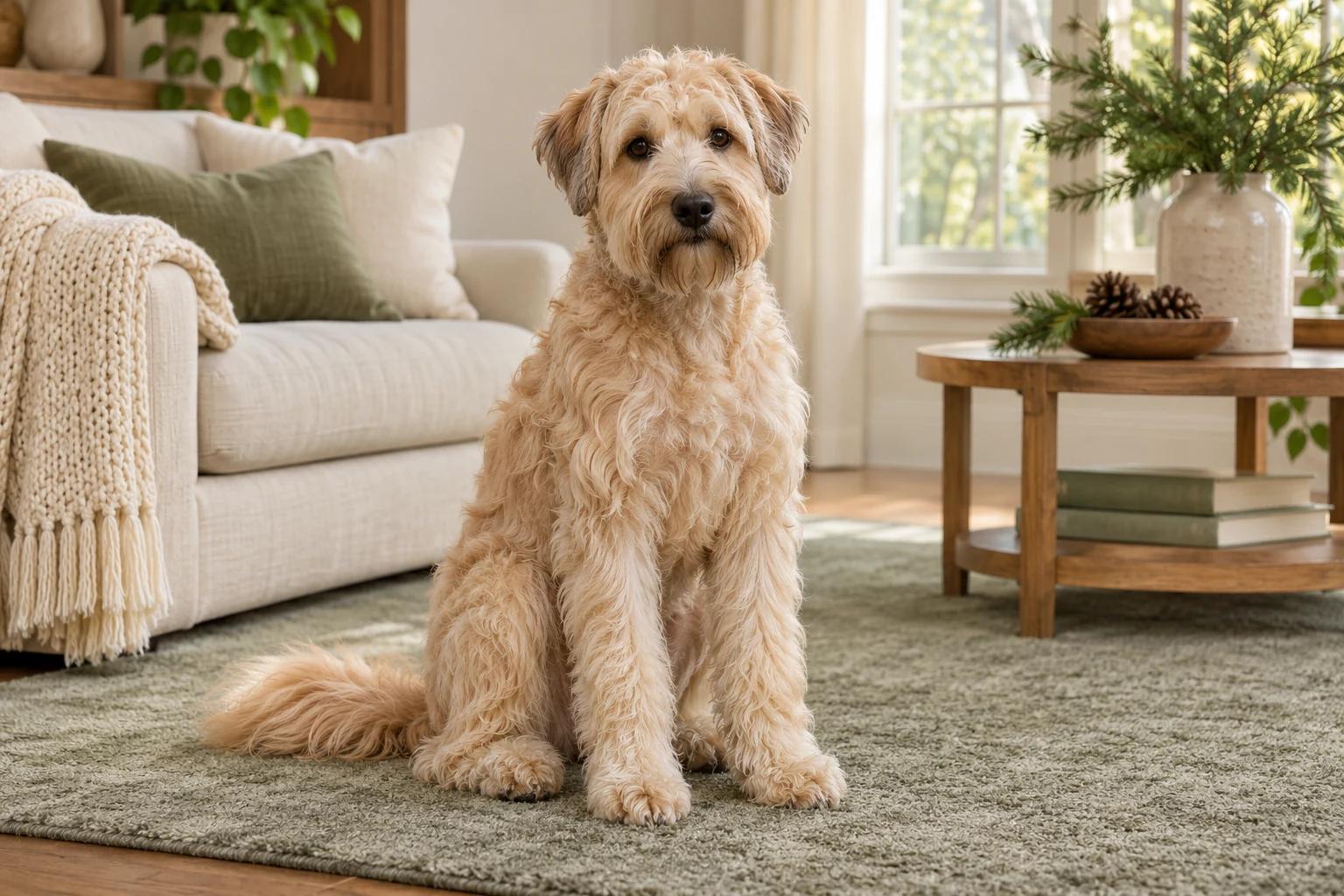
A useful Whoodle vs Schnoodle comparison starts with the actual crosses: Soft Coated Wheaten Terrier and Poodle for the Whoodle, Schnauzer and Poodle for the Schnoodle. The shared Poodle ancestry does not make the names interchangeable. Their current reference ranges also cover different territory: the Whoodle profile lists 20–45 pounds, while the Schnoodle profile lists 10–80 pounds across varieties. Neither range is a male–female division or a promise about an individual puppy.
Whoodle vs Schnoodle: the Wheaten contribution
The AKC Wheaten standard describes a square, compact dog with a deep chest, a strong level back and substantial bone. Its rectangular-looking head has a strong muzzle; the ears fold forward. These features explain why a soft outline can conceal a sturdy terrier, but they describe the purebred parent, not a required Whoodle shape.
The coat distinction is particularly useful. A Wheaten's adult coat is single, soft and silky, with a gentle wave. Puppies and adolescents may not yet show that mature texture. A fluffy young Whoodle therefore cannot be assessed simply by comparing its photograph with an adult Wheaten in full coat.
For an owner considering a Wheaten cross, appearance has several separate parts: the underlying body, the hair's texture and the way it has been trimmed. A rounded haircut can soften the visible outline without changing the dog's build. Discuss the actual dog's coat with its groomer rather than treating resemblance to a purebred show photograph as an instruction for care.
Understand the shared Poodle structure
The AKC Poodle standard describes a square outline, with body length approximately matching shoulder height. It also specifies a long, fine muzzle, ears hanging close to the head and a deep, moderately wide chest. These are useful anatomical reference points for either cross, rather than a checklist that every puppy must reproduce.
The Poodle's curly coat is described as dense and naturally harsh in texture. That differs from the Wheaten's soft wave: the word “curly” does not by itself tell you how a mixed coat feels or how easily a comb passes through it. Two dogs can have similarly rounded silhouettes after grooming but very different hair beneath your hand.
The standard also separates Toy, Miniature and Standard Poodles by shoulder height. Those parent varieties matter when describing a pairing; “Poodle cross” alone leaves out important information. However, a parent's height category does not create an official height category for either Whoodles or Schnoodles. Describe the parents accurately and assess the resulting dog as an individual.
The Miniature Schnauzer has a different coat foundation
The AKC Miniature Schnauzer standard describes a double coat with a wiry outer layer and close undercoat. Its facial and leg furnishings are substantial without being silky. That gives a miniature Schnoodle a different parental coat background from the Wheaten cross, even though both names also include Poodle ancestry.
The parent breed is sturdy and nearly square, with a short, deep body and a strong rectangular head. Thick whiskers emphasize that head shape. Natural ears are small, V-shaped and folded close to the skull. These are reference features of the purebred Miniature Schnauzer, not a compulsory appearance for its offspring.
Keep the distinction between coat inheritance and styling clear. A beard-shaped trim can suggest Schnauzer ancestry without proving it, and a rounded face can hide the same visual association. Equally, a Schnoodle is not automatically a wire-coated dog that should receive a purebred show-coat routine. Ask a professional groomer to assess the actual texture and density rather than selecting tools from the cross name alone.
A cross is not a menu of guaranteed traits
VCA's explanation of designer dogs distinguishes intentional crosses with identifiable parentage from mixed ancestry that is undocumented. It also explains that combining breeds does not reliably combine only the qualities an owner wants. The inherited combination can differ between offspring.
Applied to this choice, “Whoodle or Schnoodle” should not mean selecting Wheaten affection, Poodle cooperation or Schnauzer appearance as though each were an optional feature. A puppy's ancestry supplies background, not a completed specification. Knowing the parents is useful without making their offspring identical copies of either one.
The same distinction matters when a seller describes a dog as a hybrid. These are crosses within the domestic dog species, not crosses between separate species. The difference between Whoodle and Schnoodle needs that distinction, rather than a more impressive label.
Compare size without inventing a winner
The current Schnoodle reference includes a 10–12-inch height specifically for a common Miniature Schnauzer and Toy or Miniature Poodle combination. It is not the height of every dog in the much broader 10–80-pound weight span. Placing that miniature height beside the entire Whoodle category would create a misleading comparison.
For someone searching Schnoodle vs Whoodle, the overlap in adult weights matters more than a blanket claim that one is larger. A particular Schnoodle can fall below, within or above the Whoodle reference range. An adult dog's actual measurements answer the practical question more directly than a cross label does.
Use the dog quiz to compare your preferences, then return to the individual dog's needs. The separate article on recurring illness in a Whoodle covers a veterinary topic, not a reason to rank one cross as the healthier purchase.
Frequently asked questions
Which cross has the wider reference weight range?
The current Schnoodle profile spans 10–80 pounds across varieties; the Whoodle reference spans 20–45 pounds. Both are population descriptions rather than guaranteed puppy outcomes. Neither figure set is divided by sex.
Can I use the Schnoodle height for every size of Schnoodle?
No. The listed 10–12 inches is qualified for a common miniature pairing. Applying it to a Giant Schnauzer cross would remove the qualification that makes the figure meaningful.
Does the Whoodle profile promise compatibility with another pet?
No. A general description of household affection does not establish compatibility between particular animals. Discuss the individual dog's experience and arrange appropriately supervised introductions rather than choosing a companion solely from either cross name.
Sources behind this article
- AKC Soft Coated Wheaten Terrier standard ↗
- AKC Poodle standard ↗
- AKC Miniature Schnauzer standard ↗
- VCA Designer Dogs ↗
Article source checked: November 16, 2026. Source checked 2026-11-16
Keep reading

Affenpinscher vs Brussels Griffon: Everyday Differences
Read article →