Whoodle temperament
Explore Whoodle temperament through Wheaten and Poodle background, companionship, outdoor interests and the limits of breed predictions.
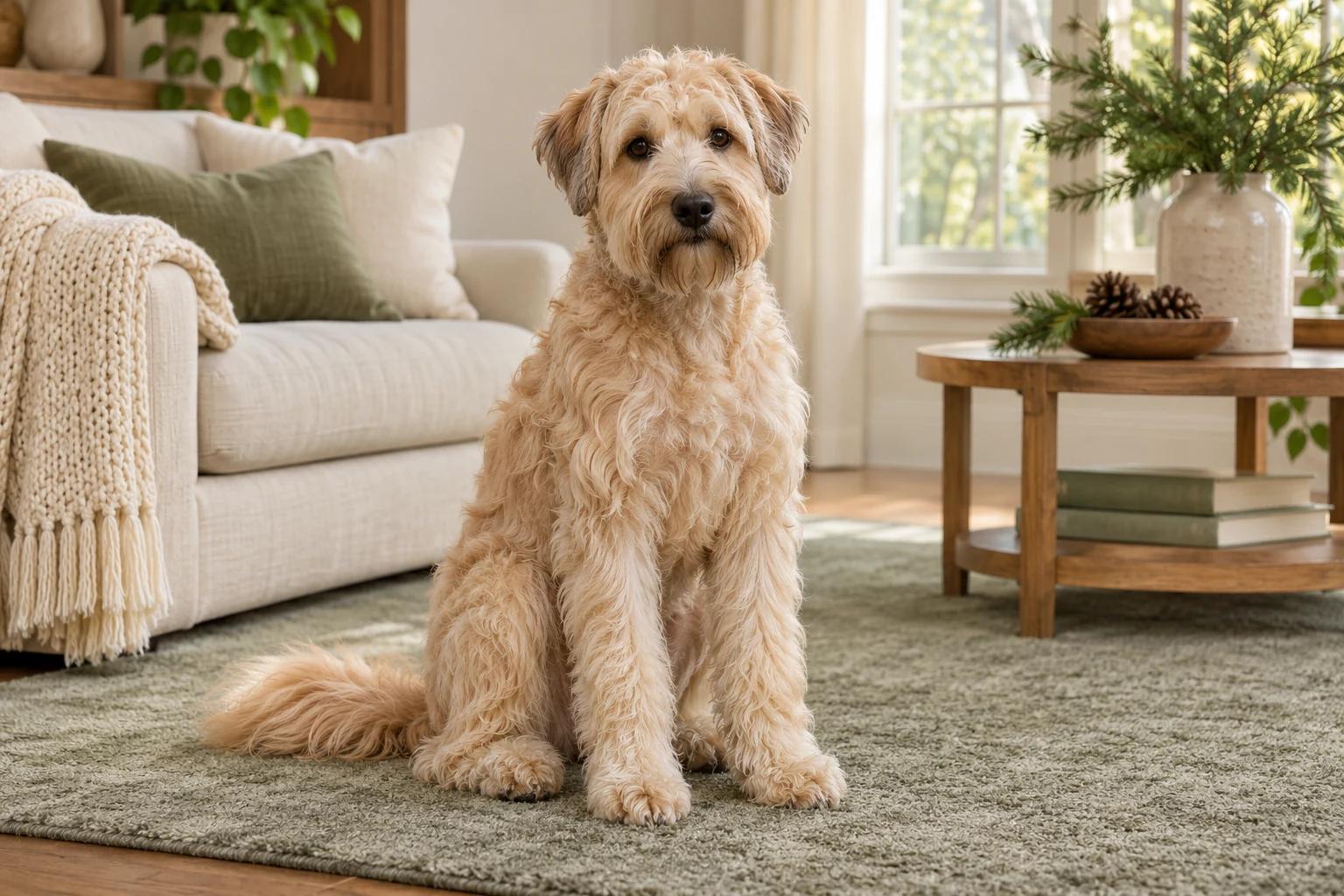
Whoodle temperament is often introduced with three appealing words: affectionate, active and enthusiastic. The current Whoodle profile uses that description, but daily life includes more than an enthusiastic welcome. This is a Soft Coated Wheaten Terrier–Poodle cross, with individual needs that deserve attention beyond its soft-looking face. Think about companionship, outdoor interests and learning as separate parts of the relationship rather than assuming that one pleasant trait answers every ownership question.
Whoodle temperament: make room for different interests
Dogs Trust's enrichment guidance distinguishes scent exploration, toy games and other opportunities to use natural behavior. It recommends choosing activities around the individual dog's preferences rather than assuming that every dog enjoys the same challenge.
For an active Whoodle, this offers alternatives to making every shared activity a faster or longer walk. Hide a favorite toy for a simple search, or allow time to investigate smells during an outing. A game involving the nose asks something different from a game involving pursuit of a moving toy. Neither needs to be treated as an intelligence test.
Choose safe, appropriately sized toys and supervise play, particularly with items that can be pulled apart. Make an unfamiliar puzzle easier if the dog cannot work out what to do. The aim is engagement, not watching the dog struggle with an impressive-looking object. Include rest as well as opportunities to explore. An activity is useful because it suits this dog, not because it looks elaborate or keeps the household busy preparing it.
The Wheaten background: liveliness and pursuit
The Soft Coated Wheaten Terrier Club of America's temperament account describes lively affection and puppy-like enthusiasm continuing into adulthood. It also highlights pursuit of moving animals and objects, and the importance of a fenced area for free running. These are tendencies in the parent breed, not proof that every Whoodle will respond identically.
The distinction between attachment and outdoor attention matters. A dog can enjoy human company while finding a squirrel across the path intensely interesting. The desire to investigate movement is not a measurement of how much the dog likes its owner. Nor does being familiar with a walking route establish that nothing surprising will appear there.
For a prospective Whoodle household, Wheaten ancestry is therefore a reason to take containment seriously rather than testing freedom on the strength of an affectionate introduction. Explore outdoors with appropriate control and learn what catches the individual's attention. Adult age alone does not turn an animated youngster into a passive companion. Choose a dog whose interests you are willing to accommodate safely, not one you expect simply to outgrow them.
The Poodle background includes active participation
The AKC's Poodle account describes all three varieties as active dogs needing stimulation. It identifies retrieving, swimming and dog sports among their interests, and describes an attentive, people-oriented learning style. These are characteristics of the parent breed, not guaranteed skills in a Whoodle.
The important implication is that Poodle ancestry should not be understood only as a coat contribution. It also comes from a dog commonly interested in doing things with people. A Whoodle owner can explore that possibility through enjoyable shared activity rather than assuming that an attractive curl is the whole story.
If an individual enjoys carrying a toy, that offers a different kind of interaction from simply throwing a ball repeatedly. A guided class may also reveal interests that a home setting has not yet shown. Choose opportunities appropriate to the dog's experience and ability; a parent breed's sporting reputation does not qualify a novice for demanding exercise. There is room for an active partnership without expecting the dog to arrive as a finished athlete.
Genetics does not produce a complete personality forecast
A UMass Chan report on canine behavior research describes a study combining owner surveys with genetic information from purebred and mixed-breed dogs. Breed explained a relatively small share of behavioral variation, while behavior reflected both genetic complexity and life experience. This was not a study establishing a special Whoodle temperament formula.
Its practical relevance is the limit it places on confident predictions. Knowing a dog has Wheaten and Poodle ancestry does not tell you exactly how it will respond to a stranger or a new task. Nor does an appealing appearance supply that missing information. The research does not say that ancestry is meaningless; it says that breed identity is a poor substitute for understanding an individual.
Treat Whoodle characteristics as possibilities to explore, not answers that make observation unnecessary. An adult dog with a known history offers information a puppy description cannot supply. That is an important distinction when your household has a particular requirement, rather than a general wish for a friendly companion.
Affection is not permission for every interaction
The current reference cautions that jumping can overwhelm small children. A Whoodle personality described as loving does not transfer responsibility for supervision to the dog. Adults need to manage contact and provide a quiet retreat. A child wanting another cuddle and a dog wanting space are not competing claims that the dog must resolve.
The same profile describes substantial movement and daily mental challenges. That makes an entirely passive role in the household a poor starting expectation. Companionship can include walks, play and learning, alongside ordinary time together. It should not depend solely on the dog fitting neatly into whatever happens around it.
Use the dog quiz to consider whether that kind of shared life appeals to you. The separate Whoodle recurring-illness article concerns veterinary assessment; illness should not be reinterpreted as a personality problem or a failure of training.
Frequently asked questions
Does affection mean a Whoodle is suitable for unsupervised play with children?
No. The reference's affectionate description does not guarantee safe interactions. Adults must supervise, manage physical enthusiasm and ensure that the dog can retreat from contact. Suitability depends on the individual dog and household, not the label alone.
Does the profile's adult weight describe males and females separately?
No. The current adult reference is 20–45 pounds without a sex-specific split. It gives context for the physical dog sharing your home, not a prediction of personality or a guaranteed adult measurement.
Does Whoodle behavior tell me which other pet to choose?
A general cross description cannot establish compatibility with a particular dog or another species. The current reference explicitly distinguishes population tendencies from individual relationships. Seek advice about the actual animals and their experience rather than treating a personality label as a matching rule.
Sources behind this article
- Dogs Trust enrichment activities ↗
- Soft Coated Wheaten Terrier Club of America temperament ↗
- AKC Is the Poodle a Good Fit for You? ↗
- UMass Chan canine behavior study report ↗
Article source checked: November 16, 2026. Source checked 2026-11-16
Keep reading

Airedale Terrier Temperament: What Everyday Life Can Feel Like
Read article →