Welsh Springer Spaniel temperament
Understand Welsh Springer Spaniel temperament through family company, individual voice, working background, introductions and constructive play.
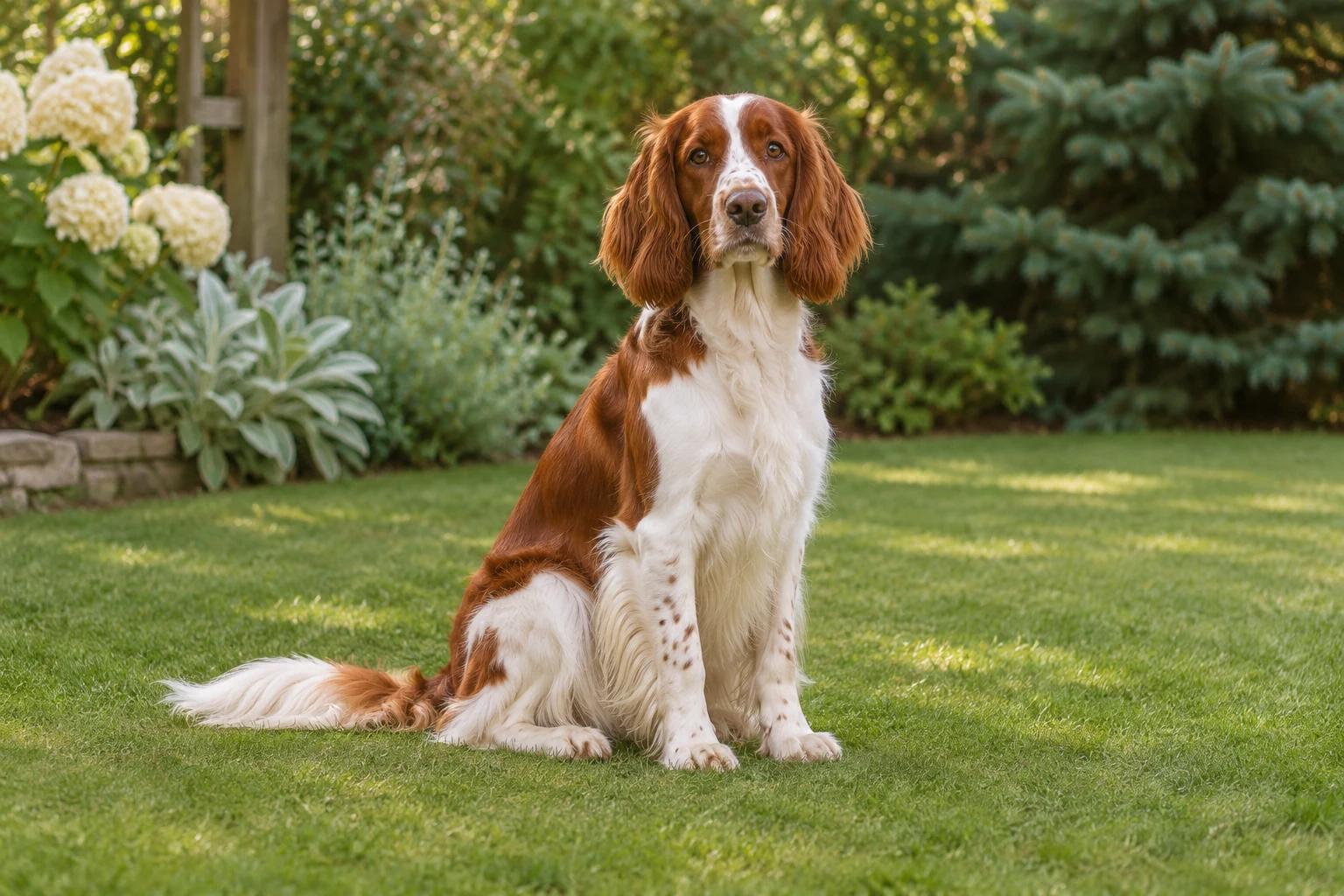
Welsh Springer Spaniel temperament combines a strong interest in familiar people with a more measured response to newcomers. The current breed profile describes an active, responsive companion, not a dog whose feelings can be inferred from a friendly-looking photograph. Understanding this combination helps you distinguish family attachment, social confidence and the skills an individual has actually learned.
Welsh Springer Spaniel temperament: leave room for individual voice
The Welsh Springer Spaniel Club of America's FAQ describes variation in vocal behavior: some dogs are quieter, while others are more vocal. It connects the breed's alerting background with the need for appropriate activity and training, rather than promising silence to every household.
For an owner, this means asking what the particular dog barks at and what normally happens next. A description such as “sometimes barks” gives less useful information than knowing whether the event is a visitor arriving, activity outside or a familiar daily routine. Do not turn one person's experience with one Welsh Springer into a rule for every other dog.
The club's account is also a reason to avoid treating barking as the complete personality. A dog can have many different interactions across a day, and its vocal response is only one part of that picture.
A working background with a practical purpose
The AKC's Welsh Springer facts article explains that these dogs were developed to find concealed game and flush it toward nets or into the air for a falcon, before guns became part of the work. The terrain included thickets, marshes and uneven ground. That history gives context to an animal expected to remain engaged with its surroundings.
The article also emphasizes endurance and the ability to keep working. This is historical context, not a command to recreate long working days with a pet or to assume a young dog already has adult conditioning. A working background describes the tasks that shaped a breed; it does not supply an individualized activity program.
For someone choosing a companion, the useful point is that the breed's appeal extends beyond its appearance. Its history contains searching, movement and a purpose shared with people. Consider whether an involved life with a dog attracts you, rather than expecting the appearance without interest in what lies behind it.
Read the whole dog during introductions
Dogs Trust's body-language guidance emphasizes the whole body and the situation, rather than interpreting one feature in isolation. A wagging tail, for example, is not automatically a declaration that a dog wants closer contact. Mixed signals can reflect mixed feelings.
The guidance also explains that distance matters. A dog may be comfortable with something farther away but not with the same thing approaching closely. The amount of space needed can change with the intensity of the situation. One quiet person and a busy group are not equivalent introductions merely because both involve people.
For a Welsh Springer meeting someone new, allow that distinction to shape your expectations. Watch the animal's overall response rather than asking a visitor to keep approaching until the dog accepts contact. If the dog needs space, provide it. The goal is not to obtain a particular pose or a compulsory greeting, but to make the interaction manageable for the animal actually taking part.
Play can include manners without losing its enjoyment
Battersea's constructive-play guidance shows how familiar cues can become part of a toy game. With a dog that already understands the relevant skills, ask for a sit or down before releasing it to fetch. Start with a very short pause rather than making the exciting toy a test the dog cannot yet manage.
On the return, request a known release or exchange for another toy. If the dog leaves its position too early, reduce the challenge or practice the skill separately before adding the toy again. Clear, achievable steps are more useful than repeating an increasingly difficult demand.
For tug, keep the toy low and move it from side to side rather than sharply lifting it upward. Use clear cues for taking and releasing the toy. This makes play a shared activity with understandable transitions, not a contest over who can become most excited. Choose a game the individual enjoys and already has the foundation skills to attempt.
Welsh Springer Spaniel characteristics in everyday company
The current profile describes strong family involvement and a tendency to stay close. That does not mean every moment of proximity has the same purpose: the dog may be sharing quiet time, anticipating an outing or responding to something its familiar person is doing. Learn the individual rather than attaching one explanation to every approach.
Welsh Springer Spaniel personality also includes the reference's strong interest in learning. A dog that enjoys daily training games still needs to learn your particular words and gestures. Responsiveness is a starting tendency, not a guarantee that an adult arriving in a new home understands that household's expectations.
Consider the physical companion as well as the adjectives. Current female weights are 35–50 pounds and males 40–55 pounds. This is a substantial presence beside you, not only the small puppy in an introductory photograph. The dog quiz can help you consider company, activity and care together.
Our article about the Welsh Springer's ear outline addresses a separate appearance detail. An attractive feature cannot tell you how an individual feels or which interactions it prefers.
FAQ
Is a Welsh Springer Spaniel equally outgoing with family and strangers?
Not necessarily. The current profile describes strong family involvement alongside a need for patient introductions to unfamiliar people. A close relationship at home does not establish how the dog will respond to someone it has just met.
Does the breed's training reference mean an adult already knows my cues?
No. It indicates responsiveness, not a completed education in your household's words or gestures. Ask the current keeper which cues are familiar and how they are given before interpreting a new dog's response to your instructions.
Can Welsh Springer Spaniel behavior be predicted from adult weight?
No. The current female range of 35–50 pounds and male range of 40–55 pounds describe physical scale. They do not tell you an individual's preferences, prior experience or relationship with the people it knows.
Sources behind this article
- WSSCA frequently asked questions ↗
- AKC Welsh Springer facts ↗
- Dogs Trust body language ↗
- Battersea constructive play ↗
Article source checked: November 16, 2026. Source checked 2026-11-16
Keep reading

Airedale Terrier Temperament: What Everyday Life Can Feel Like
Read article →