Weimaraner vs Greyhound
Compare Weimaraner vs Greyhound size, structure, working interests and learning preferences, with sex-qualified adult measurements.
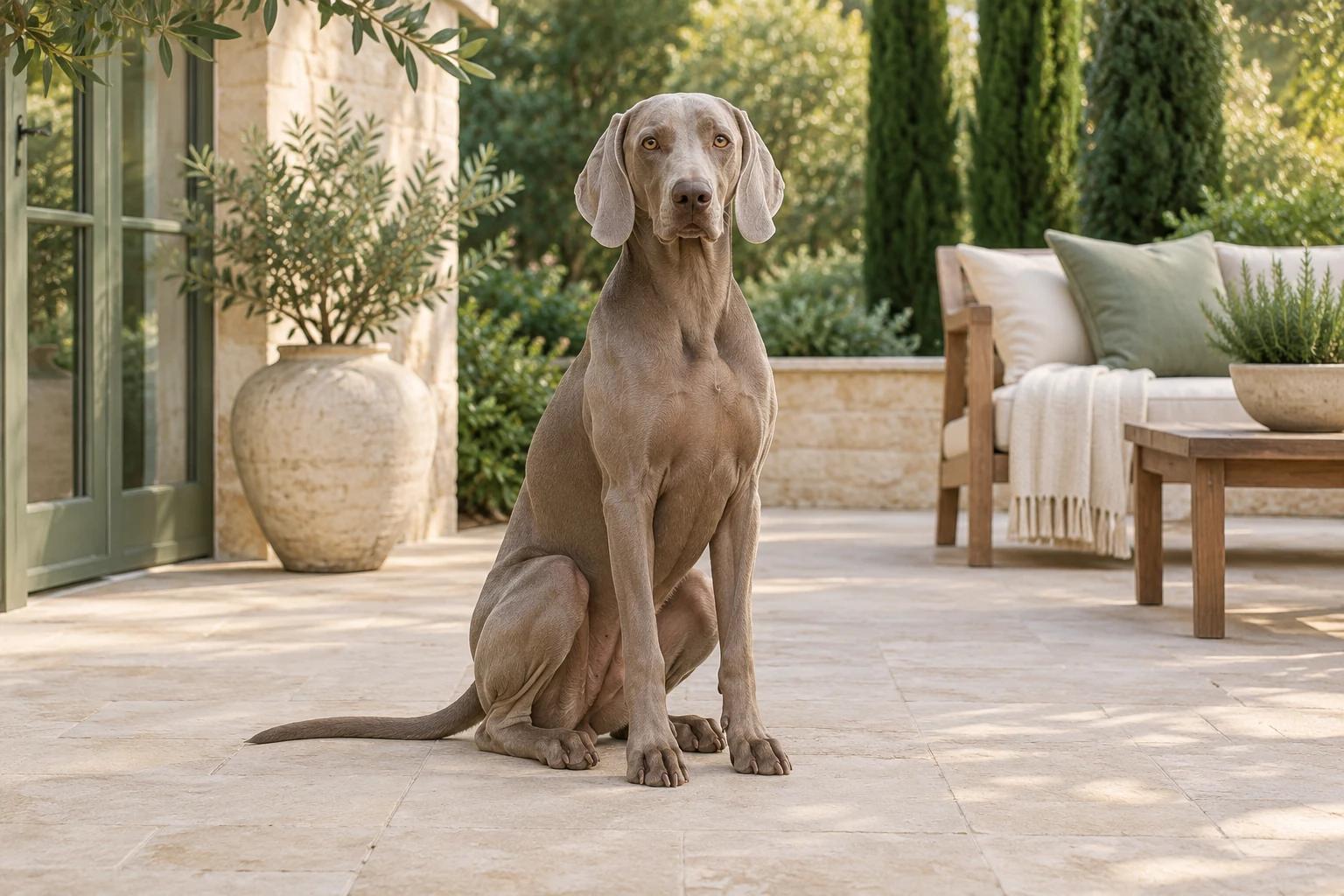
Weimaraner vs Greyhound is not simply a choice between two tall dogs with short coats. Their measurements overlap in some ways and separate in others, while the activities that interest an individual dog deserve just as much attention as appearance. Start with the current Weimaraner profile and Greyhound profile, then distinguish physical scale from the way you hope to spend time together.
Weimaraner vs Greyhound: look beyond height
The AKC Greyhound standard describes a long, narrow head, small folded ears, an arched neck and a deep chest. The broad, muscular back and arched loin lead into powerful hindquarters, while the flanks draw upward. This is a distinctive arrangement of depth, length and muscle, not merely a dog made narrow everywhere.
The feet are closer to a hare shape than a round cat shape, and the long tail tapers. A short, smooth coat makes much of the outline visible. Looking at a Greyhound from the side therefore tells you something different from looking directly down at its back: a narrow-looking view does not mean the chest lacks depth.
These anatomical distinctions help explain why a photograph of the head alone is a poor guide to the whole dog. When learning the breed's outline, follow the neck into the chest and then the topline through the loin. Avoid judging structure solely by the apparent width of the face or by the sleekness of the coat.
Greyhound games need not resemble a retriever's games
VCA's Greyhound profile describes a dog that can enjoy running and chasing without necessarily wanting to retrieve. A ball moving away and a ball being returned to a person's hand are different parts of a game. Interest in the first does not establish enthusiasm for the second.
VCA also notes that repetitive lessons can lose the dog's interest and that food rewards can help with learning. For a Greyhound owner, a successful game might be a brief trick lesson rather than an extended sequence of identical throws. Notice which part the individual actually enjoys before deciding that an incomplete retrieve represents failure.
The same profile emphasizes secure fencing because fast-moving animals can attract pursuit. An apparently relaxed moment is not evidence that an open boundary will remain uninteresting. Choose appropriate enclosed opportunities rather than treating apparent calm as a substitute for containment. This is a practical difference between arranging a safe activity and trying to prove that the dog will ignore every possible moving distraction.
What the Weimaraner's working background adds
The AKC's Weimaraner seminar traces the breed to hunting work in nineteenth-century Weimar, with later emphasis on birds and retrieving. That background offers a more useful starting point for activities than treating the silver coat as the breed's defining contribution to everyday life.
The article describes a dog that values activity, company and a job, with opportunities in organized pursuits such as obedience and agility. For a prospective owner, the important question is whether working with the dog sounds appealing in its own right. Wanting a companion beside you and wanting to teach a shared task are related, but they are not identical commitments.
A household does not need to hunt to take this history seriously. It can investigate an appropriate club activity and find out what participating actually involves. The point is not to assign every Weimaraner the same hobby. It is to recognize that the breed's background contains purposeful work alongside the attractive appearance that first catches many people's attention.
Compare current adult measurements by sex
The current profiles list female Weimaraners at 55–77 pounds and males at 66–88 pounds. Greyhound females are listed at 60–65 pounds and males at 65–70 pounds. The ranges overlap, so “the heavier breed” is not an adequate description of every pair of dogs. A female Weimaraner may fall below or above the listed Greyhound female range.
Height gives a different comparison. Weimaraner males are listed at 25–27 inches and females at 23–25 inches; Greyhound males at 28–30 inches and females at 27–28 inches. On those references, the Greyhound is taller, but height does not tell you which individual weighs more. Keep the two measurements separate rather than assuming that the taller dog must also be the heavier one.
For a concrete example, a 68-pound adult could fall within either male weight range. The number alone would not identify its breed, height or outline. Equally, selecting the lowest end of one range and the highest end of the other exaggerates a contrast that may not describe the dogs you meet. Ask for the actual adult's measurements when physical fit is important.
Choosing Weimaraner or Greyhound for shared learning
The Weimaraner reference describes strong interest in training and daily learning games. The Greyhound reference favors shorter lessons with clear rewards. This does not make either dog a finished learner on arrival, and it does not tell you which particular skill an individual already knows.
In a Greyhound vs Weimaraner decision, ask to see a familiar lesson with the person who currently handles the dog. Distinguish an understood cue from one the dog has never encountered. A new owner using different words or movements is not repeating exactly the same lesson simply because the intended behavior has the same name.
Our Weimaraner adoption article covers the separate puppy-or-adult decision. Use the dog quiz to consider wider preferences, without allowing one attractive feature to settle the entire choice.
FAQ
What is the difference between Weimaraner and Greyhound weight?
The current adult references overlap: Weimaraner females are 55–77 pounds and males 66–88, while Greyhound females are 60–65 and males 65–70. Compare sex-qualified ranges and the actual dog rather than assuming every Weimaraner is heavier.
Which breed is taller in the current references?
Greyhounds are listed at 28–30 inches for males and 27–28 for females. Weimaraners are listed at 25–27 and 23–25 inches respectively. These are reference ranges, not measurements of a particular dog you are considering.
Does an adult dog's breed tell me which cues it knows?
No. Breed descriptions do not provide an individual training history. Ask the current handler to demonstrate familiar cues and explain the words or gestures used, so that a change of handler is not confused with an inability to learn.
Sources behind this article
Article source checked: November 16, 2026. Source checked 2026-11-16
Keep reading

Affenpinscher vs Brussels Griffon: Everyday Differences
Read article →