Treeing Walker Coonhound vs American Foxhound
Compare Treeing Walker Coonhound vs American Foxhound dimensions, structure, learning interests and styles of companionship.
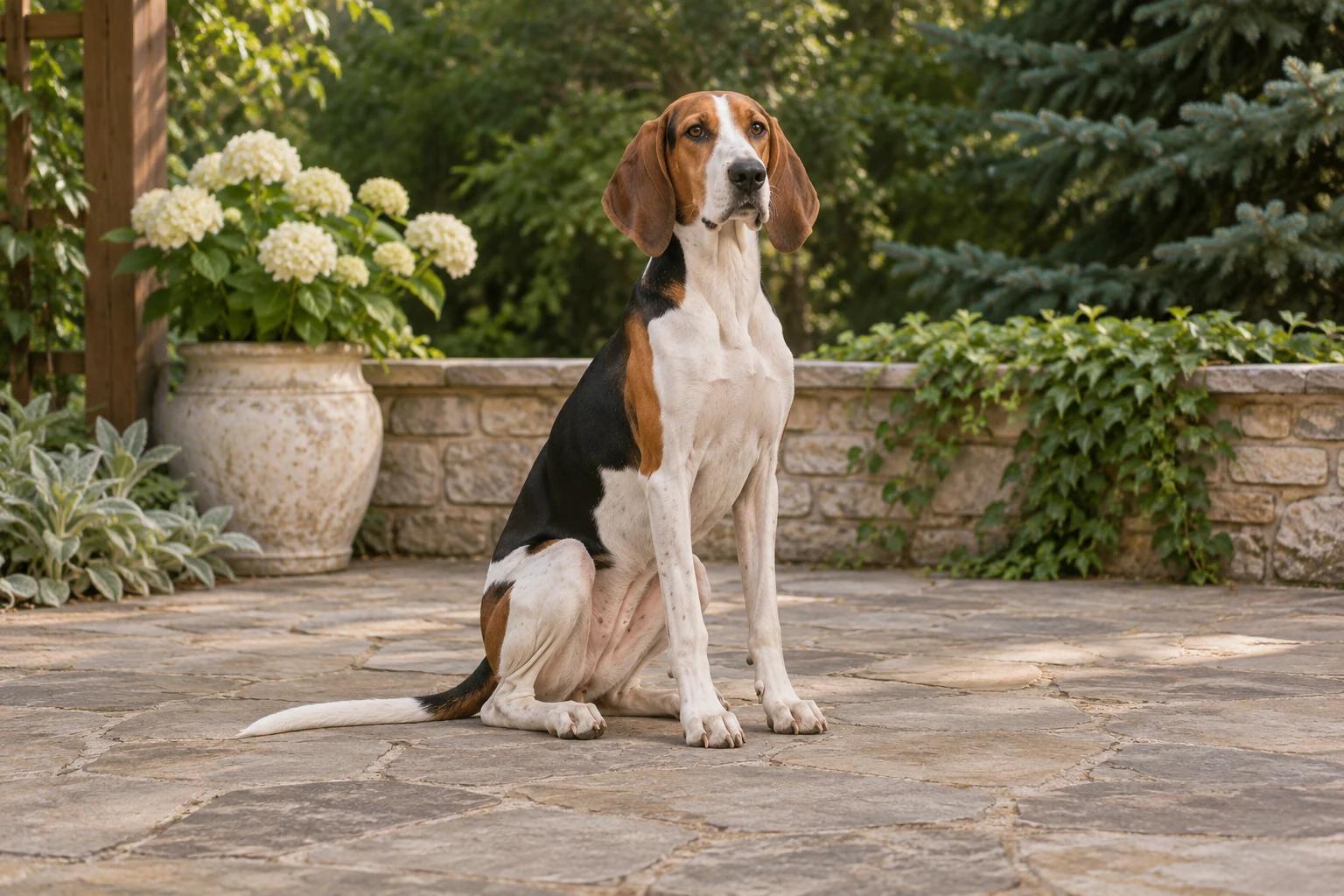
Explore the
Treeing Walker Coonhound
Background, care, and everyday considerations.
View breed profile →A Treeing Walker Coonhound vs American Foxhound comparison is most useful when it separates appearance from everyday interaction. The current Treeing Walker Coonhound profile and American Foxhound profile describe active, smooth-coated hounds with overlapping adult dimensions. Their learning profiles and preferred styles of company deserve as much attention as the familiar hound silhouette.
Treeing Walker Coonhound vs American Foxhound: the Foxhound outline
The American Foxhound standard describes a fairly long head, broad skull, square-cut muzzle and long, low-set ears. Its neck is strong without being heavy, and the shoulders should allow freedom of movement. AKC Foxhound standard.
The chest is described in terms of depth rather than a broad, bulky front. A muscular back, slightly arched loin and well-muscled rear assembly complete the outline. This is more informative than assessing the dog from a head photograph alone.
The feet have firm pads and well-arched toes, while the tail has a slight curve rather than turning forward over the back. Those details help a viewer recognize the combination of features in the standard without relying on coat markings.
A breed outline is not a diagnosis or a guarantee of athletic ability in an individual. Watch the whole dog moving and standing, and keep structural description separate from health assessment. Two hounds with similar-looking faces can still differ in body proportions, condition and experience; none of those questions is settled by a cropped photograph.
The Foxhound's nose offers a teaching opportunity
VCA highlights the American Foxhound's interest in scent and suggests search games as an outlet. A hidden food reward presents a task that uses that interest, rather than asking the dog to ignore it throughout every activity. VCA Foxhound guidance.
This helps explain why a repetitive exercise may not be as engaging as a problem with something to locate. The useful question is what makes participation worthwhile for the individual dog, not whether the breed should be expected to enjoy every task equally.
VCA also warns that following a trail can carry the dog toward hazards. A compelling smell is not confined to the place where an owner intended the activity to happen. Secure arrangements matter independently of how enthusiastic the hound is about a game.
That interest should not be interpreted as an inability to learn household manners. Instead, it helps an owner choose a form of engagement that suits the dog while recognizing that scent-driven exploration needs boundaries. A successful search and a dependable response around distractions are related training goals, but they are not identical achievements.
The Walker's learning needs consistency
VCA describes Treeing Walkers as quick learners that respond to positive reinforcement but may find their own ways around unclear expectations. It cautions against harshness and emphasizes consistent manners training. VCA Walker guidance.
One practical example is jumping up. The guidance singles it out as something to address rather than assuming enthusiasm will become polite greeting behavior on its own. An owner of a substantial hound needs to decide what response is wanted and teach it clearly.
The same source identifies dog sports as possible outlets for a dog that enjoys work. That is an invitation to discover an activity the individual likes, not a promise that every Walker will enjoy the same discipline or reach the same competitive level.
For the comparison, the central point is that learning ability still requires a teaching partnership. Quick understanding does not eliminate the need for clear communication. If the owner changes the expectation from one attempt to the next, the dog is not being given a stable problem to solve. Choose the relationship you want, not merely the label intelligent.
Current adult size ranges overlap substantially
The Walker profile gives an adult weight range of 50–70 pounds without a separate weight range for each sex. Its heights are sex-qualified: males at 22–27 inches and females at 20–25 inches.
The American Foxhound profile lists females at 60–65 pounds and males at 65–70 pounds. Its current height ranges are 21–24 inches for females and 22–25 inches for males. Keep those labels attached when comparing a particular pair of dogs.
The difference between Treeing Walker Coonhound and American Foxhound size is therefore not captured by saying that one is always bigger. A 65-pound adult lies within both overall references. The Walker height range extends higher at the upper male endpoint, while the weight references overlap.
An American Foxhound vs Treeing Walker Coonhound comparison also needs like-for-like information. Comparing an adult male of one breed with an unspecified puppy of the other would not answer the adult-size question. The current ranges help establish scale, but individual measurements describe the dog actually under consideration.
Compare company and play without turning tendencies into guarantees
The Walker's current profile emphasizes close family involvement and relatively high playfulness. The Foxhound profile describes companionship that can combine shared time with independence. Someone who wants a dog frequently nearby may therefore read the profiles differently from someone comfortable with a less contact-focused style of company.
Neither description predicts every interaction. A dog can enjoy being in the same room without requesting continuous attention, and an affectionate tendency does not establish how an individual handles time apart. Consider the actual dog's experience as well as the reference.
Both profiles describe other-dog sociability favorably, while explicitly warning that compatibility is individual. That distinction matters if the decision concerns adding a Treeing Walker Coonhound or American Foxhound to a home with an existing dog. A breed tendency is not a guarantee about that particular pair.
The coat descriptions are comparatively straightforward: both current profiles list short, smooth coats and regular shedding. That shared feature should not overshadow the interaction and activity commitments. The dog match quiz helps weigh those priorities. The separate Walker color article covers the existing appearance topic.
FAQ
Is one breed always heavier?
No. The current Walker range is 50–70 pounds overall, while Foxhound females are 60–65 pounds and males 65–70 pounds. The ranges overlap rather than creating an absolute ranking.
Are Walker weight figures sex-specific in the current profile?
No. The weight reference is overall. The same profile does provide separate male and female height ranges, which should retain their labels.
Does a favorable other-dog rating guarantee a successful match?
No. Both profiles distinguish breed tendencies from compatibility between particular dogs. The individual animals and their experiences remain essential to the decision.
Sources behind this article
- AKC: American Foxhound standard ↗
- VCA: American Foxhound learning interests ↗
- VCA: Treeing Walker Coonhound learning interests ↗
Article source checked: November 16, 2026. Source checked 2026-11-16
Keep reading

Affenpinscher vs Brussels Griffon: Everyday Differences
Read article →