Treeing Tennessee Brindle vs Mountain Cur
Compare Treeing Tennessee Brindle vs Mountain Cur size, working background, structure and everyday learning interests.
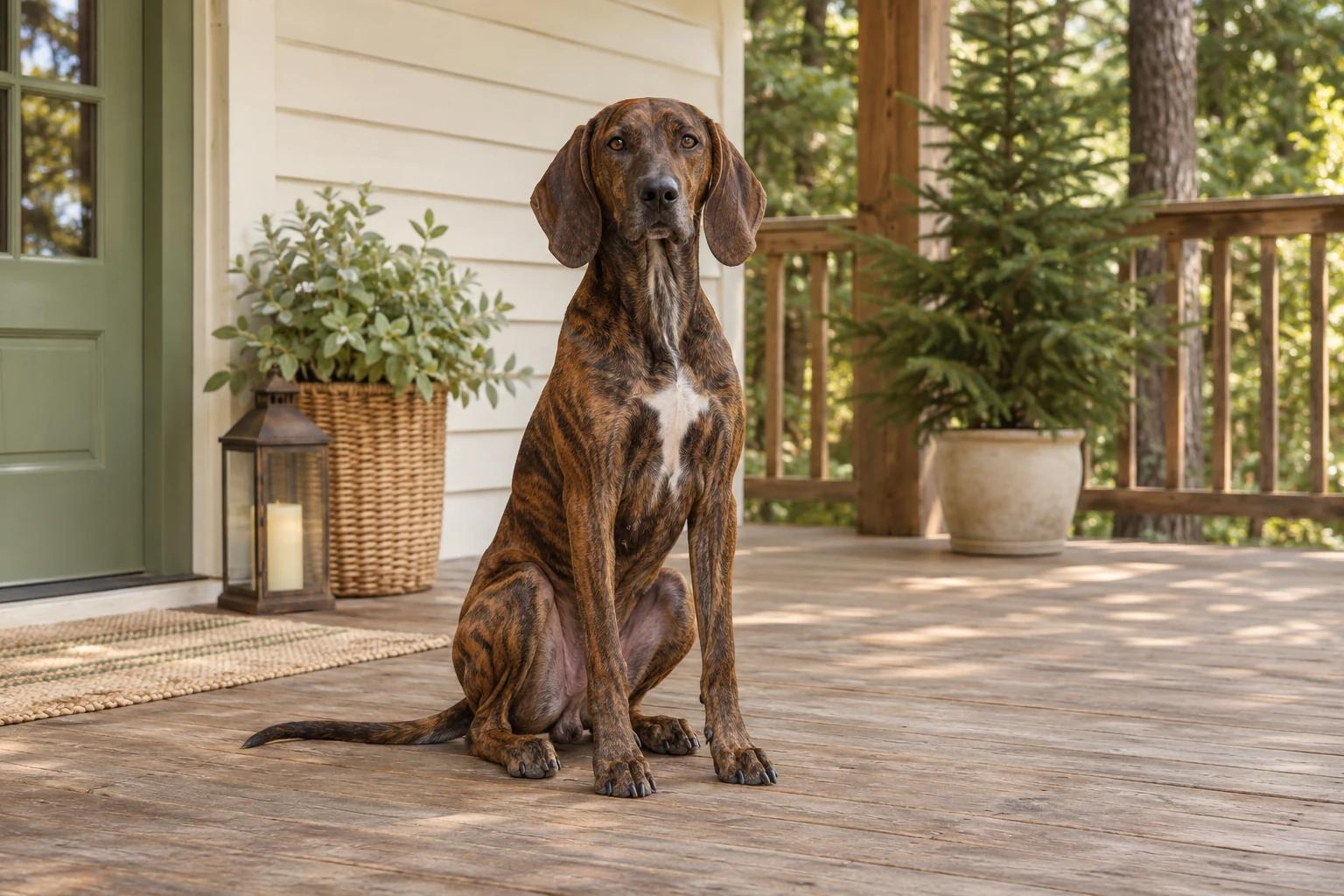
Explore the
Treeing Tennessee Brindle
Background, care, and everyday considerations.
View breed profile →Treeing Tennessee Brindle vs Mountain Cur is a comparison between two distinct American breeds, not two interchangeable names for any brindle dog. The current Treeing Tennessee Brindle profile and Mountain Cur profile show overlapping adult dimensions but different everyday tendencies. Start with those differences, then look beyond color to the individual dog's structure, experience and interests.
Treeing Tennessee Brindle vs Mountain Cur: the Cur's outline
The UKC Mountain Cur standard describes a body that is square or slightly longer than tall, with legs suited to agile movement over rough ground. The broad head has a muzzle shorter than the skull and close-fitting lips. UKC Mountain Cur standard.
High-set, dropped ears are short to medium in length. The feet are compact and slightly oval, with well-arched toes. Together, those details create a working outline that is more informative than coat color alone.
The standard also permits more than one coat texture: the short outer coat can be smooth or rough, over a short, soft, dense undercoat. That means two Mountain Curs need not feel identical when stroked, even when their basic silhouette is similar.
Look at the whole dog rather than treating one feature as an identification test. A broad head, a particular ear carriage or a brindle pattern does not independently prove ancestry. The standard describes a combination of features and a working form; the dog's background supplies information that a photograph cannot.
Registration dates are not the start of every lineage
UKC's separate recognition announcement records the Treeing Tennessee Brindle entering its recognized breeds effective July 1, 2017. The announcement describes an American scenthound used on both small and larger game and notes that much of the early background was passed down orally. UKC recognition announcement.
The useful distinction is between a registry milestone and the existence of the dogs that preceded it. A recent formal recognition date does not mean that the working type appeared from nowhere on that date.
It also helps explain why a label encountered in an older hunting account may not match the exact wording on a modern registration document. The announcement records several earlier names associated with the dogs. Historical terminology and present-day breed identity therefore need careful interpretation, rather than assuming that every similar name is interchangeable.
For an owner comparing the two breeds, verified background is more useful than a confident visual guess. Ask what documentation identifies the particular dog, rather than treating a familiar regional name as a complete pedigree.
The Brindle's hunting interest remains relevant
AKC describes the Treeing Tennessee Brindle as intelligent and courageous, with a strong inherited hunting instinct. That is a useful reminder that an appealing companion can have interests extending beyond household games. AKC breed introduction.
Do not translate intelligence into a promise that the dog will automatically prefer your chosen activity. Understanding a task and being motivated to participate are different questions. When considering this breed, interest in the individual's working background is more useful than expecting a generic, instantly compliant companion.
That does not require every owner to seek the same activities. It does require taking the breed's purpose seriously when judging whether the partnership appeals to you.
Mountain Cur confidence and purposeful activity
Purina's owner guidance describes a Mountain Cur that enjoys work and can be reserved around unfamiliar people. It emphasizes consistent teaching, varied experiences and activities that engage both body and mind. Purina Mountain Cur guidance.
For someone comparing breeds, the distinction is not simply friendly versus unfriendly. A dog that takes time to become comfortable with a newcomer may still have a strong relationship with familiar people. A brief first greeting is only one part of that picture.
The guidance includes obedience games and suitable dog sports among possible outlets, alongside outdoor exercise. That gives a prospective owner more to consider than access to a yard. The interesting question is whether you enjoy taking part in the dog's activities and helping it learn.
Purina also highlights prey interest and secure boundaries. Enthusiasm for work should not be confused with automatic reliability around small animals or outside an enclosure. A dog's eagerness to pursue an activity and its ability to disengage from it are separate matters, both relevant to the household considering it.
Compare current weights without making them destiny
The current Treeing Tennessee Brindle weight ranges are 31–40 pounds for females and 35–51 pounds for males. Mountain Cur females are listed at 40–50 pounds, with males at 45–60 pounds. These are reference ranges, not a prediction for every puppy.
There is overlap, particularly between males. A 47-pound adult, for example, could fall inside either male reference range. Weight alone would not distinguish the breeds. The difference between Treeing Tennessee Brindle and Mountain Cur size is therefore a tendency in the ranges, not an identification rule.
The current profiles also separate physical activity from mental engagement. Both make room for learning and games; the Mountain Cur reference places particularly strong emphasis on activity and play. The Brindle's profile describes motivation and consistent practice as important to learning. Neither should be chosen on the assumption that a short coat means a low-involvement personality.
When deciding on a Treeing Tennessee Brindle or Mountain Cur, consider how much interaction you want during ordinary days. The dog match quiz helps put those preferences together. The existing Brindle voice article covers a separate working-context question.
FAQ
Does a Mountain Cur vs Treeing Tennessee Brindle comparison identify every brindle dog?
No. The current profiles describe different breeds with overlapping size ranges. A coat pattern and approximate weight do not establish an individual dog's ancestry.
Are the female weight ranges identical?
No. The current Brindle range is 31–40 pounds; the Mountain Cur range is 40–50 pounds. Those figures should remain labeled as female reference ranges.
Does a short coat mean little mental engagement?
No. Both current profiles include learning and purposeful interaction in everyday life. Coat length does not describe the whole ownership commitment.
Sources behind this article
- UKC: Mountain Cur standard ↗
- UKC: Treeing Tennessee Brindle recognition ↗
- AKC: Treeing Tennessee Brindle ↗
- Purina: Mountain Cur owner guidance ↗
Article source checked: November 16, 2026. Source checked 2026-11-16
Keep reading

Affenpinscher vs Brussels Griffon: Everyday Differences
Read article →