Toy Fox Terrier Exercise Requirements: Walks and Play
Explore Toy Fox Terrier exercise requirements through daily movement, agility foundations, a paw-target trick and the needs of an active toy dog.
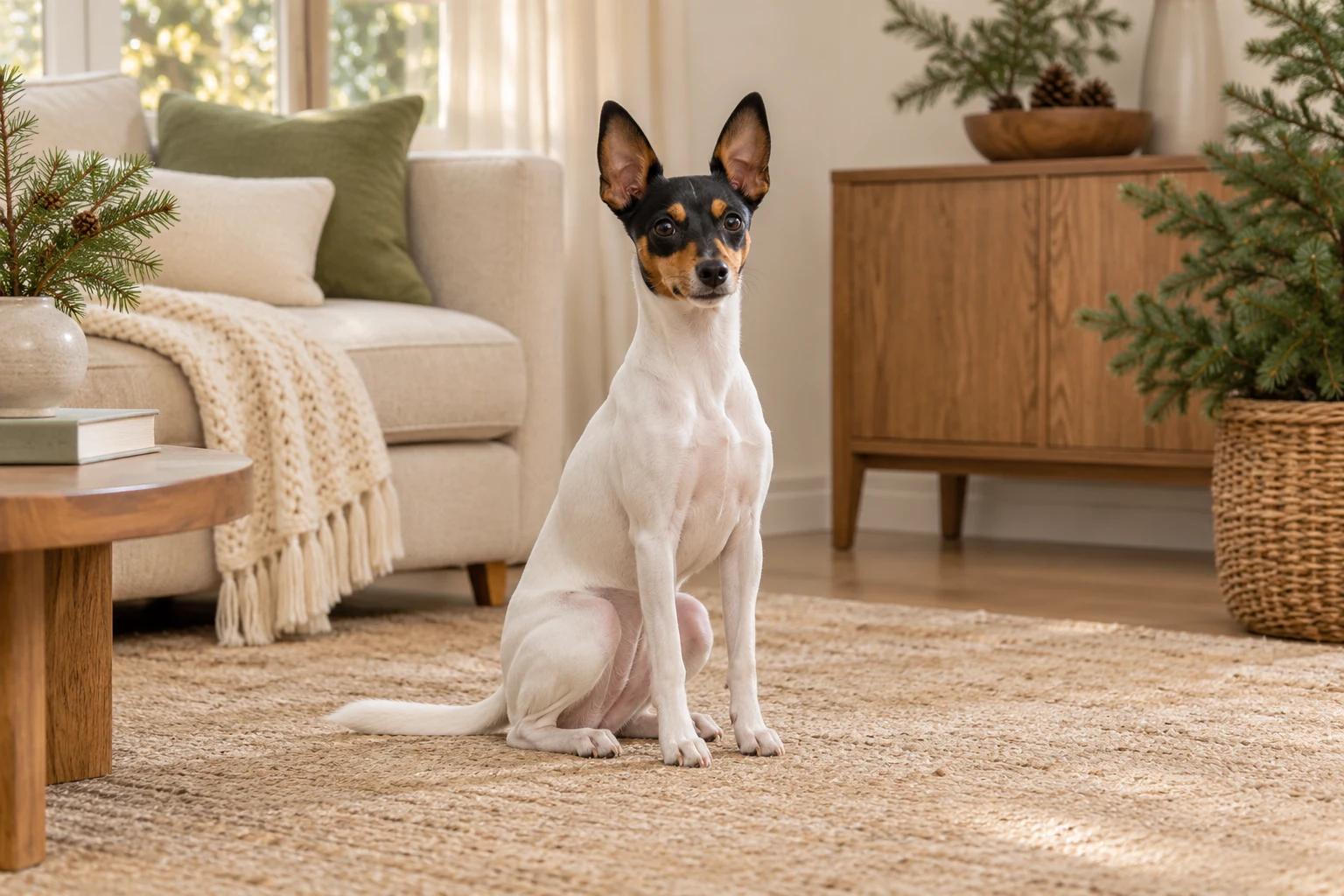
Toy Fox Terrier exercise requirements belong to an active companion, not a dog whose small dimensions remove the need for an interesting day. The current Toy Fox Terrier profile lists adults of either sex at 4–7 pounds, alongside relatively high activity, playfulness and mental engagement. The useful question is how to meet those interests at the individual's scale, rather than how little exercise a tiny dog might tolerate.
Toy Fox Terrier exercise requirements include different activities
VCA describes a curious dog that can move quickly from resting close to a person to investigating something happening nearby. Its training section identifies obedience and agility among possible interests. VCA: Toy Fox Terrier activity.
That picture is broader than either a permanent lap dog or a dog that must be moving continuously. The attraction is often the change of pace: companionship interspersed with purposeful activity, with the owner involved in both.
The activities named by VCA offer different kinds of participation. Obedience centers on learned responses, while agility introduces a course and handling skills. Interest in either should be explored through instruction appropriate to the individual, not assumed from the breed name alone.
When assessing an adult's existing routine, ask what it actually enjoys. A dog may engage readily with a lesson but show less interest in another form of play. Breed possibilities are starting points for discovery, not a requirement to enroll every Toy Fox Terrier in the same sport or produce the same performance.
Try agility handling before obstacle height
AKC's home-agility guidance begins with small, achievable tasks and short sessions. One foundation is teaching the dog to work comfortably on either side of the handler, rewarding it for staying on the indicated side until asked to switch. AKC: agility foundations at home.
For a Toy Fox Terrier, this offers a moving partnership without beginning with ambitious jumps. Start at a walking pace where you can keep track of the little dog beside you. The lesson concerns position and communication, not how fast you can complete a course.
Another foundation is going around an object. AKC suggests rewarding an approach first, then building toward a complete circuit and return. A suitable stable object gives the dog something concrete to navigate while you practice the timing of your reward.
Keep the aim distinct from testing physical limits. The guide cautions that agility is not a high-jump contest and distinguishes what a dog can jump from what it should jump. Appropriate instruction is more useful than building taller obstacles because the dog appears enthusiastic about clearing them.
Add a small paw-target game
Battersea's high-five lesson develops a voluntary paw lift from a comfortable sit. Moving a food lure slightly to one side encourages a weight shift; mark and reward a small lift of the opposite paw. Battersea: teach a high five.
For this little terrier, keep your receiving hand within easy reach rather than presenting it at a human-sized high-five height. The objective is a small, deliberate contact, not stretching upward or jumping to reach you.
As the paw lift becomes predictable, offer a flat hand to receive it and reward contact. Once that is understood, gradually change the hand from a horizontal receiving position to an upright palm. Add the spoken cue when the action is reliable.
This is a thinking game to accompany physical activity, not a replacement for the rest of the day. It also illustrates how a finished-looking trick can be built from smaller actions. Reward the stage the dog understands rather than repeatedly presenting the final gesture and hoping it will guess what you mean.
How much exercise does a Toy Fox Terrier need?
The current breed profile describes an active routine that combines walks, play and learning. Its everyday narrative gives about an hour as a broad reference, but a single number does not describe the content of that time or establish a prescription for every age and condition.
A Toy Fox Terrier daily walk is one part of that picture. The profile's separate emphasis on mental engagement means that walking time and learning time answer related but different needs. An owner who enjoys both outdoor company and small teaching projects is considering the whole profile more accurately than someone counting only distance.
Use the reference to understand the ownership commitment before choosing the breed. It is not a reason to impose a fixed adult exercise quota on a puppy, an older dog or an individual with a health limitation. Discuss appropriate activity for that dog with your veterinarian.
Small size does not describe a low-key personality
The Toy Fox Terrier activity level should be considered beside its other current tendencies. The profile describes strong family involvement and responsiveness to learning, but also a relatively high voice and marked watchfulness. Activity is not a promise that every bark or alert response will disappear.
That matters when imagining apartment life. The dog occupies little physical space, yet its interest in people and events can be noticeable. A smaller bed or shorter stride does not automatically mean a smaller need for company, engagement or considerate handling of the surroundings.
The current reference also distinguishes sociability toward people from compatibility with other dogs. Enthusiasm for greeting a person does not establish that a group of unfamiliar dogs is the right activity for the individual. Consider the dog's own experience rather than using the word playful as a blanket answer.
For a prospective owner, the best fit is not simply someone who has room for a tiny dog. It is someone who wants the interaction described here. The dog match quiz helps consider that preference, while the separate Toy Fox Terrier registration story covers the breed's historical naming milestone.
FAQ
Does the Toy Group label mean exercise is optional?
No. The current profile describes relatively high activity and mental engagement despite an adult weight range of only 4–7 pounds. Classification and body size do not cancel those commitments.
Will activity necessarily make a Toy Fox Terrier quiet?
No. The profile separately describes a relatively high vocal tendency and watchfulness. Those characteristics should remain part of the ownership decision rather than being assumed to vanish after an outing.
Does friendliness with people establish suitability for every dog group?
No. The current profile treats other-dog compatibility as individual. A sociable human greeting does not answer how the dog will respond to unfamiliar canine companions.
Sources behind this article
Article source checked: November 16, 2026. Source checked 2026-11-16
Keep reading

Afghan Hound Exercise Needs: Build a Workable Active Day
Read article →