Tosa vs Dogo Argentino: Build and Daily Life
Compare Tosa vs Dogo Argentino through adult weights, distinctive build, coat care, stranger responses and shared activity.
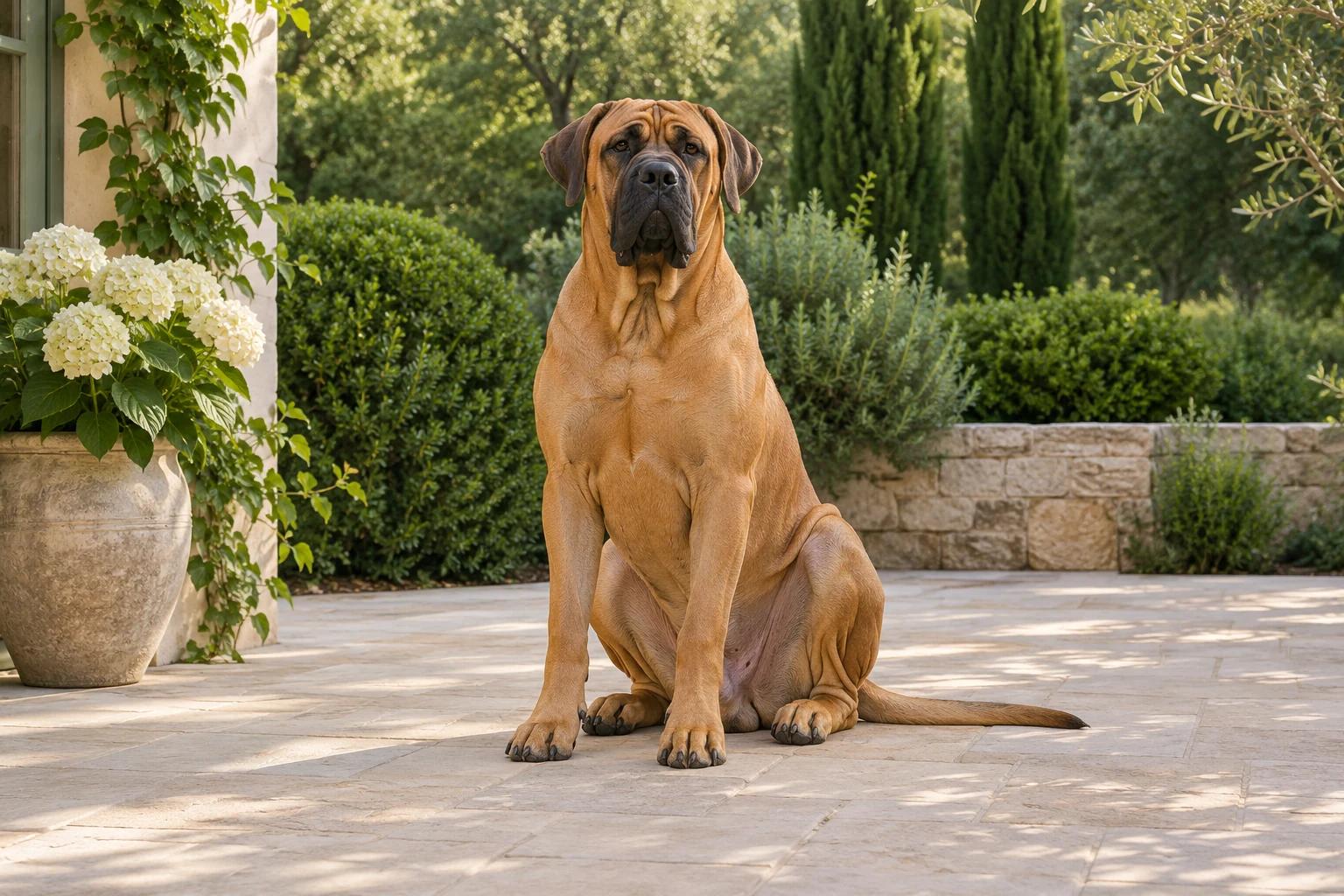
Tosa vs Dogo Argentino is a comparison between two substantial dogs, not two versions of the same companion. The current Tosa profile lists a broad adult weight range of 100–200 pounds. The Dogo Argentino profile lists females at 88–95 pounds and males at 88–99 pounds. Size is an important difference, but outline, coat and the dog's response to unfamiliar company also deserve attention.
Tosa vs Dogo Argentino: the Tosa's outline
The UKC Tosa standard describes a body slightly longer than tall, with a broad, deep chest and a large, blocky head. Its muzzle is shorter than its skull, and the lips are pendulous rather than close-fitting. Loose skin at the throat creates a visible dewlap. UKC Tosa Ken standard.
These details help identify the breed's shape without reducing it to weight. In a side view, look at the relationship between head, neck and body: the substantial front does not mean the dog should be understood as a square block on legs.
The standard also describes a muscular, level back and a tail that is thick at the base, tapering toward its end. The tail reaches approximately to the hock when lowered and is not curled over the back.
Taken together, these features give a more useful physical picture than a close-up of the face alone. A full-body view shows the proportions that a dramatic head photograph can conceal, especially when the dog is standing naturally rather than being posed toward the camera.
The Dogo's different balance
The Dogo Argentino standard emphasizes an athletic, muscular dog whose body length only modestly exceeds its height. The muzzle and skull are of approximately equal length, and the lips fit closely. That creates a different facial construction from the Tosa's heavier-lipped outline. Dogo Argentino Club of America standard.
The chest extends below the elbows, while the withers stand above the croup. The standard's picture is of strength combined with mobility, not bulk pursued independently of movement. Its short white coat leaves much of the body's outline easy to see.
Natural ears hang at the sides of the head and have rounded tips. When comparing photographs, remember that ear presentation can change the impression of a dog's expression without changing the underlying muzzle-to-skull relationship.
A useful comparison therefore includes both front and side views, preferably with the dog moving as well as standing. Look for the overall arrangement of the body rather than selecting whichever photograph makes either breed appear more imposing. Their strength is real, but their proportions are not interchangeable.
What an active Dogo owner describes
In an AKC interview, breed advocate Amy Collins emphasizes an experienced owner who includes the Dogo in meaningful activity and begins education and social exposure early. The account describes a dog that wants involvement, not merely accommodation in a large yard. AKC: living with the Dogo Argentino.
The article gives examples of participation in obedience, agility, tracking, barn hunt and lure coursing. These are examples of possible outlets, not a promise that every Dogo will enjoy or qualify for every activity. They illustrate the breadth of engagement owners may explore with an individual dog.
For a prospective owner, the useful question is which form of shared activity genuinely appeals to both partners. Someone interested in searching exercises may approach that differently from someone who enjoys precise obedience work.
This account also makes the distinction between physical space and participation especially clear. A yard is a location; an activity involves the dog and handler doing something together. Consider whether that active partnership attracts you, rather than assuming that a strong dog will provide its own satisfactory occupation outdoors.
Compare current adult weights carefully
The Tosa's displayed 100–200-pound range is much broader than either Dogo range. The lower Tosa reference sits just above the upper male Dogo reference, but that does not mean every pair of dogs will look dramatically different. An adult near one end of a range is not a representative of the opposite end.
The Dogo's female and male ranges overlap from 88 to 95 pounds. A female can therefore be heavier than a particular male without either falling outside the current references. Use the sex-qualified figures rather than automatically describing every male as the larger animal.
For the Tosa, the current profile does not divide weight by sex. It would be misleading to assign the lower half of its range to females and the upper half to males. Meet the adult and ask its actual weight when scale matters to your decision.
Coat and unfamiliar company
Both current profiles describe short, smooth coats and relatively straightforward grooming. Their shedding references differ: Tosa shedding is listed as light, while the Dogo's is substantial. Short hair should not be mistaken for an absence of loose hair, especially when deciding which daily coat commitment you would prefer.
The profiles also distinguish stranger responses. The Tosa entry emphasizes patient introductions, while the Dogo entry describes greater sociability. That is a tendency to investigate, not permission to let unfamiliar people crowd either dog or a guarantee about an individual greeting.
When weighing Tosa or Dogo Argentino, these everyday differences matter alongside appearance. The difference between Tosa and Dogo Argentino is not simply a red or dark dog versus a white one. Use the dog match quiz to consider the wider commitment, and read the separate Tosa height explanation for that specific measurement topic.
FAQ
Does Dogo Argentino vs Tosa always mean choosing the heavier Tosa?
The current Tosa reference is 100–200 pounds, compared with female Dogos at 88–95 and males at 88–99. Those ranges establish scale, but an individual adult's actual weight is more informative than an imagined maximum.
Are female Dogos always lighter than males?
No. Their current ranges overlap between 88 and 95 pounds. Sex provides context, not a reliable ranking of two individual dogs.
Which current profile indicates more shedding?
The Dogo Argentino profile indicates substantial shedding; the Tosa profile indicates light shedding. Both have short coats, so coat length alone does not answer that ownership question.
Sources behind this article
- UKC Tosa Ken standard ↗
- Dogo Argentino Club of America standard ↗
- AKC: living with the Dogo Argentino ↗
- FCI approximate standard weights — adult-weight reference ↗
- AKC approximate standard weights — adult-weight reference ↗
Article source checked: November 16, 2026. Source checked 2026-11-16Article source checked: November 18, 2026. Source checked 2026-11-18
Keep reading

Affenpinscher vs Brussels Griffon: Everyday Differences
Read article →