Tibetan Terrier Temperament: Company and Character
Explore Tibetan Terrier temperament, independence, sensitivity, companionship and shared learning without relying on personality guarantees.
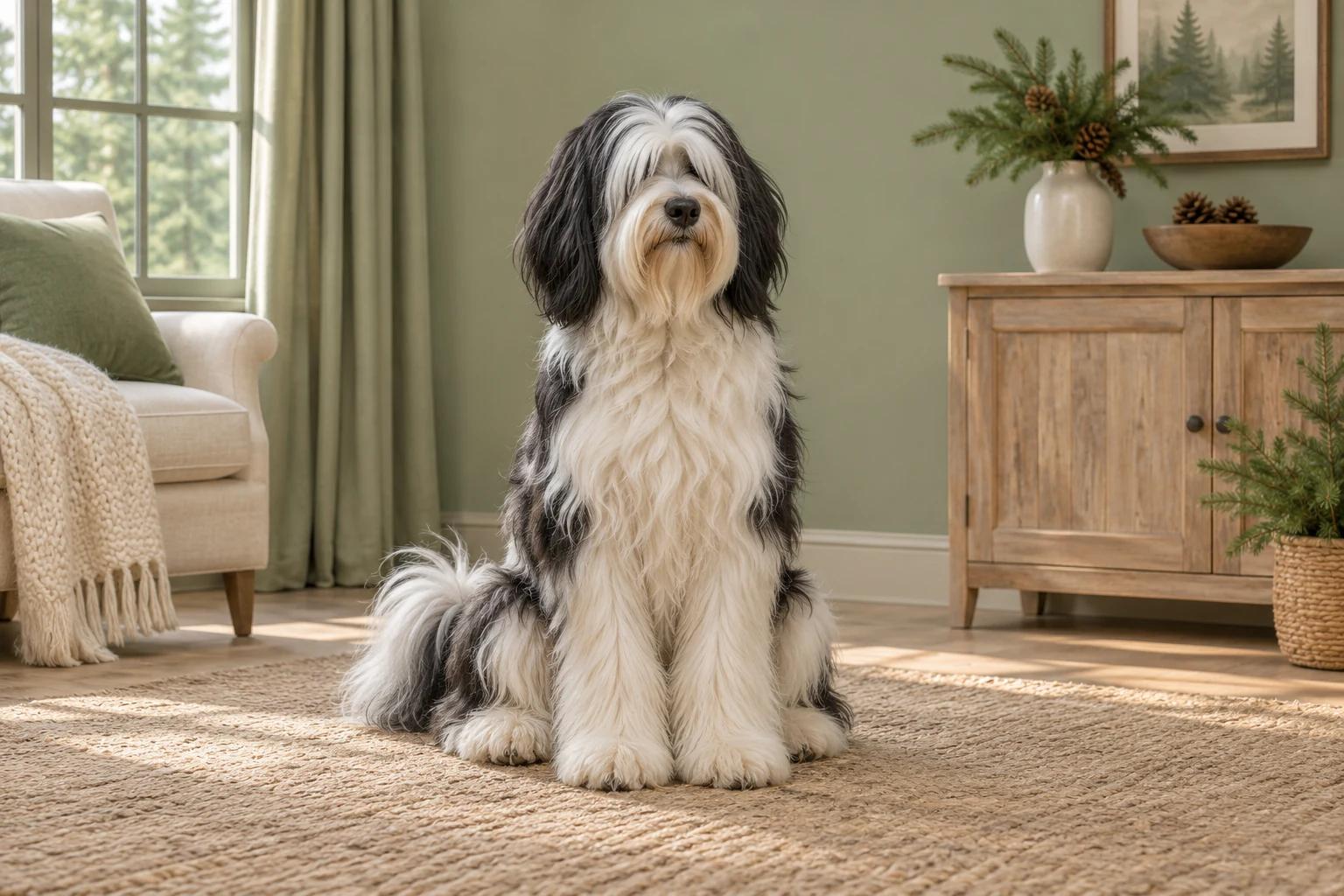
Tibetan Terrier temperament is easier to understand when you look at companionship, activity and learning together. The current Tibetan Terrier profile describes a loyal, affectionate and sensitive dog, with a daily place for physical activity and mental engagement. That combination matters more than the shaggy appearance. A dog can be deeply involved in family life without being a passive accessory to it, and a pleasant afternoon visit will not show every side of an individual.
Tibetan Terrier temperament includes an independent streak
The Tibetan Terrier Club of America describes playful dogs that often seem attuned to their owners' emotions. It also emphasizes individual differences: some dogs welcome new people enthusiastically, while others are more reserved. Close family bonds do not produce identical behavior in every setting. TTCA: Is a TT right for you?.
The club's discussion of independence is especially useful. A Tibetan may enjoy being petted at one moment and choose another activity at the next. That change does not cancel the relationship. It means companionship can include both shared attention and the dog's own interests.
For an owner, the practical distinction is between offering contact and requiring it continuously. A dog moving away from a cuddle has supplied information about that interaction; it has not delivered a verdict on the entire household.
Observe the individual in several ordinary circumstances. How does it rejoin familiar people after exploring? Does it initiate a game, settle nearby, or seek physical contact? Those different forms of participation reveal more than a single affectionate label.
Sensitivity does not rule out determination
In her club article about living with Tibetan Terriers, Andrea Reiman describes sensitivity alongside tenacity, mischief and inventive problem-solving. Her examples are observations of particular dogs, not a promise that every Tibetan will perform the same antics. TTCA: Tibetan Terriers at Home.
The important combination is that a dog may notice changes keenly while also persisting with an idea of its own. Calling it sensitive should not lead an owner to imagine an animal without initiative. Calling it determined should not become an excuse to ignore its emotional response.
Reiman also describes dogs that enjoy active outings yet spend quieter time beside their people. Those are different parts of the same day, rather than mutually exclusive breed identities. A Tibetan resting on a sofa has not thereby demonstrated that it has no interest in activity.
When meeting a prospective companion, look for the transitions between those states. The dog's behavior during a game, after the game and while people resume their own activities offers a fuller portrait than either an exciting demonstration or a sleepy photograph alone.
Cooperation can require patience
PDSA describes Tibetan Terriers as affectionate and generally interested in pleasing their owners, while allowing for a headstrong streak. Its guidance favors patient, reward-based training. PDSA Tibetan Terrier guide.
That is a helpful way to interpret the apparent contradiction between affection and an imperfect response to a request. Enjoying a person's company does not mean the dog automatically understands every instruction or chooses it over everything else happening nearby. A relationship and a learned behavior are related, but they are not interchangeable.
For Tibetan Terrier behavior, avoid making every missed response a judgment about character. Ask what has actually been taught and what the dog finds rewarding. A label such as headstrong describes an impression; it does not itself supply the next teaching step.
Patience also changes what a successful interaction looks like. It allows room for a dog to work out a task rather than requiring an instant performance to prove that it is cooperative. The aim is useful learning with this individual, not winning an argument about whether the breed should be easy.
Shared learning can become a hobby
VCA notes the Tibetan Terrier's enjoyment of working with familiar people and identifies agility, competitive obedience and rally obedience as possible performance activities. Its training description emphasizes consistency and a positive approach. VCA Tibetan Terrier guide.
These possibilities broaden the companion portrait. A Tibetan does not have to become a competitive dog for learning to be part of the relationship. Equally, an owner interested in a sport need not assume that the long coat confines the dog to being admired from a distance.
Choose an introduction that suits the individual's age, comfort and experience, with appropriate professional guidance. The breed's appearance on a list of potential activities is not permission to start difficult equipment or demanding sequences without preparation.
The useful question is what you and the dog enjoy doing together. Watching an introductory class can help you understand the human side of a discipline as well as the canine task. An activity is a better fit when the owner likes learning it too, rather than regarding training solely as something the dog must endure.
Read the everyday profile as several separate needs
The current breed profile places watchfulness above the middle of its scale, while vocal tendency sits in the middle. Those are not the same trait. Interest in what is happening around the home does not tell you exactly how frequently an individual will bark, or how it behaves after noticing a change.
The profile also describes substantial mental engagement. A walk and a lesson are different experiences: one may provide movement and outdoor interest, while the other asks the dog to solve a familiar task with a person. Considering both gives a more complete picture of the commitment than counting only time spent outside.
Tibetan Terrier personality should also be separated from compatibility promises. The current profile treats interactions with children and other dogs as individual matters. Neither a pleasant description nor a middle-scale reference guarantees that a particular pairing will work without supervision and thoughtful introductions.
Among Tibetan Terrier characteristics, the double coat adds another daily consideration. An owner is choosing a relationship that includes coat care, not just walks and play. The dog match quiz can help compare those commitments. The existing article about Tibetan Terrier feet covers a separate physical feature.
FAQ
Does the current profile describe a low-engagement companion?
No. It includes both physical activity and mental engagement in everyday life. Consider whether shared activity and learning genuinely fit your day, rather than making the choice only because you like the coat.
Is watchfulness the same as constant barking?
No. The current Tibetan Terrier profile treats watchfulness and vocal tendency separately. An individual dog's responses to ordinary events are more informative than assuming one trait automatically determines the other.
Does the breed description guarantee compatibility with another dog?
No. The current profile makes other-dog compatibility an individual question. Past experience, the particular dogs involved and the circumstances of their introductions all matter; a breed label does not settle the outcome.
Sources behind this article
- TTCA: Is a TT right for you? ↗
- TTCA: Tibetan Terriers at Home, Andrea Reiman ↗
- PDSA Tibetan Terrier guide ↗
- VCA Tibetan Terrier guide ↗
Article source checked: November 16, 2026. Source checked 2026-11-16
Keep reading

Airedale Terrier Temperament: What Everyday Life Can Feel Like
Read article →