Tibetan Spaniel vs Pekingese: Build and Everyday Care
Compare Tibetan Spaniel and Pekingese adult size, body shape, movement and practical care without mistaking similar weight for identical needs.
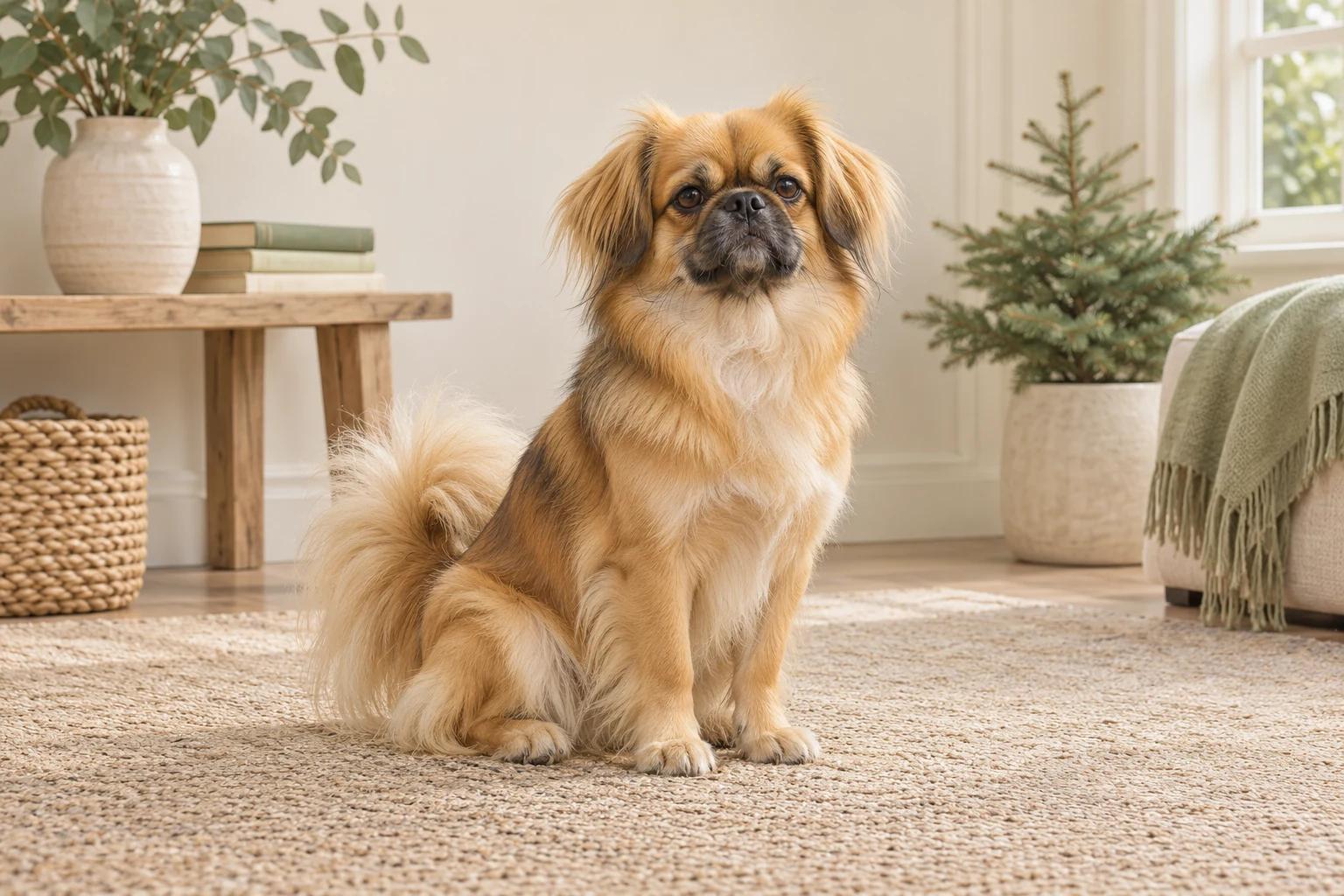
Tibetan Spaniel vs Pekingese is a useful comparison for someone seeking a small companion, but similar weight does not mean similar construction. The current Tibetan Spaniel profile and Pekingese profile describe overlapping adult weights alongside different heights and coat-care considerations. Look at the whole adult dog, not just a face framed by hair. The differences become clearer when body proportions, movement and daily handling are considered separately.
Tibetan Spaniel vs Pekingese: the Tibetan Spaniel outline
The Tibetan Spaniel standard describes a body slightly longer than tall, without being excessively long, low, leggy or square. It calls for moderate bone, a level back and good rib depth. The head is small relative to the body rather than oversized. AKC: Tibetan Spaniel standard.
Its muzzle has medium length, cushioning and a noticeable chin, without wrinkles. The eyes are oval and forward-facing; the pendant ears sit fairly high and may lift slightly from the skull. These details create a different expression from a broad, flat-faced portrait.
The coat lies relatively flat over the body, with longer furnishings at the ears, legs and tail. It should leave the outline recognizable rather than hiding the dog beneath a continuous mass of hair. Movement is described as quick, free and positive.
For a prospective owner, watch the dog walking as well as standing. The standard's balance is a relationship among the head, body and limbs, not a single feature to maximize. A close-up of a luxurious tail or an expressive face cannot show the complete structure or how the dog carries it in motion.
The Pekingese has a low, front-heavy construction
The Pekingese standard describes a compact, muscular body that is heavier in front and lighter behind. Its outline is longer and lower, with a broad chest, short forelegs and a narrower waist. The head is large relative to the body. AKC: Pekingese standard.
The face is flat in profile, with a broad skull and lower jaw. The over-nose wrinkle must not crowd the eyes or cover the nose. The standard also calls for open nostrils rather than pinched ones. These are descriptions of construction, not reasons to seek a more exaggerated face.
Its characteristic rolling movement comes from the combination of chest, shoulders, bowed forelegs and lighter rear. The desired motion is smooth, not bouncing or jarring. Watching several strides is more informative than assuming that any unusual movement is normal because of the breed name.
The outer coat is long and coarse, with a soft undercoat and substantial fringes. Although the coat contributes to the silhouette, the body should remain identifiable. A photograph showing mostly hair makes comparison harder; it does not prove the dog underneath has more substance.
Pekingese care includes areas hidden by the coat
VCA highlights more than brushing in its Pekingese care guidance. It identifies the facial wrinkle and the hair around the rear as areas needing regular attention, and describes reward-based teaching with food as preferable to forceful methods. VCA: Pekingese breed guide.
That combination matters in everyday life. A small dog still needs to participate comfortably in care. Being physically easy to lift does not make repeated restraint the best way to manage a routine. Ask the caregiver to demonstrate what the particular dog already accepts rather than discovering its objections after bringing it home.
VCA also warns about overheating and advises against overly vigorous exercise for this breed. Do not choose a Pekingese as a miniature version of a more athletic dog and then expect the same pace. Discuss suitable activity with the veterinary team, especially if the individual has difficulty during outings.
The practical comparison is not “small dog versus small dog.” It is a particular body, face and coat, with the care those features involve. A manageable adult weight does not remove the need to understand those details before making a decision.
Compare the current adult figures carefully
For a Pekingese vs Tibetan Spaniel weight comparison, current Tibetan Spaniel males and females are both listed at 9–15 pounds. Current Pekingese females are listed at 7–12 pounds and males at 7–11 pounds. The reference heights are 10 inches for the Tibetan Spaniel and 6–9 inches for the Pekingese.
These figures support a taller Tibetan Spaniel reference, but they do not establish that every Tibetan Spaniel outweighs every Pekingese. Their weight ranges overlap. A lighter Tibetan Spaniel and a heavier Pekingese can be close in weight while presenting noticeably different outlines.
Keep the male and female Pekingese figures attached to their labels instead of combining them into a supposed universal adult prediction. For an individual adult, actual measurements are more informative than selecting the middle of a breed range. For a puppy, the range provides context, not a promise about the eventual number on the scale.
Height and weight also answer different questions. The taller dog need not be the heavier of two individuals. Nor does a shorter dog necessarily take up proportionally less space when lying down. A single number cannot replace a view of the whole animal.
What their current care profiles have in common
Both profiles describe moderate shedding and a double coat. Neither should be chosen on the assumption that a small body leaves no loose hair. Both need an established coat routine tailored to the individual dog.
The profiles also place physical activity, mental engagement and training responsiveness in the middle of their respective scales. That shared pattern does not mean identical routines. It means neither profile supports choosing solely on the assumption that one dog will require no teaching or meaningful activity.
A useful difference between Tibetan Spaniel and Pekingese is therefore the combination of size, construction and care rather than a claim that one is universally easier. Consider which actual routine you would enjoy carrying out, and meet an adult whose daily life can be described in concrete terms.
If you are deciding on a Tibetan Spaniel or Pekingese, use the dog quiz to consider the wider commitment. The separate Tibetan Spaniel classification article explains the breed-name question without replacing an individual assessment.
Frequently asked questions
Is every Tibetan Spaniel heavier than a Pekingese?
No. The current weight ranges overlap. Tibetan Spaniels are listed at 9–15 pounds for both sexes, while Pekingese females are 7–12 pounds and males 7–11 pounds.
Which has the taller current height reference?
The Tibetan Spaniel reference is 10 inches, compared with 6–9 inches for the Pekingese. These are breed references, not a measurement of every individual adult.
Is either breed a no-shedding option?
No. Both current profiles describe moderate shedding. Their small size does not eliminate loose hair or the need for coat care.
Sources behind this article
Article source checked: November 16, 2026. Source checked 2026-11-16
Keep reading

Affenpinscher vs Brussels Griffon: Everyday Differences
Read article →