Tibetan Spaniel Temperament: Playful and Independent
Understand Tibetan Spaniel temperament through independence, sensitivity, observation and play, without confusing small size with simple needs.
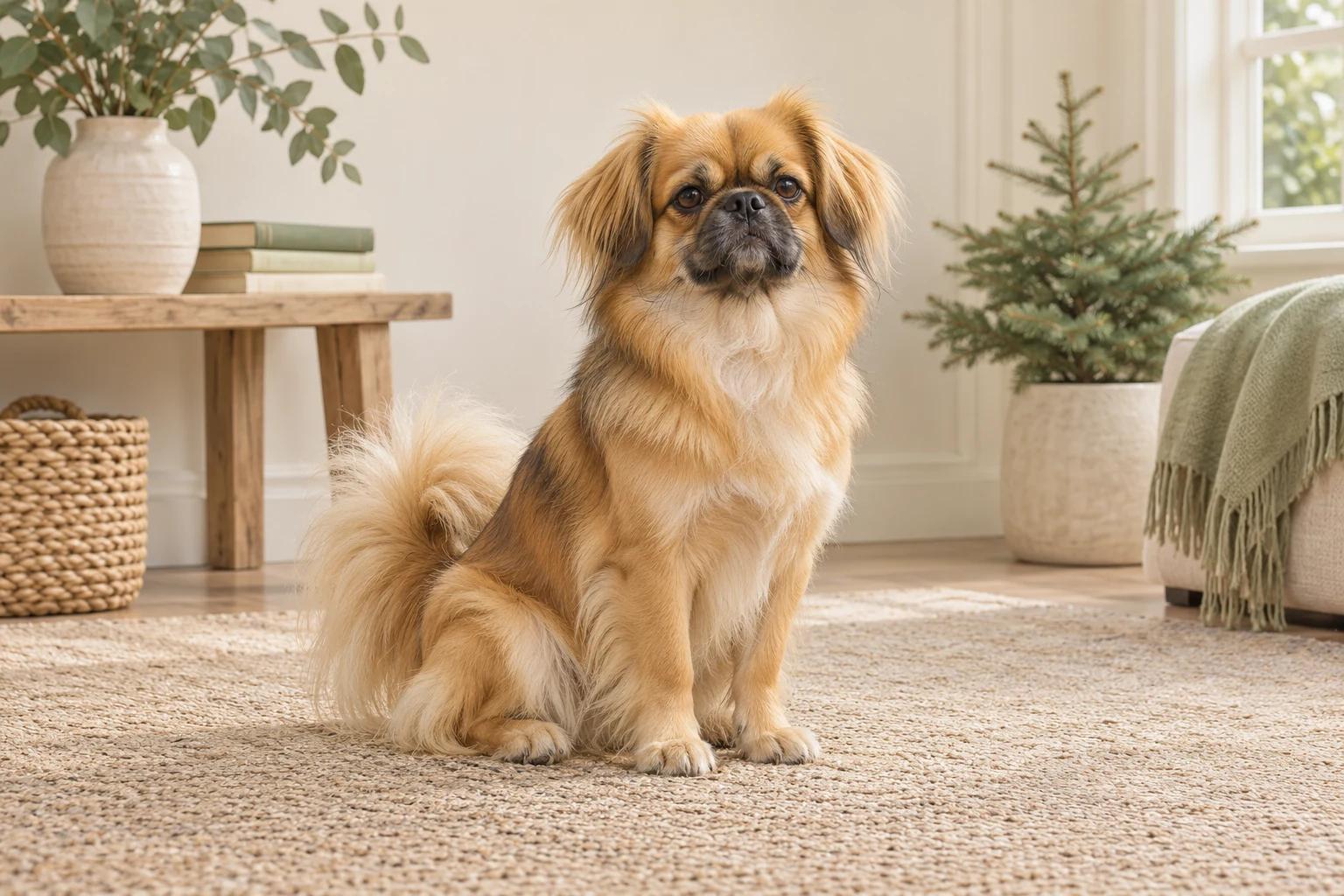
Tibetan Spaniel temperament deserves more than a verdict from a photograph. The current Tibetan Spaniel profile describes a playful, bright and self-confident companion. Those descriptions invite a closer look at the actual dog: what it notices, what it enjoys and how it responds during ordinary interactions. A small adult body does not provide a complete behavioral picture.
Tibetan Spaniel temperament includes interest in a good viewpoint
The American parent club describes Tibetan Spaniels choosing elevated places from which to observe their surroundings. It also depicts a companion that enjoys being near familiar people, whether they are active or relaxing. Tibetan Spaniel Club of America: about the breed.
A dog watching from a favored place is not necessarily asking for a game. Observation can be part of how it occupies itself. That helps explain why a quiet-looking Tibbie may still be paying close attention to what changes around the home.
The club also describes sensitivity to people's moods. This is not mind-reading, and it should not become an expectation that the dog manage a person's feelings. It is a reason to notice how the atmosphere of an interaction affects the individual animal.
For an owner, the useful portrait is of company that includes both participation and observation. Sharing space does not have to mean constant handling. Ask what the particular dog does during a relaxed evening as well as during an outing. Notice the ways the dog chooses to participate.
A small dog still has preferences about an approach
The British breed association notes that a Tibetan Spaniel may avoid looking directly at an unfamiliar observer and may dislike a person swooping down toward it. It also describes curiosity about household activity and an inclination to select soft places to sit. Tibetan Spaniel Association: about the breed.
Those details make the dog's scale relevant without turning smallness into helplessness. A person bending rapidly over a Tibbie is creating a different experience from standing at a comfortable distance. Do not interpret the absence of direct eye contact as a requirement to move closer and obtain it.
The association's description of individuality also challenges the idea that ownership should be based on domination. Cooperation is not the same as having every preference overridden. A dog choosing a resting place or investigating household activity is showing you what matters to it at that moment.
For Tibetan Spaniel behavior, look at the interaction itself rather than assigning a sweeping label such as “difficult.” Was the dog approached suddenly? Was it resting? Did the person expect a response that had never been taught? The context can be more informative than the label.
Sensitivity and assertiveness can occur together
VCA describes a Tibetan Spaniel as independent and capable of being assertive, yet sensitive to scolding or raised voices. Its training guidance favors a gentle approach rather than treating the dog's determination as a reason for harshness. VCA: Tibetan Spaniel breed guide.
This combination is important. A dog that strongly prefers one course of action is not necessarily emotionally robust when confronted. Loud correction does not become helpful merely because someone has described the breed as stubborn.
For a prospective owner, ask how the individual responds when an activity changes or a familiar person interrupts it. Useful answers describe actual behavior and what helps the dog understand the next step. They do not simply claim that the dog needs a more forceful personality in charge.
The same distinction applies to learning. A Tibbie that has not responded may lack understanding, motivation or comfort in that situation. The appearance of confidence does not establish which explanation is correct. Clear, gentle teaching is a more constructive starting point than turning a missed response into a contest. An individual whose behavior changes unexpectedly should be discussed with the veterinarian rather than dismissed as displaying a breed trait.
Playfulness does not mean constant high intensity
The current profile gives playfulness a relatively strong reference while placing physical activity and mental engagement in the middle of their scales. That is a useful distinction within Tibetan Spaniel personality. Interest in a game does not automatically mean a demand for strenuous exercise, and a moderate activity reference does not mean that the dog has little interest in participating.
In a home visit, look at what the adult initiates. It might bring a toy, follow a familiar person's activity or choose to rest nearby. One brief interaction cannot establish a permanent personality ranking, but several ordinary examples can help you understand the individual better than a description based solely on appearance.
The current profile also describes daily learning games as part of the breed's routine. A playful companion still needs education: enjoyment and understanding are different things. Someone who wants only a dog to admire on a cushion would be overlooking the engagement described in the reference.
Watchfulness is not a request for confrontation
The current profile places watchfulness above the middle of the scale and vocal tendency in the middle. Those are separate traits. A Tibbie noticing activity outside is not necessarily barking throughout the day, and a dog that sometimes barks is not thereby demonstrating a desire to confront someone.
This matters when choosing a household companion. Do not encourage increasingly forceful responses simply because the dog is small and the display seems amusing. Consider what the individual does when a familiar routine is interrupted and whether you understand the situations that draw its attention.
Among Tibetan Spaniel characteristics, adult size is one of the easier facts to describe: the current reference is 9–15 pounds for males and females, with a height of 10 inches. Those figures do not predict a quieter personality, less need for teaching or a particular level of sociability. Physical compactness and behavioral simplicity are not the same thing.
The dog quiz can help place these tendencies alongside the rest of the commitment. The separate Tibetan Spaniel classification article explains the naming and classification question without substituting for getting to know an individual.
Frequently asked questions
Do males and females have different listed weight ranges?
The current profile gives both sexes the same adult reference of 9–15 pounds. That shared range describes size, not a claim that all males and females behave identically or have the same preferences.
Does a playful Tibbie need constant vigorous games?
No. The current profile distinguishes stronger playfulness from middle-range physical activity. Enjoying participation is not the same as needing every game to be intense or prolonged.
Does small size mean little personality or teaching is involved?
No. The current adult range is 9–15 pounds, but the behavioral profile includes playfulness, watchfulness and daily learning. Size alone does not establish how simple life with an individual dog will be.
Sources behind this article
- Tibetan Spaniel Club of America: about the breed ↗
- Tibetan Spaniel Association: about the breed ↗
- VCA: Tibetan Spaniel breed guide ↗
Article source checked: November 16, 2026. Source checked 2026-11-16
Keep reading

Airedale Terrier Temperament: What Everyday Life Can Feel Like
Read article →