Standard Schnauzer Temperament: Alert and Involved
Explore Standard Schnauzer temperament, watchfulness, family involvement and introductions, with useful guidance for understanding individual behavior.
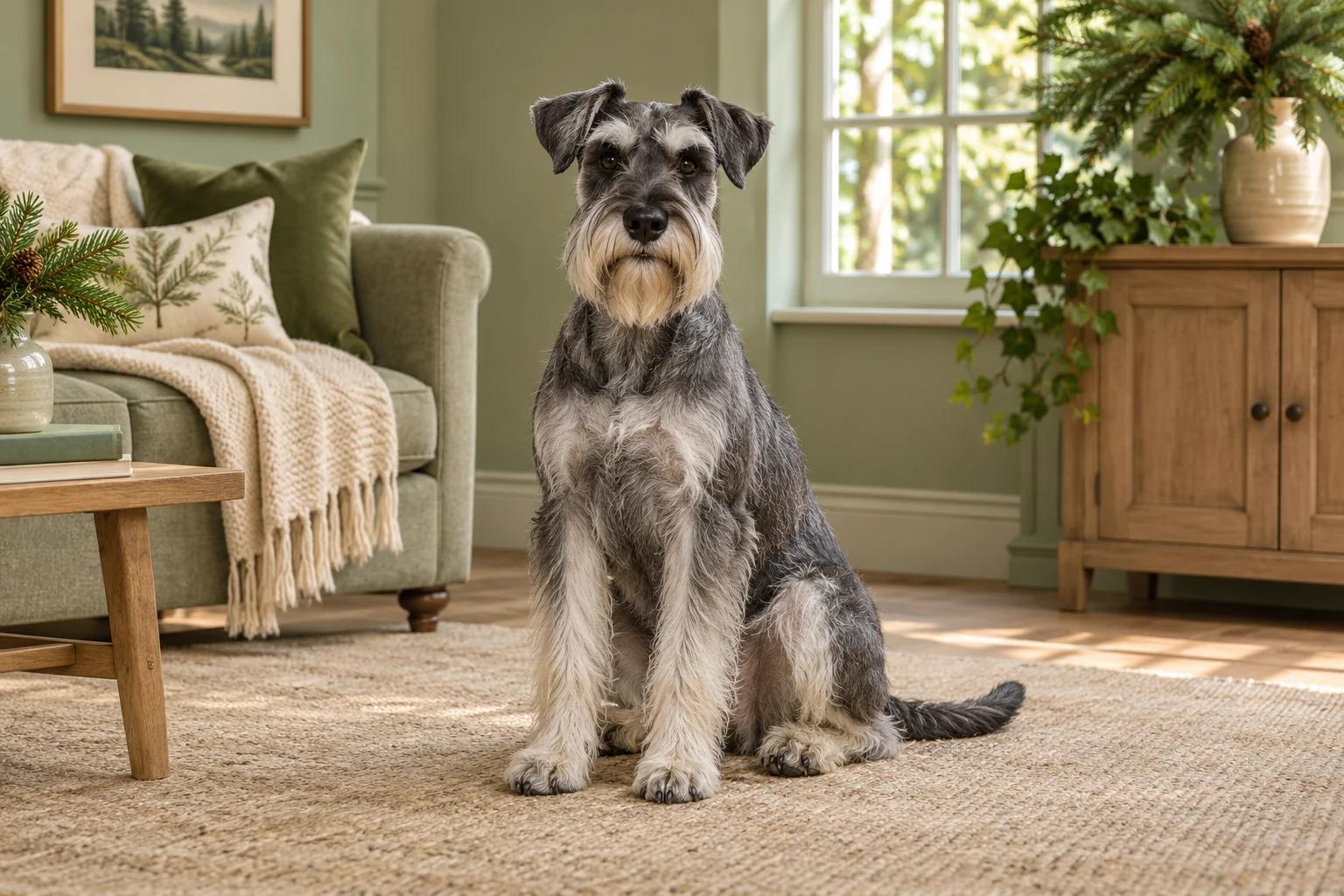
Standard schnauzer temperament is worth considering separately from the breed's distinctive appearance. The Standard Schnauzer profile describes strong family affection, substantial mental engagement and pronounced watchfulness. That combination can appeal to someone who wants an involved companion. It also means that a decision based mainly on coat or adult size overlooks important parts of daily life. The individual dog's experience still matters more than an imagined ideal personality.
Standard Schnauzer temperament: busy, observant and capable of learning
VCA describes the Standard Schnauzer as bold, watchful and busy, with a tendency toward reserve around unfamiliar people. Its account also notes that the dog can learn quickly yet lose interest quickly, and favors reward-based teaching using food or games. VCA: Standard Schnauzer.
This is not a contradiction. Learning an action and wanting to repeat it indefinitely are different things. A dog that notices much of what is happening around it may also find alternative activities when the lesson becomes uninteresting. Think about the value of the interaction rather than measuring intelligence by the number of identical repetitions completed.
VCA includes games and tricks among ways to provide mental work. For an owner, that means the relationship can involve more than issuing instructions during a walk. It also cautions against assuming that every unfamiliar dog will be a welcome companion. A lively learner is not automatically socially indiscriminate. Assess the actual dog instead of treating alertness, play and sociability as a single trait that rises or falls together. These distinctions help make sense of a multifaceted standard schnauzer personality.
Watchfulness needs an outlet other than constant window patrol
Dogs Trust explains that barking can become habitual when it appears to achieve a result. A dog may bark at a passerby, see the person move away and behave similarly next time, although the person was simply continuing along the street. Dogs Trust: barking causes and help.
For a watchful Schnauzer, consider what the environment allows it to rehearse. Covering the view, moving furniture away from a window or limiting access to a lookout can reduce repeated triggers. Reward quiet behavior and offer a familiar alternative before the dog is fully engaged in barking. Shouting does not explain what you want instead.
Do not assume that all vocal behavior has the same cause. Fear, excitement and a wish for attention can call for different responses. New or changed barking deserves veterinary attention, while persistent fear or difficult-to-manage reactions call for qualified behavioral help. The goal is not to erase communication. It is to understand what is happening and reduce the situations that keep the dog on duty. A watchful breed description is not an obligation to provide unrestricted access to every passing disturbance.
Let introductions include a genuine choice
Battersea recommends asking the owner before approaching, avoiding staring or looming, and giving the dog an opportunity to come closer rather than reaching toward it immediately. Stop if the dog turns away or looks tense. A calm, side-on approach is less imposing than a direct approach over the head. Battersea: approaching a dog.
For a Standard Schnauzer that takes time with unfamiliar people, this gives you something concrete to ask of a visitor. Permission from the owner does not mean the dog must immediately accept touch. Let the encounter remain optional.
If the dog comfortably seeks contact, keep the first interaction brief and then pause. A dog that leans back toward the person may want more; one that does not should be allowed to finish. Avoid restraining hugs or reaching over the head. Successful contact is not measured by how long someone can continue petting. It is an interaction the dog can comfortably enter and leave. This approach respects the individual rather than insisting that a family-affection reference must apply equally to a stranger.
Look at the whole body, not the facial hairstyle
The RSPCA's body-language guide distinguishes relaxed posture from lowered, tense or stiff positions. A dog that turns its head away, lowers its body or holds its ears back may be uncomfortable. Stiff forward weight, a tense face and exposed teeth require space, not a closer examination. RSPCA: understanding body language.
For this breed, do not let the familiar eyebrows become a substitute for observing movement and posture. A still photograph can make a dog look serious or comic without showing how it is responding to the situation. Notice whether its body is loose, where its weight is directed and whether it is moving toward or away from contact.
The guide also illustrates a play invitation with the front lowered and rear raised. Read that alongside the rest of the body and the unfolding interaction. One feature is not a complete emotional report. If behavior concerns you, start with your veterinarian and seek appropriate behavioral support rather than experimenting with closer contact to see what the dog will do. Understanding should reduce pressure, not create another test.
Family involvement and activity are different commitments
The profile's family-affection reference is 5/5, while activity is 3/5 and mental engagement is 5/5. These standard schnauzer characteristics do not describe a dog whose needs can be reduced to a single exercise score. Shared involvement and opportunities to use the mind remain important even when the physical-activity category is not at the top of the scale.
Openness to new people and vocal tendency each sit at 3/5, while watchfulness is 5/5. Those categories also differ: noticing the surroundings is not the same as always barking, and family affection is not a guarantee of identical responses to everyone.
Consider that full picture with the breed quiz. The Barn Hunt and Earthdog article addresses a separate activity question. Everyday standard schnauzer behavior should be understood on its own terms, not solely through the appeal of a sport or a recognizable silhouette.
Frequently asked questions
Does strong family affection mean identical interest in strangers?
No. The profile separates family affection, rated 5/5, from openness to new people, rated 3/5. These references cannot predict a particular dog's response to a particular visitor.
Is watchfulness the same as vocal tendency?
No. Watchfulness is 5/5 and vocal tendency 3/5 in the profile. A tendency to notice the surroundings is not a numerical promise about how often an individual will make noise.
Does a middle activity rating mean little mental engagement?
No. The profile lists activity at 3/5 but mental engagement at 5/5. These are separate aspects of ownership, so do not use one as a substitute for the other.
Sources behind this article
- VCA: Standard Schnauzer ↗
- Dogs Trust: barking causes and help ↗
- Battersea: approaching a dog ↗
- RSPCA: understanding body language ↗
Article source checked: November 16, 2026. Source checked 2026-11-16
Keep reading

Airedale Terrier Temperament: What Everyday Life Can Feel Like
Read article →