Staffordshire Bull Terrier vs American Bulldog
Compare Staffordshire Bull Terrier and American Bulldog build, adult weight, breed history, activity and coat-care references before choosing.
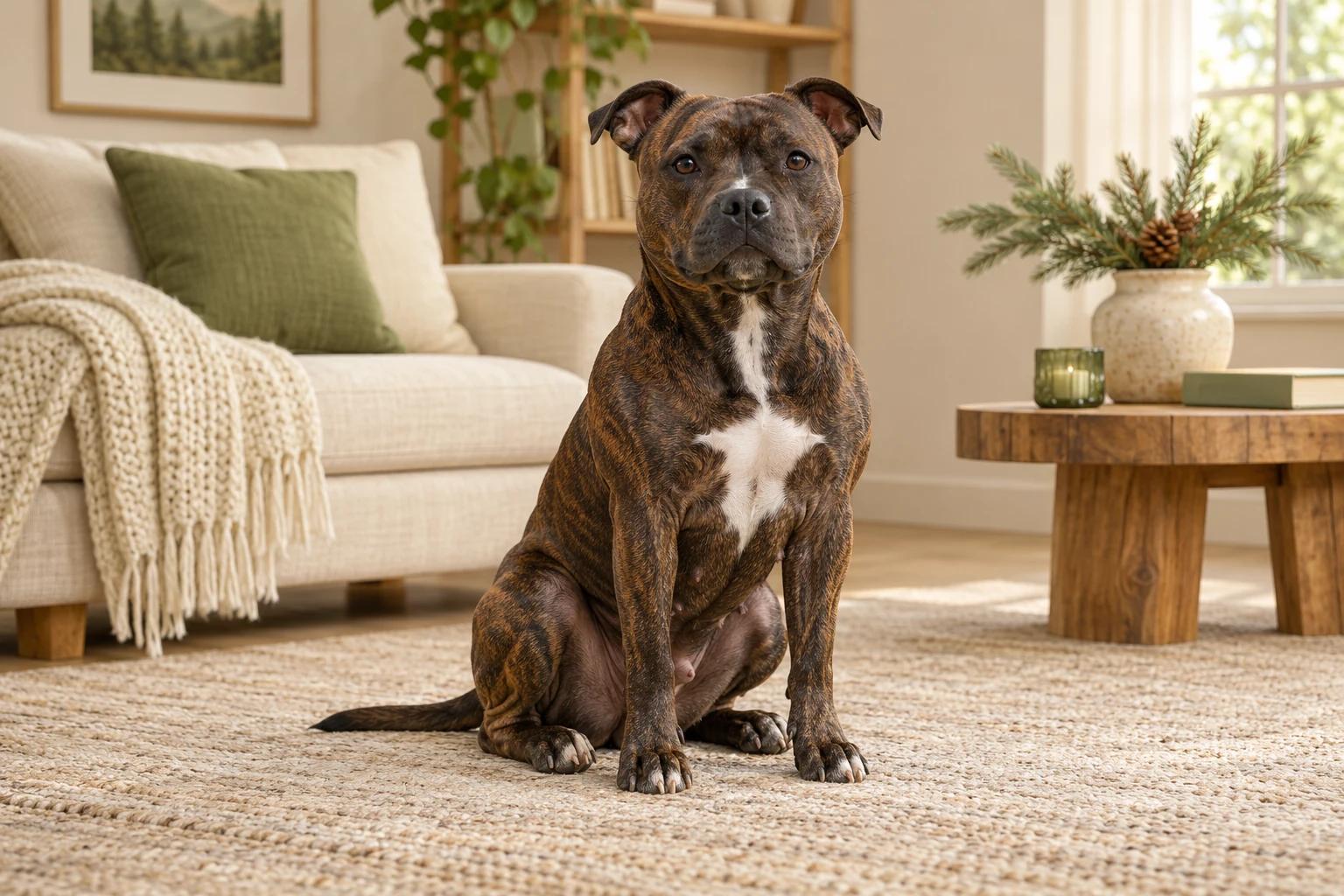
Explore the
Staffordshire Bull Terrier
Background, care, and everyday considerations.
View breed profile →Staffordshire bull terrier vs american bulldog is not a comparison between two names for the same dog. The Staffordshire Bull Terrier profile and American Bulldog profile describe different adult sizes, backgrounds and care tendencies. Both have smooth coats, but that shared feature says little about the full commitment. Start with their actual proportions and current reference profiles rather than treating a broad head as a complete description.
Staffordshire Bull Terrier vs American Bulldog: the Stafford's build
The Staffordshire Bull Terrier's AKC standard emphasizes strength in a muscular dog that should remain active and agile. It describes a short, deep head, broad skull and pronounced cheek muscles. The muzzle is short, the lips close-fitting, and the ears are rose-shaped or partly pricked. AKC: Staffordshire Bull Terrier standard.
The short muscular neck widens toward the shoulders. A close-coupled body, level topline, broad front and well-sprung ribs contribute to the recognizable outline. Its medium-length tail is set low and tapers, rather than curling tightly over the back. The short coat lies close to the skin.
Movement matters as much as a still photograph: the standard calls for free, powerful, agile movement with economical effort. A wider-looking chest or more exaggerated head is not automatically an improvement on that complete picture. When learning to recognize the breed, consider head, body, limbs and movement together. Looking only at the amount of visible muscle misses the standard's emphasis on a functional, coordinated dog.
American Bulldog type includes meaningful variation
The UKC standard describes a powerful, athletic dog whose body is slightly longer than tall. It explains the distinction between the generally sleeker Scott or standard type and the bulkier Johnson or bully type, while noting that many dogs combine those lines. Type labels therefore help explain variation; they are not separate promises about every individual. UKC: American Bulldog standard.
The head is large and broad, with prominent cheeks and a broad muzzle. The standard type generally has a longer muzzle and less pronounced stop than the bully type. Natural ears can have several forms. The body has a deep chest, strong back and muscular hindquarters, with a short, close coat.
UKC's account connects this build with all-purpose farm work in the American South. The desired outline is not simply maximum bulk: the standard repeatedly values working ability and discourages exaggeration. Ask what a type label means in the particular dog's background instead of assuming that two American Bulldogs must have identical proportions because their registration names match.
The Stafford has its own historical identity
The Staffordshire Bull Terrier Club of America traces the breed through British Bulldog-and-terrier crosses. Its account places that development in the context of historical blood sports, not modern household suitability. Different groups of fanciers later developed distinguishable Bull and Terrier types. SBTCA: breed history.
The club describes the separate path of the white Bull Terrier associated with James Hinks and the Stafford maintained by working-class enthusiasts. In 1935, Stafford fanciers in England formed a club and drew up a standard. That history helps explain why several familiar bull-breed names are not interchangeable.
It does not tell you whether an individual will enjoy your home, learn a particular task quickly or welcome every visitor. Historical purpose and present behavior are different kinds of information. Use the background to identify the breed accurately, then assess current needs and the actual dog. The practical answer to choosing a staffordshire bull terrier or american bulldog should not rest on a dramatic origin story alone.
The size difference is substantial
Current profile references put the Staffordshire Bull Terrier at 24–38 lb: females 24–34 lb and males 28–38 lb. The American Bulldog reference is 60–100 lb: females 60–80 lb and males 75–100 lb. These intervals do not overlap. The American Bulldog occupies a distinctly larger adult weight category, not merely the upper end of the Stafford's range.
That is a major difference between staffordshire bull terrier and american bulldog for an owner thinking about ordinary handling. An American Bulldog at the lower reference weight still outweighs a Stafford at the upper reference weight by 22 lb. This comparison describes the published intervals, not a prediction that every adult will sit neatly inside them.
Do not choose a puppy by asking which one looks more substantial in a photograph. Adult references give a clearer starting point, and neither breed's upper weight is a target to pursue through feeding. For an actual dog, discuss body condition and development with its veterinarian.
Smaller does not mean a lower activity commitment
The Stafford profile rates activity 5/5 and playfulness 4/5; the American Bulldog profile lists activity 3/5 and playfulness 2/5. These references make a useful distinction: the smaller breed is not presented as the lower-activity option. Weight and activity are separate questions.
Training responsiveness is high in both profiles, at 5/5 for the Stafford and 4/5 for the American Bulldog. That is not a guarantee of instant obedience. Grooming frequency is 2/5 for both. That shared reference does not mean identical experience with loose hair in every home. Ask about the actual dog’s coat routine rather than choosing between these breeds on a shedding ranking.
Use the breed quiz to consider these demands together. The Staffy dog-park article covers a separate decision about group outings. This american bulldog vs staffordshire bull terrier comparison is about the broader breed choice, not selecting an outing for a particular dog.
Frequently asked questions
Is the American Bulldog just a bigger Staffordshire Bull Terrier?
No. The profiles identify separate breeds with different origins and adult references. The American Bulldog's 60–100 lb interval is substantially above the Staffordshire Bull Terrier's 24–38 lb interval.
Which profile describes more activity?
The Staffordshire Bull Terrier has the higher activity reference, 5/5 compared with 3/5 for the American Bulldog. These describe breed tendencies, not measured requirements for every individual.
Do both smooth coats have identical care ratings?
Both profiles give grooming frequency 2/5, but that is only one part of coat care. Similar appearance does not establish an identical cleaning routine or the amount of hair an individual will leave behind.
Sources behind this article
Article source checked: November 16, 2026. Source checked 2026-11-16
Keep reading

Affenpinscher vs Brussels Griffon: Everyday Differences
Read article →