Stabyhoun vs Wetterhoun: Build, Character and Care
Compare Stabyhoun and Wetterhoun size, physical outlines, independent character and coat care to understand these two distinctive Dutch breeds.
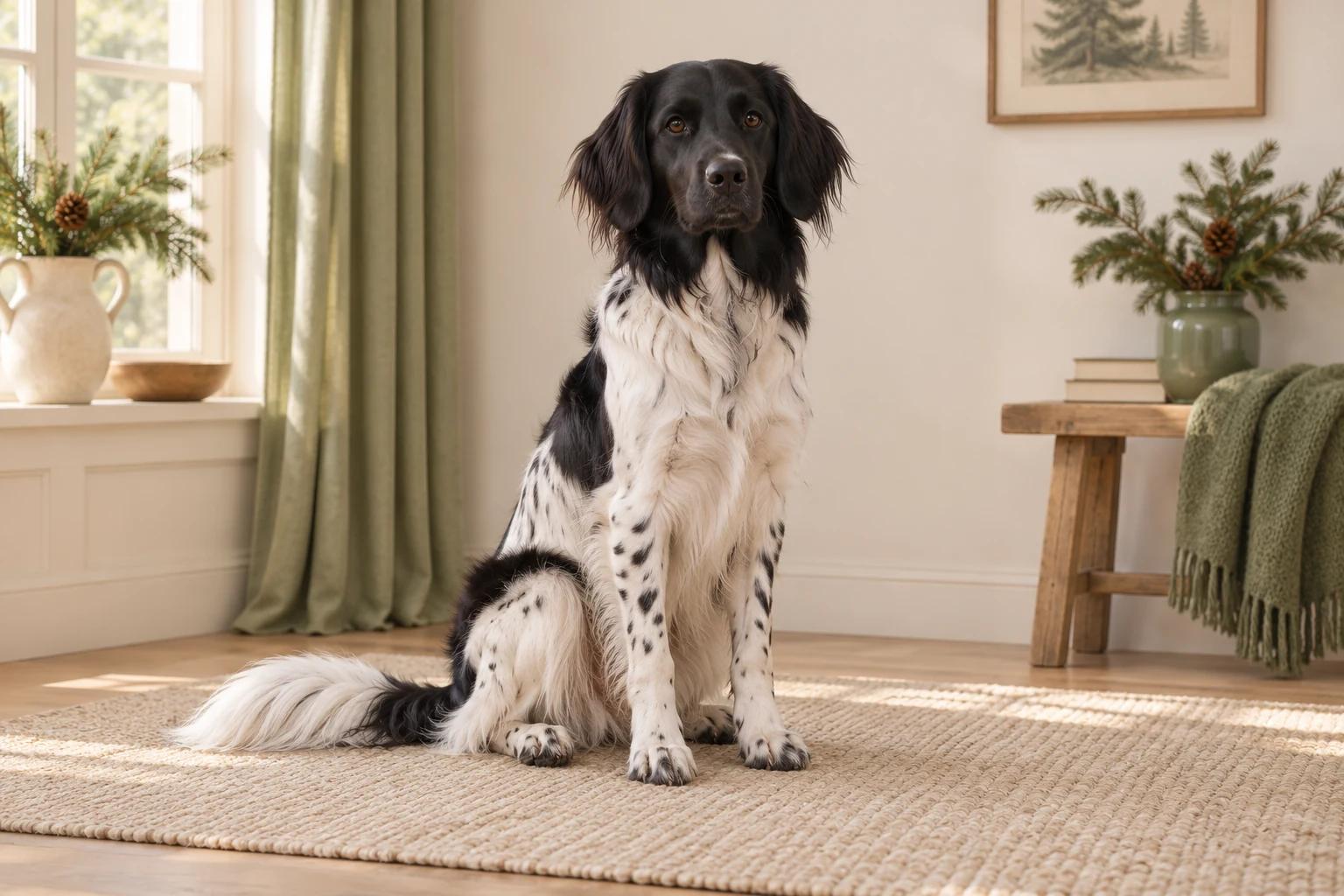
Stabyhoun vs wetterhoun is a comparison between two Dutch breeds with different adult size references and individual ownership considerations. Start with the Stabyhoun profile and Wetterhoun profile, then look beyond a similar black-and-white photograph. Neither a shared country of origin nor a familiar color pattern makes two breeds interchangeable.
Stabyhoun vs Wetterhoun: the Staby's outline
The Stabijhoun's FCI standard describes a body slightly longer than tall, a head longer than wide and a muzzle approximately equal in length to the backskull. Its tail is bushy and normally carried down, lifting during movement without forming a spiral over the back. This is a functional pointing-dog outline, neither excessively heavy nor fine. Those proportions help identify the breed more accurately than color alone. FCI: Stabijhoun standard.
The Wetterhoun is square and distinctly curled
The Wetterhoun's FCI standard describes a square, compact body, a short powerful neck and a tail rolled into a spiral over or beside the croup. The broad chest has more emphasis on width than depth. Its skull is slightly longer than the muzzle, and the upper head lines are parallel. These features produce a different overall outline rather than simply a heavier version of its Frisian neighbor. FCI: Wetterhoun standard.
The body coat forms firm curls in bundles, with shorter hair on the head and legs. The standard describes a coarse, somewhat greasy texture. That is a specific coat structure, not a statement that all curly dogs need the same grooming technique.
In temperament, the standard combines independence, family affection and watchfulness, with possible initial reserve toward strangers. These are breed ideals, not predictions about a particular greeting. A reserved response is not proof that the dog dislikes people, while family affection does not establish comfort with every unfamiliar visitor or animal.
A Stabyhoun needs motivation, not a 'stubborn' label
The UK Stabyhoun Association describes a dog with initiative and an independent working outlook. It recommends reward-based teaching and points out that sensitivity can coexist with determination. A dog may be capable of learning while still needing a thoughtful introduction to an unfamiliar situation. Stabyhoun UK: breed questions.
That matters if your comparison starts with the expectation that a Staby will simply follow instructions because it looks like another familiar gundog. The club warns against assuming that an approach suited to a previous dog will transfer unchanged. Think about how the individual responds, not how quickly you believe a breed ought to comply.
The association also notes variation in barking, including vocal reactions to things that worry a dog. If unfamiliar situations become difficult, seek positive-reinforcement training support rather than interpreting every noisy response as defiance. Choosing a stabyhoun or wetterhoun should involve interest in teaching the dog you actually meet, not a plan to force it into a borrowed personality template.
The Wetterhoun's care is not a generic curl routine
The Dutch Kennel Club describes the Wetterhoun as persistent and responsive to patient, respectful handling. It values outdoor time and long walks, but does not become an unquestioning follower merely because it has learned some obedience. That account is useful context for an owner who enjoys cooperation without expecting identical enthusiasm for every request. Dutch Kennel Club: Wetterhoun.
The same guidance advises restrained coat maintenance rather than frequent shampooing, and notes seasonal shedding. Do not assume that a curly coat means no loose hair or that the best care is to wash and comb it as frequently as possible. Ask someone experienced with this breed to demonstrate appropriate maintenance on the individual dog.
For the comparison, the important point is that coat texture and grooming frequency are separate questions. An appealing curl does not tell you which tools to use, and a simple-looking routine is not permission to ignore the skin beneath it. Care should suit the coat rather than a fashion borrowed from a different curly breed.
Compare adult size without inventing a ranking of individuals
The current Stabyhoun profile lists 40–60 lb, with females 40–51 lb and males 49–60 lb. Its height reference is 19–21 in. The Wetterhoun profile lists 50–75 lb, with height references of 23 in for males and 21.5 in for females. On those references, the Wetterhoun generally occupies the larger size category, but the weight intervals overlap.
This is a concrete difference between stabyhoun and wetterhoun that can easily be lost in photographs. A close-up Staby may appear larger than a Wetterhoun photographed farther away. Compare adult measurements rather than the amount of the picture filled by the dog, and do not treat the upper end of either interval as a desirable target for a puppy.
The Stabyhoun's profile gives high references for training responsiveness, activity and mental engagement. Those values help describe its ownership demands, but are not a comparative scorecard proving that one of these breeds is easier. For a meaningful choice, connect the breed information with the actual adult's experience and behavior, rather than assigning a winner to each photograph.
Choose the dog, not the rarity story
If a wetterhoun vs stabyhoun search began with interest in an unusual breed, make sure the attraction extends to daily life. For the Staby, the profile's strong family-affection reference sits alongside substantial activity and mental engagement. Admiring an uncommon name is not the same as wanting those commitments.
Use the breed quiz to examine that wider fit. The existing Stabyhoun population-context article addresses a separate historical question; it should not determine which individual dog suits you.
Frequently asked questions
Is a Wetterhoun always heavier than a Stabyhoun?
No. The current reference intervals overlap: 50–75 lb for the Wetterhoun and 40–60 lb for the Stabyhoun. Breed-level ranges cannot establish which of two particular adults is heavier.
Are black-and-white dogs of these breeds the same size?
Color does not determine adult dimensions. Compare the individual measurements with the appropriate breed profile instead of using a shared pattern as a size guide.
Does the Stabyhoun's high training rating remove its activity commitment?
No. Training responsiveness, activity and mental engagement are separate profile categories. A favorable learning reference does not mean an owner can omit opportunities for activity and interaction.
Sources behind this article
- FCI: Stabijhoun standard ↗
- FCI: Wetterhoun standard ↗
- Stabyhoun UK: breed questions ↗
- Dutch Kennel Club: Wetterhoun ↗
Article source checked: November 16, 2026. Source checked 2026-11-16
Keep reading

Affenpinscher vs Brussels Griffon: Everyday Differences
Read article →