Small Munsterlander vs Brittany: Everyday Differences
Compare Small Munsterlander vs Brittany in build, coat, activity, companionship and learning to understand two distinctive sporting dogs.
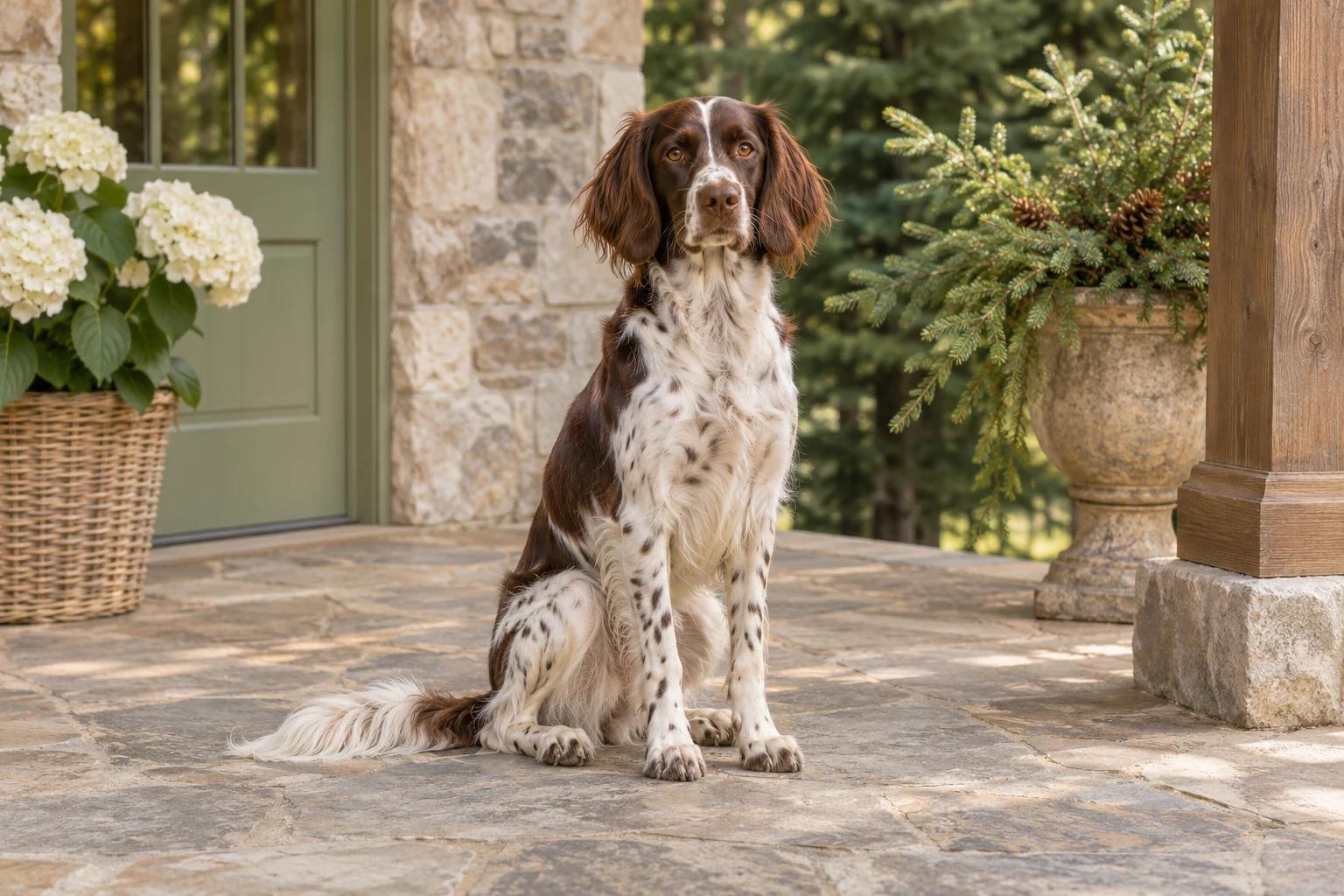
Small Munsterlander vs Brittany is a choice between two breeds for people who want to engage with their dog, not just admire it. The Small Munsterlander profile and Brittany profile both record strong responsiveness to training and substantial mental engagement. Their other tendencies, however, are not identical.
Small Munsterlander vs Brittany: the Munsterlander outline
The FCI description gives the Small Munsterlander a body slightly longer than its shoulder height. Its outline includes feathered forelegs, fuller hair behind the hindlegs and a flagged tail. The coat lies close and is straight or only slightly waved, rather than so abundant that it hides the body.
Look at the whole silhouette, not simply the colored patches. The intended impression is a balanced working dog whose shape remains visible beneath its furnishings. Coat length should not become the only feature you notice.
The Brittany's more square impression
The AKC Brittany standard describes a compact, leggy dog, with body length approximately matching shoulder height. Its back is short and straight, and the chest reaches down toward the elbows without becoming excessively broad. This makes the outline a useful distinction when comparing Brittany vs Small Munsterlander.
The Brittany's ears are short and triangular, carried close to the head with relatively little fringe. Its coat may be flat or wavy, but not curly, and excessive feathering is not the intended presentation. A luxuriant coat is therefore not a reliable measure of breed quality.
Movement adds information that a posed portrait misses. The standard emphasizes an efficient, ground-covering side gait. Look at the dog moving naturally as well as standing, without trying to diagnose soundness from a casual viewing. A photograph can make a dog seem longer, shorter or lower depending on its stance and the camera angle. The most useful comparison concerns the entire outline rather than one attractive headshot or an unusually dramatic action picture.
Brittany play and everyday teaching
VCA's Brittany overview describes a playful dog that responds to praise and food motivation. This gives a practical starting point for someone who enjoys interactive lessons, rather than expecting activity to consist entirely of independent running.
Think about what you enjoy doing with a dog. Someone delighted by a willing play partner may appreciate this side of the Brittany; someone wanting a largely passive presence should examine that expectation carefully. Enjoying the breed's enthusiasm is different from merely tolerating it until a walk is over.
VCA also points out the need to remove loose hair and debris collected during outings. Brush through the coat after time in vegetation rather than assuming its relatively restrained furnishings cannot pick anything up. The working dog in the photograph eventually comes home, and routine care is part of that picture too. None of this makes an individual Brittany automatically sociable in every encounter or ready for every sport. Its existing experiences and the activities it actually enjoys still matter when choosing a companion.
The Munsterlander's changing search
The Small Munsterlander Club of America describes a versatile dog that adjusts its search to the cover, ranging differently in open ground and dense vegetation. That is a more informative working distinction than calling every sporting dog a retriever.
For a prospective owner, the important question is whether you are interested in the dog's actual style of engagement. Watching an experienced handler and dog together can reveal how an activity works. It is not proof that an untrained youngster already has the same practiced partnership.
Compare activity without inventing a daily quota
A clear difference between Small Munsterlander and Brittany appears in the Atlas activity ratings: four out of five for the Munsterlander and five for the Brittany. Both have mental engagement rated four. The distinction is relative, not an instruction to walk one dog a fixed number of minutes longer than the other.
If your preferred leisure time is active, ask yourself which parts you want to share. A person who likes going out but dislikes teaching may find that both profiles ask for more involvement than expected. Conversely, someone who enjoys learning with a dog should not assume that satisfying the mental side automatically answers the activity question.
Playfulness is rated three for the Munsterlander and four for the Brittany. This can help frame what you hope for, but it does not tell you which particular dog will love a ball, a toy or a specific game. Shared enjoyment is more useful than insisting that either animal reproduce a breed stereotype.
Companionship, voice and coat work
The Munsterlander's family-affection rating is higher in the Atlas references, while the Brittany's allows more room for a mix of social time and independence. Neither is a prediction of how long a dog can be left alone. For someone choosing Small Munsterlander or Brittany, this is a question about the kind of companionship they enjoy when present, not permission to omit care when absent.
Voice and coat work also deserve separate consideration. The Munsterlander has a lower recorded vocal tendency and grooming-frequency rating; the Brittany sits in the middle for both. Both have some shedding. Less frequent grooming does not mean no loose hair, and a lower voice rating does not mean silence.
Keep those differences distinct rather than combining them into an overall winner. A person who values a quieter tendency may weigh it differently from someone whose favorite aspect of dog ownership is playful interaction. Use the dog quiz to compare those preferences. The separate Munsterlander history article explores its development without turning historical dates into a compatibility test.
Frequently asked questions
Which breed has the higher activity rating?
The Brittany has the higher Atlas activity rating, although the Small Munsterlander is also toward the active end. Neither rating supplies an individual exercise prescription. Compare the whole activity-and-learning profile rather than treating one as a low-demand substitute for the other.
Which profile suggests less frequent grooming?
The Small Munsterlander has the lower grooming-frequency rating. Both profiles still record shedding. Choose with realistic expectations about coat care and household cleaning rather than assuming the word “lower” means the coat can be ignored.
Does either breed have a guaranteed advantage with other dogs?
No. The Brittany's other-dog rating is higher in the references, but a score does not assess a specific pair. The history and preferences of the dogs involved matter more than assuming either breed will accept every potential companion.
Sources behind this article
- FCI: Kleiner Munsterlander standard ↗
- AKC: Brittany standard ↗
- VCA: Brittany ↗
- Small Munsterlander Club of America: general characteristics ↗
Article source checked: November 16, 2026. Source checked 2026-11-16
Keep reading

Affenpinscher vs Brussels Griffon: Everyday Differences
Read article →