Sloughi vs Saluki: Appearance and Everyday Character
Compare Sloughi and Saluki appearance, company, learning and activity, with practical distinctions beyond a similar silhouette.
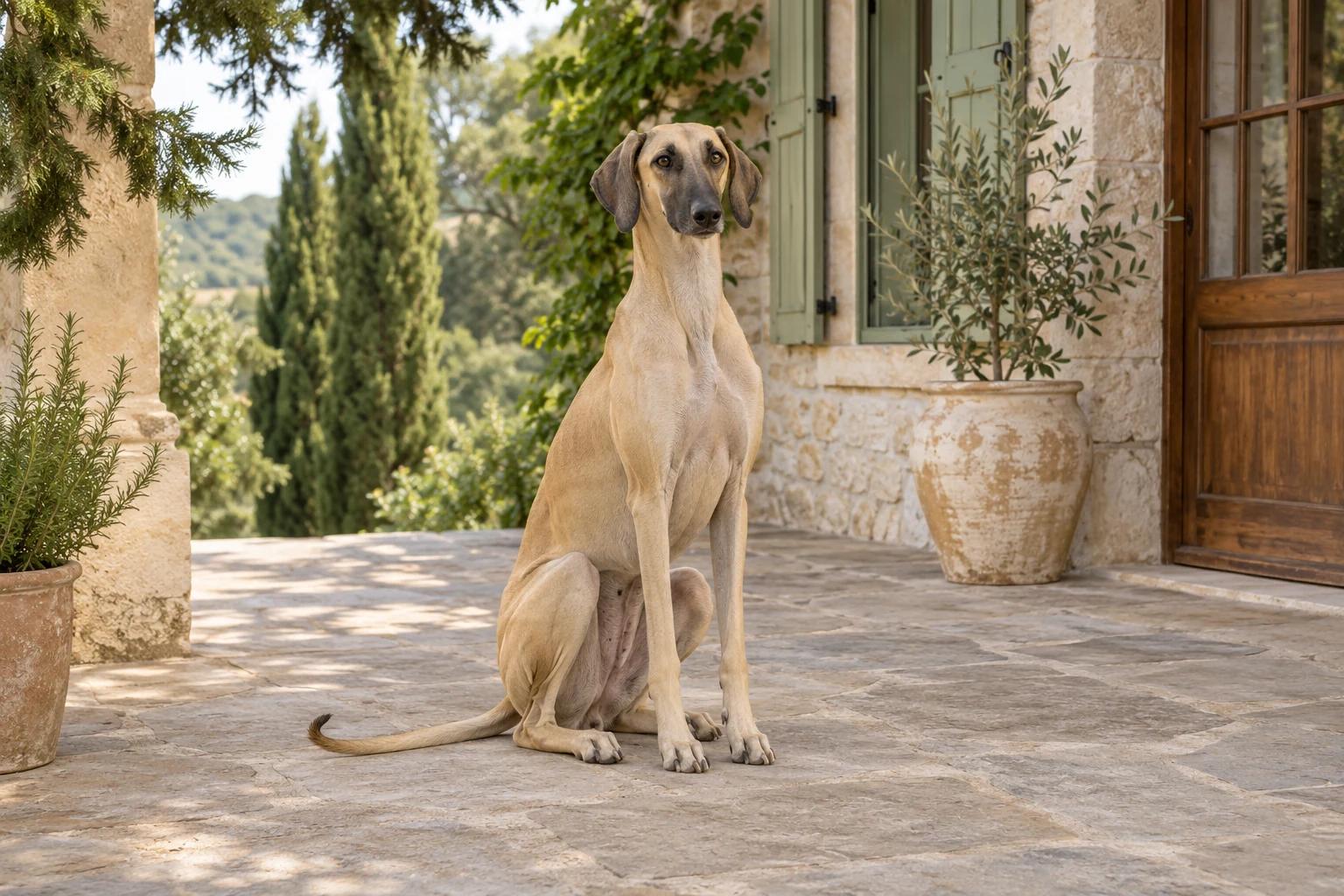
Sloughi vs Saluki is a comparison between two dogs that deserve more than the label “elegant hound.” The Sloughi profile and Saluki profile both place activity toward the higher end of the scale, but their mental-engagement and social reference points differ. Neither is simply a decorative alternative to the other.
Start with what you want to share with a dog: outdoor movement, learning, play and everyday company. Then examine the actual dog rather than expecting a breed name to answer every question. A useful comparison separates observable physical distinctions from tendencies that vary between individuals.
Sloughi vs Saluki: reading the Sloughi's head and movement
The AKC Sloughi standard describes a long, refined but substantial head, with a broad skull and a narrowing muzzle. The ears are triangular, with gently rounded tips, and hang close to the head. These features offer more useful identification clues than judging a photograph by apparent thinness alone.
Look at the feet as well: they are elongated and oval, with the middle toes longer than the outer ones. In motion, the desired trot is supple and covers ground through an extended stride. That is different from posing a dog with its legs stretched apart to exaggerate an outline.
A side photograph can obscure the width of the skull or the way the ears sit. Compare a relaxed front view with a walking video before drawing conclusions about appearance. This is observation, not a home substitute for assessing conformation. A pet's comfort and actual movement matter more than making every photograph resemble a show illustration.
What the Saluki standard adds to the comparison
The AKC Saluki standard describes a long, narrow head, large oval eyes and long ears. Feathered Salukis carry silky furnishings, particularly around the ears and tail. Smooth Salukis lack that feathering while otherwise following the same standard. Consequently, an unfeathered dog is not automatically a Sloughi.
Saluki feet have long, well-arched toes and are not meant to be compact, round catlike feet. The tail is long and curves naturally, carried low rather than curled tightly over the back. Taken together, the head, ears, feet and tail give a more complete picture than coat alone.
For someone choosing a companion, the important lesson is not to create an identification shortcut from one feature. Two pale dogs photographed against different backgrounds may appear much more alike than two differently colored members of the same breed. Ask to see the whole dog standing naturally, then moving, rather than relying on a cropped face or a dramatic running photograph.
Sloughi company is not the same as instant familiarity
The American Sloughi Association's temperament discussion distinguishes attachment to familiar people from reserve toward strangers. A Sloughi can have a strong relationship with its household without wanting an enthusiastic greeting from every visitor. That distinction helps explain why an affectionate dog may look restrained during a first meeting.
Allow the dog to approach rather than making touching the test of friendliness. A visitor who reaches directly over the head or insists on an embrace is changing the encounter, not merely observing the dog. Give the dog space to become familiar with the person's presence.
Positive introductions involve more than collecting encounters. A manageable experience with a new sound, place or person is more useful than overwhelming exposure. For a prospective owner, ask how this particular Sloughi behaves once someone becomes familiar. The contrast between first contact and established companionship is much more informative than expecting immediate enthusiasm at the door.
Saluki companionship includes the quiet hours
The original introductory discussion from the Saluki Club of Canada emphasizes sharing family life, physical comfort and the contrast between outdoor activity and indoor rest. A Saluki is not described as a dog to leave outside merely because it enjoys vigorous movement.
Translate that into the actual living room. Can the dog occupy a comfortable resting place near the household without repeatedly being displaced? Is there space for an adult dog to stretch out rather than perch on a bed chosen for its puppy size? Resting arrangements are part of companionship, not a prize reserved for a dog that has performed enough exercise.
This also changes how to interpret a quiet visit. A Saluki relaxing indoors may not be showing the whole range of its outdoor behavior. Equally, an energetic outing does not mean that constant entertainment is required every moment at home. Meet the dog across those different parts of its ordinary day.
Learning and activity: similarities with a meaningful difference
The Atlas profiles rate both breeds similarly for activity and responsiveness to training, while placing the Saluki higher for mental engagement. Treat that as a reason to consider what the dog enjoys doing with you, not as a ranking of intelligence. A Saluki household should particularly consider whether it enjoys purposeful learning alongside movement.
Both profiles place playfulness in the middle of the scale. Neither entry supports choosing a dog on the assumption that it will retrieve a ball endlessly. Observe which invitations produce participation: a toy, a familiar cue, movement with a person, or a change of setting. A dog declining one game has not declined all interaction.
The Sloughi's lower vocal reference point may matter in a noise-sensitive home, but it does not promise silence. The Saluki's middle rating does not mean continuous barking either. Ask about actual triggers such as arrivals or outdoor activity, rather than treating quietness during one visit as the full answer.
For the separate question of outline, read Sloughi body length and height proportion. Use the dog match quiz to compare the broader ownership commitments.
Frequently asked questions
What is the main difference between Sloughi and Saluki for learning?
The Atlas reference gives the Saluki a higher mental-engagement rating, while responsiveness to training is similar. That favors comparing the kinds of purposeful activities you enjoy, rather than assuming one breed is automatically easier or more intelligent.
Is Saluki vs Sloughi mainly a grooming decision?
Both Atlas profiles have a low grooming-frequency rating, so grooming alone is a weak basis for the choice. Their shedding reference points differ, and an individual dog's care should still be demonstrated rather than inferred from a photograph.
Should I choose a Sloughi or Saluki for a playful household?
Both profiles put playfulness around the middle of the scale. Look for compatible play preferences in the actual dog. A family wanting continuous toy games should not assume that either breed label guarantees that particular style of interaction.
Sources behind this article
- AKC: Sloughi standard ↗
- AKC: Saluki standard ↗
- American Sloughi Association: Temperament ↗
- Saluki Club of Canada: About Salukis ↗
Article source checked: November 16, 2026. Source checked 2026-11-16
Keep reading

Affenpinscher vs Brussels Griffon: Everyday Differences
Read article →