Silky Terrier vs Yorkshire Terrier: Beyond the Blue Coat
Compare Silky Terrier vs Yorkshire Terrier size, head shape, learning and daily demands without confusing a haircut with breed identity.
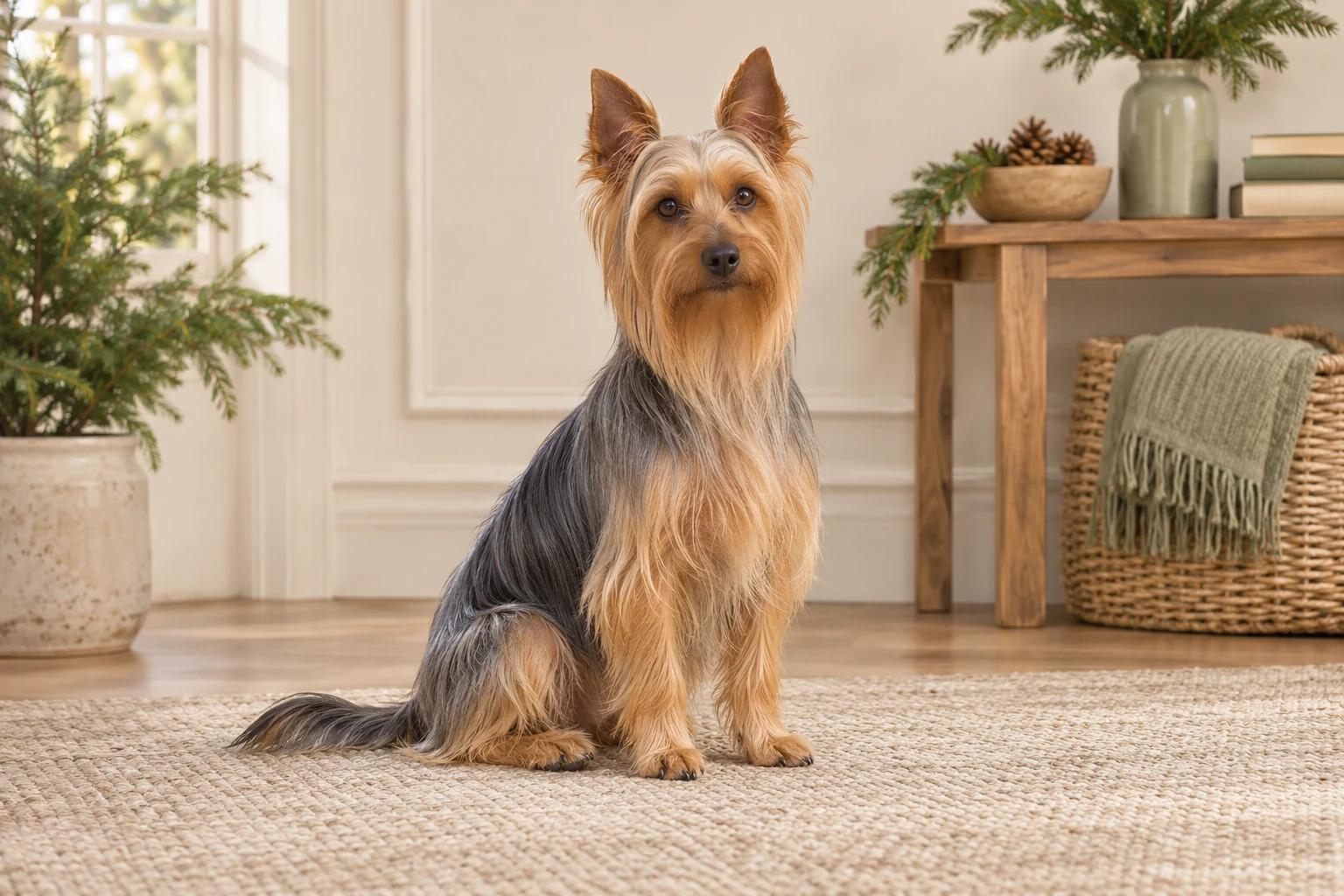
Silky Terrier vs Yorkshire Terrier can be confusing when both dogs wear short pet trims. Start with their actual scale: the My Breed Atlas profiles describe the Silky as the larger option. That difference matters when meeting adults, although size cannot identify a dog by itself.
The Silky Terrier profile and Yorkshire Terrier profile also show important similarities. Both score highly for family affection, watchfulness and vocal tendency. Neither is simply a quiet ornament that happens to have attractive hair.
Silky Terrier vs Yorkshire Terrier: read the Silky’s frame
The Silky Terrier Club of America’s standard describes a dog slightly longer than tall, with a level back and a moderately low-set body. Its bone is fine but strong. The intended impression is a small working terrier, not a delicate figure balanced on unusually thin supports.
The head is wedge-shaped and moderately long, with a flat skull and shallow stop. Small, dark, almond-shaped eyes contribute to its intent expression. The ears are erect, set high and shaped like pointed Vs. These are useful details to examine when a haircut has removed the familiar silhouette.
Look at the feet and legs, too. The feet are compact and rounded, and the forelegs stand straight beneath the body. Movement should be lively and direct, with propulsion from the hindquarters. A still face photograph leaves out most of that information. A natural standing view and a short walking sequence let you compare the entire dog without treating one hairstyle as a diagnostic feature.
The Yorkie has a more compact outline
The AKC Yorkshire Terrier standard emphasizes a compact body and relatively short back. It describes a small head with a muzzle that is not excessively long. Compare the underlying proportions rather than the rounded outline a groomer may create with hair.
Dark eyes and small upright ears contribute to the alert expression. The head is carried high, giving the dog a confident presence despite its size. The back remains level, with shoulder and rump at the same height. These structural details are not created by adding a bow.
Adult coloration and puppy coloration can also differ. The standard describes black-and-tan puppies developing toward the adult blue-and-tan pattern. Therefore, comparing a dark puppy with a mature dog can exaggerate an apparent difference. Ask the dog’s age before interpreting color. Coat presentation, maturity and underlying construction each answer a different question; none should replace reliable information about the dog’s background.
Both names belong to terriers, not just toy dogs
AKC’s comparison explains that the breeds have related backgrounds but developed as distinct dogs. The Yorkshire Terrier emerged in northern England, while the Silky developed in Australia with connections to both Yorkshire and Australian Terriers. Similarity is therefore understandable, but it does not make the names interchangeable.
The article’s breed specialists describe lively terrier personalities in both. A Silky may be intensely interested in what is happening nearby while also wanting close company. The Yorkie’s small presentation likewise does not remove its spirited approach to life. Choosing between Silky Terrier or Yorkshire Terrier should not start with the assumption that either is passive.
For the Silky, the article highlights the importance of making learning engaging rather than monotonous. If you enjoy a dog that notices things and participates in activity, that can be appealing. If your priority is an animal content to be carried everywhere without learning everyday skills, reconsider the expectation before choosing either breed on appearance alone.
A Yorkie still needs learning and exploration
VCA’s Yorkshire Terrier account describes a quick learner that can also become bored and invent its own entertainment. Food and games can make reward-based practice worthwhile. A dog being capable of learning quickly does not mean a long series of repetitions will remain interesting.
The account also distinguishes indoor games from the mental stimulation of walking and investigating outdoors. Small dimensions do not make the outside world irrelevant. A Yorkie can have a full day of interesting activity without its owner trying to turn it into a distance-running partner.
Games and tricks offer additional mental work. When considering Yorkshire Terrier vs Silky Terrier, ask yourself whether you enjoy teaching as part of companionship, rather than seeing training as a brief puppy stage to finish. VCA also flags that housetraining can require patience. Do not confuse a small dog’s manageable physical size with automatic household manners: it still needs clear opportunities to learn what you expect.
Which daily differences matter most?
The difference between Silky Terrier and Yorkshire Terrier is not usefully reduced to a ranking of activity. Both profiles invite questions about everyday outings and teaching. Ask what the individual enjoys, how it participates in walks and games, and which routines are already familiar. Small size does not answer those questions, and a rating is not an instruction to exercise a dog until it matches a number.
Coat care is a sharper distinction in the profiles: the Yorkie has a high grooming-frequency rating, while the Silky’s is moderate. Both have low shedding ratings, with the Yorkie lower still. Low shedding and low grooming are plainly not the same thing. Someone choosing mainly to avoid loose hair should still account for the work that remains on the dog.
Compare those priorities in the dog quiz. The separate Silky Terrier coat article explains the breed’s coat presentation without making it the whole basis of this choice.
Frequently asked questions
Is a Silky usually larger than a Yorkie?
Yes. The Atlas profiles describe the Silky as the larger breed. An individual’s identity still requires more than a scale reading.
Does a bow identify a Yorkshire Terrier?
No. A bow is presentation. The breed standard describes the underlying head and compact body, which remain relevant regardless of the haircut.
Are these simply two names for one breed?
No. They have related backgrounds but developed as distinct breeds. Their resemblance is not a reason to substitute one name for the other.
Sources behind this article
- STCA: Silky Terrier standard ↗
- AKC: Yorkshire Terrier standard ↗
- AKC: Yorkshire and Silky Terriers compared ↗
- VCA: Yorkshire Terrier ↗
Article source checked: November 16, 2026. Source checked 2026-11-16
Keep reading

Affenpinscher vs Brussels Griffon: Everyday Differences
Read article →