Scottish Deerhound Temperament: Quiet, Not One-Dimensional
Explore Scottish Deerhound companionship, puppy behaviour, household reach and motivation without turning a gentle reputation into a guarantee.
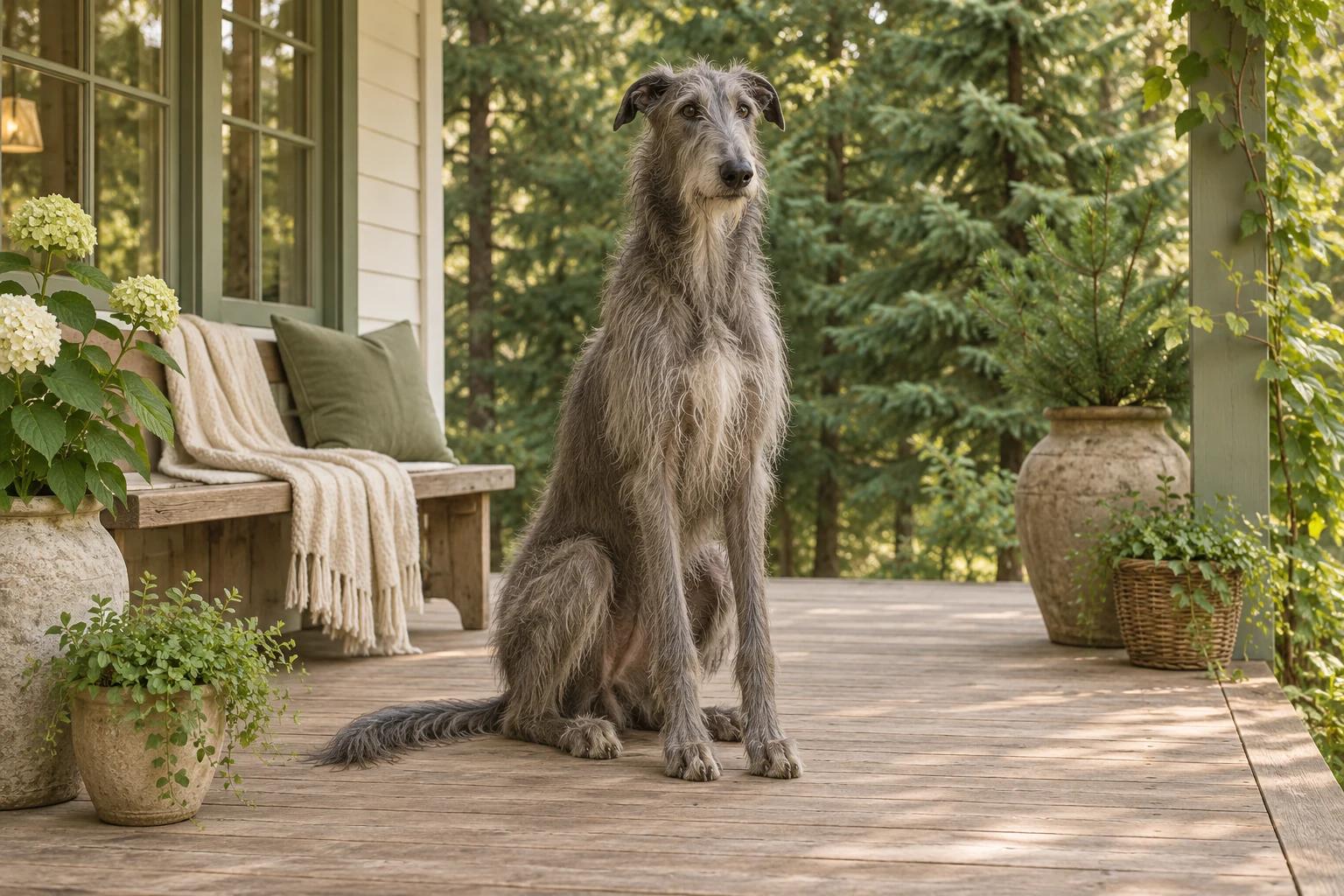
Scottish Deerhound temperament is worth exploring through ordinary scenes rather than a single flattering adjective. What happens when you sit down to work, prepare food or invite the dog to join an activity? Those moments reveal the kind of companionship you would share much more clearly than a posed photograph.
A breed reputation is a starting point for questions, not a replacement for meeting individuals. It also helps to distinguish the dog you admire today from the stage of life you would actually bring home. Choosing a puppy after meeting a settled adult can involve very different expectations.
Scottish Deerhound temperament: understanding the gentle ideal
The Royal Kennel Club standard describes a gentle, friendly temperament and a dignified bearing. These are ideals used to describe the breed, not a promise that every individual is comfortable with every person or situation.
When meeting an adult, allow its own style of greeting to become apparent. A dog does not need to perform an exuberant welcome to be interesting company. Ask the caregiver what a familiar greeting looks like and whether your visit resembles it. A stranger's brief impression is not the entire relationship.
Think about the interaction you would enjoy. Some people want constant invitations to play; others appreciate being together without a continuous exchange. Describe your preference honestly, then ask about the particular dog. Do not assign a moral value to either style. The question is whether the way this dog approaches people, joins activities and spends time at home fits the companionship you are hoping for, with room for the individual rather than a rigid stereotype.
The puppy is not a miniature version of a settled adult
The SDCA care booklet describes young Deerhounds that collect and shred household items, including paper, clothing and shoes. It also emphasizes balancing activity with sleep. A large-looking youngster still needs to be treated as a youngster rather than expected to behave like the mature dog you first admired.
Make the distinction practical. A basket of laundry on the floor is not merely background decoration when a puppy can reach it. Put belongings away and provide an appropriate resting area rather than repeatedly recovering the same items after they have been taken.
Ask a breeder or caregiver about the puppy's active periods and how rest is supported. Do not assume that every lively moment calls for another outing or that every quiet period should be interrupted for a lesson. The household arrangement should allow both activity and sleep. If you are drawn to the adult's composure, be equally interested in what raising that dog involved; the finished relationship does not appear automatically on arrival.
Scottish Deerhound characteristics become household details
Woodgreen's Deerhound guide describes affectionate contact such as leaning and nudging, alongside a need for space when the household becomes noisy. It also highlights the breed's reach around kitchen counters, where items may be taken.
These are useful prompts for arranging daily life. If the dog seeks contact beside your chair, consider whether there is room for you both without blocking the route through the room. Make a quiet resting place genuinely available rather than putting it beside the busiest doorway and expecting it to function as a retreat.
In the kitchen, do not treat the back edge of a worktop as automatically inaccessible. Put food and potentially hazardous objects away and think about where the dog will be while you prepare a meal. The practical response is to arrange the space and teach the routine, not rely on an elegant appearance as evidence that temptation will never matter. Ask the current caregiver which household situations have needed the most management.
Scottish Deerhound personality and motivation in lessons
The SDCA obedience article by Debbie Cutter and Betty Stephenson emphasizes attention, breaking exercises into components and finding rewards the individual values. It distinguishes knowing an exercise from choosing to perform it on request.
That is a useful way to approach Scottish Deerhound behavior without writing off the dog as stubborn. If a whole sequence falls apart, identify the part that is unclear. Following beside you, changing direction and stopping are different components, even if you think of them as one tidy exercise.
Ask a reward-based trainer to help you choose a manageable starting point. Find out whether this dog values a food reward, a toy or another appropriate activity in that setting. Do not assume that the reward you find convenient is the one the dog finds worthwhile. A thoughtful lesson is a shared activity, not a demonstration of who can be more persistent. The breed's appearance should neither inflate your expectations nor become an excuse to offer no teaching at all.
Look for the relationship behind the description
Ask for an example when someone uses an adjective. “Affectionate” might mean the dog seeks a brief touch, joins the person in the next room or stays nearby during a quiet evening. “Independent” might describe a very different moment. Without the example, two people can use the same word while imagining quite different lives.
You can make the conversation clearer by describing your own habits. Perhaps you work at a desk and take regular breaks. Perhaps you prefer uninterrupted evenings but enjoy a shared outing. Ask what the dog currently does in comparable situations, and which differences would need preparation.
Also distinguish a familiar routine from an unfamiliar test. The fact that a dog acts one way with its caregiver does not require it to behave identically with you during the first visit. Ask what changed as the relationship developed. That discussion is more useful than trying to provoke a response to settle a question immediately.
If several household members will share care, compare what each hopes for. One person may picture an activity partner while another imagines quiet company. Neither wish is wrong, but a real dog should not have to resolve an unspoken disagreement. Decide which experiences you want to share and investigate whether the individual fits them.
The Scottish Deerhound profile and dog match quiz help broaden that conversation. The existing coat-and-ear article is about appearance, not a personality test. Make your decision from an honest picture of daily life rather than asking an attractive outline to answer every question.
FAQ
What is the best follow-up to a temperament adjective?
Ask for a recent example. A description of what happened, where and with whom is more informative than another adjective.
Should everyone in the household want the same interaction?
Not necessarily, but discuss your expectations openly. Different preferences are easier to accommodate when they are explicit rather than left for the dog to resolve.
Can a first meeting settle every temperament question?
No. Use it to learn and identify what you still need to ask. A continuing conversation with someone who knows the dog can add important context.
Sources behind this article
- Royal Kennel Club: Deerhound standard ↗
- SDCA: Overview of care and requirements ↗
- Woodgreen: Deerhound ↗
- SDCA: Obedience training ↗
Article source checked: November 16, 2026. Source checked 2026-11-16
Keep reading

Airedale Terrier Temperament: What Everyday Life Can Feel Like
Read article →