Schapendoes vs Bearded Collie: Beyond the Shaggy Look
Compare Schapendoes and Bearded Collie build, movement and daily companionship without assuming similar hair means identical dogs.
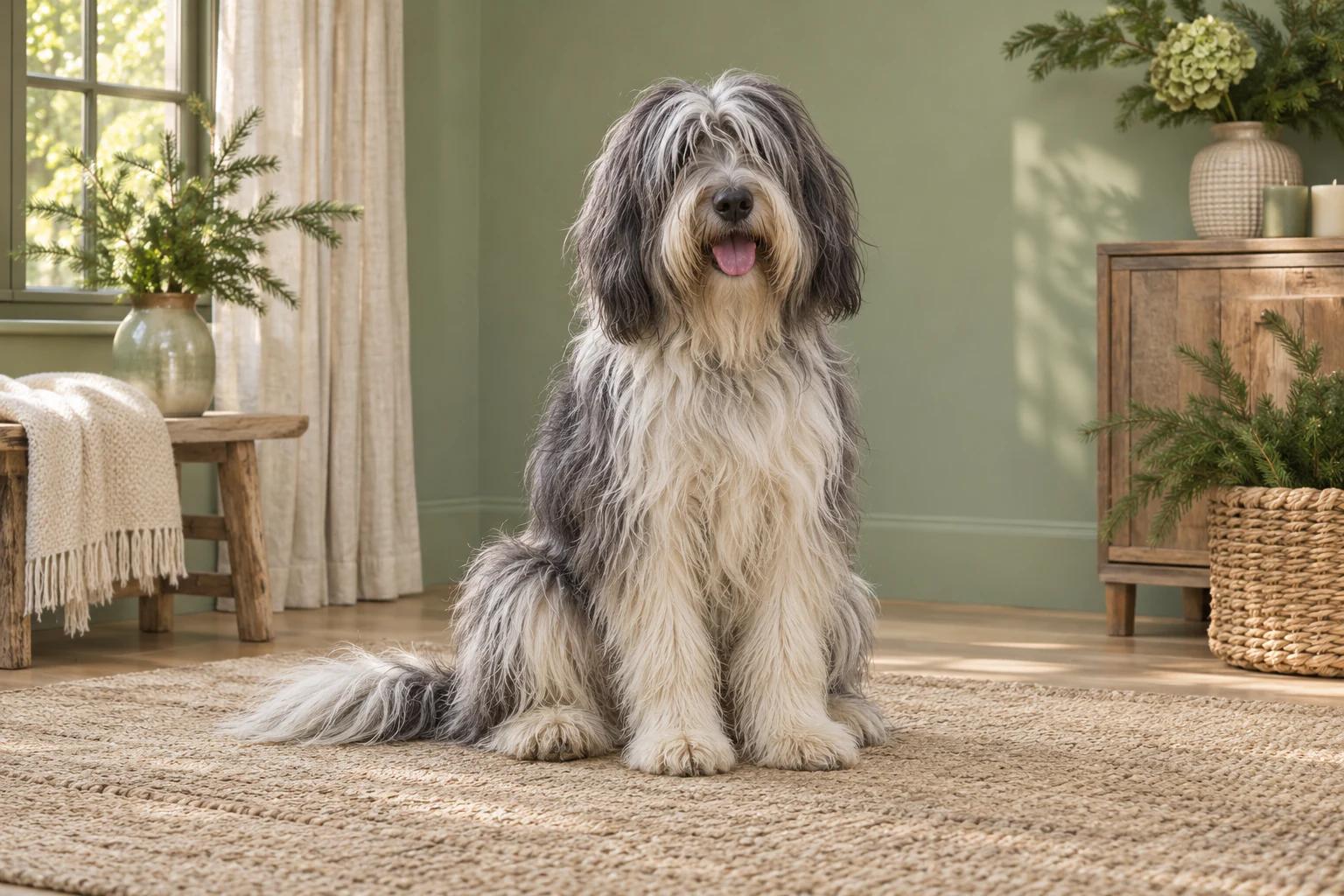
A Schapendoes vs Bearded Collie comparison can be misleading if it begins and ends with a shaggy face. Look at the complete dog, including body proportions and movement, then ask how the individual participates in everyday life. Similar photographs are a reason to look more closely, not a reason to treat the breeds as interchangeable.
Start with adult examples where possible. A puppy's appearance is only one stage, and a carefully arranged photograph says little about the work or companionship behind it. Separate what you can observe from what you still need to ask a breeder or caregiver.
Schapendoes vs Bearded Collie: begin beneath the hair
The FCI Schapendoes standard describes a lightly built dog, slightly longer than tall, with fine bone and springy movement. Males stand 43–50 centimetres at the shoulder and females 40–47 centimetres. Abundant head hair can make the head appear broader than its underlying structure.
Round brown eyes, mobile hanging ears, a relatively short muzzle and a long feathered tail contribute to the picture. The dense, lightly waved coat includes a topknot, moustache and beard. Longer hair tends to form tufts, especially around the rear, adding apparent volume.
When viewing an adult, look for the body's actual proportions rather than tracing the outer edge of the hair. Ask to see the dog standing naturally and walking on level ground. You do not need to conduct a show assessment; you are learning why a front-facing portrait can give a different impression from the whole animal.
The difference between Schapendoes and Bearded Collie shape
The Bearded Collie standard describes a long, lean body with an approximate length-to-height ratio of five to four. Its back is level, its chest deep and its head broad, with a strong muzzle. The ideal shoulder height is 21–22 inches for males and 20–21 inches for females.
The ears hang at about eye level. Hair beneath the cheeks and chin forms the beard. The standard describes free, supple movement, with the feet clearing the ground efficiently. These are more useful comparison points than the amount of hair visible around the face.
Watch the dog move away and return as well as passing sideways. Different angles reveal different parts of the outline. Do not infer athletic fitness from a single energetic stride, or assume that a dog matching a preferred appearance has already learned the everyday skills you need.
Schapendoes or Bearded Collie for shared activities?
The Schapendoes Club of Canada's agility introduction describes a dog-and-handler team negotiating an obstacle course, with accuracy and safety central to the activity. It identifies the Schapendoes as a candidate for the sport, not a dog that arrives knowing how to perform the obstacles.
If agility interests you, watch a beginner lesson before choosing a dog on the strength of a competitive video. Notice what the person must learn: where to move, when to give information and how to help the dog understand the next task. The human half of the activity deserves as much consideration as the dog's appearance on a course.
Ask the instructor how foundations are introduced and how physical readiness is assessed. Do not recreate elevated equipment from a photograph. You can enjoy learning together without committing to competition, and you can decide that another shared activity is a better fit.
Bearded Collie vs Schapendoes: the everyday relationship
The Bearded Collie Club of America describes active, outgoing companionship, while noting a range from quieter individuals to more exuberant ones. It also gives prospective owners an unromantic picture of wet beards, muddy feet and regular brushing. The appealing appearance comes attached to a real dog.
Meet the individual after the excitement of arrival has passed. Ask what happens during a normal afternoon, not just during play. Does the caregiver's description of ordinary company match the kind of relationship you want? A breed tendency is a starting point for that conversation, not its conclusion.
The club notes that some Beardies jump up during greetings or pursue movement. Ask which alternatives the individual has learned and how the caregiver manages situations that are still difficult. Do not choose a dog on the assumption that enthusiasm will always express itself conveniently. Equally, do not judge the entire breed from one busy greeting.
Compare the tasks you will actually perform
A useful meeting includes a small, ordinary task: preparing for an outing, moving through a doorway or getting ready for care. Watch the complete sequence. Which parts happen easily, and where does the caregiver help? This is not an exam for the dog; it is a demonstration of daily life.
If a particular task would be difficult for you, say so. Ask to try the practical arrangement with guidance rather than hoping it will become obvious after the dog comes home. Physical reach, room layout and the person's confidence can matter as much as an attractive breed description.
Do not turn the choice into a ranking of intelligence or charm. A dog that suits another household beautifully may ask for a relationship you do not enjoy. It is reasonable to prefer one individual, to meet more adults or to decide that neither is the right match at present.
Explore the Schapendoes profile and Bearded Collie profile, then use the dog match quiz to identify remaining questions. The Schapendoes rebuilding and recognition article covers the separate historical story rather than everyday comparison.
FAQ
Is the Schapendoes simply a small Bearded Collie?
No. Similar facial furnishings do not make them different sizes of one breed. Compare their full outlines and individual backgrounds rather than relying on a resemblance.
Should I choose whichever dog looks calmer at one meeting?
Not on that observation alone. Ask about ordinary life in several settings and find out whether the meeting was typical for that individual.
What is useful to watch before deciding?
Watch an everyday task from beginning to end, including the help the caregiver provides. That can reveal practical questions a posed photograph cannot answer.
Sources behind this article
- FCI: Dutch Schapendoes standard ↗
- AKC: Bearded Collie standard ↗
- Schapendoes Club of Canada: Agility ↗
- Bearded Collie Club of America: About Beardies ↗
Article source checked: November 16, 2026. Source checked 2026-11-16
Keep reading

Affenpinscher vs Brussels Griffon: Everyday Differences
Read article →