Pudelpointer temperament: work, company and calm
Explore Pudelpointer temperament through activity, household companionship, learning and practical questions for meeting a puppy or adult dog.
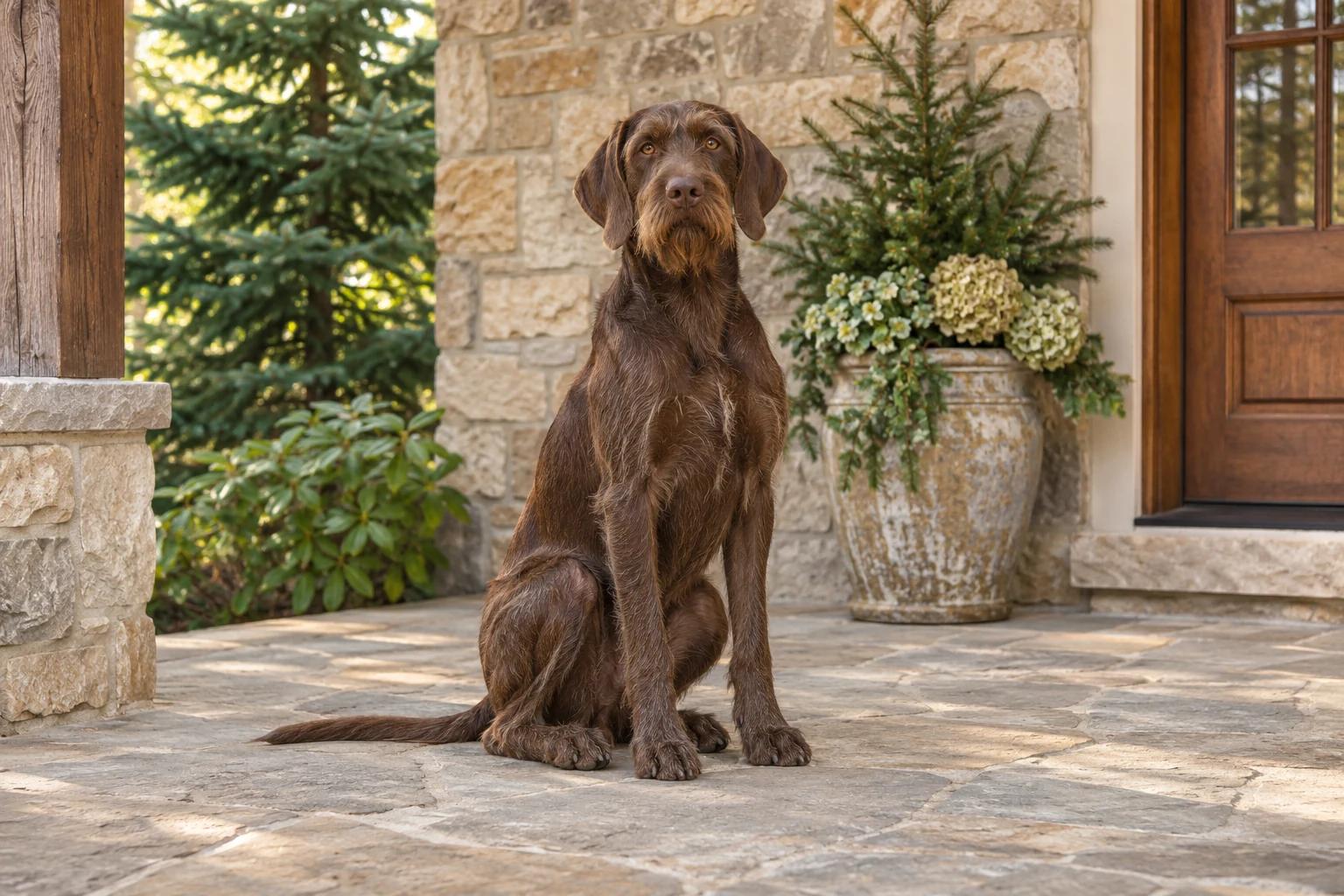
Pudelpointer temperament makes most sense when you consider the dog's whole day. A companion can be quiet beside its people at one moment and deeply interested in an outdoor task at another. Those are not contradictory personalities. Before choosing this breed, think about whether you want that combination and can support it consistently. The appealing image of a relaxed dog after an outing leaves out the time, teaching and involvement that came before it.
Pudelpointer temperament combines composure with interest
The FCI standard describes calm self-control alongside a distinct hunting instinct. The Canadian Kennel Club profile likewise presents a work-oriented dog needing outdoor activity. Read those descriptions together rather than selecting only the word that matches your hopes.
Pudelpointer personality is therefore worth exploring through transitions. How does the dog move from an outing to quiet time? What happens when equipment comes out? How does it respond when an interesting activity ends? Specific examples reveal more than an owner's claim that the dog has an ideal temperament.
The Pudelpointer profile highlights family involvement and learning. Consider whether you enjoy the process of building a routine with a dog, not only the finished picture. A breed known for responsiveness still needs someone to explain what life in a particular home requires.
Give interest somewhere useful to go
Plan shared activities before the dog arrives. These might include suitable outings, structured learning or an activity taught with qualified guidance. The important point is that your plans are real and repeatable, rather than a list of possibilities you might explore someday.
Talk openly with the breeder or rescue about your intended life together. If you do not hunt, say so. Ask how the particular dog or family has lived and whether the placement fits your proposed activities. Do not assume that every source of a working breed has the same expectations.
A garden is helpful space, but it cannot make those decisions for you. Decide what you will do together there and what remains part of the wider routine. Simply being outdoors is different from having an interesting, supported activity.
Avoid responding to every lively moment by increasing intensity. Review timing, clarity and opportunities for rest. If behaviour becomes difficult to manage, get qualified help rather than assuming that a more exhausting routine is the only answer.
Build companionship that includes ordinary life
The most sustainable relationship includes uneventful moments. Set up a comfortable resting place near household life without putting the dog directly in the busiest route. Let it be present without requiring a cue, game or greeting every time someone passes.
If you work at home, decide how the dog will recognise periods when you are available and periods when you are occupied. Prepare its routine before an important call rather than improvising once you need silence. Other household members should understand the arrangement too.
Ask how the dog has coped with different caregivers and time apart. Introduce necessary changes in manageable steps and observe the response. Being people-oriented does not establish a problem, but it does make care arrangements worth discussing explicitly.
Do not let one person become the only person who knows the routine. Share cues, equipment locations and practical care instructions. A familiar backup caregiver is more useful than a vague plan to find someone when travel is already booked.
Take learning seriously without making everything a lesson
Pudelpointer characteristics associated with learning can make training enjoyable. Start with useful daily skills such as coming when called in an appropriate setting, waiting while equipment is prepared and settling after an activity. Keep expectations aligned with what has actually been practised.
A dog that understands a cue in the kitchen may need help in a new place. Treat that as a change in the task, not an insult to your authority. Choose an easier setting and build from success with qualified instruction as needed.
Keep household language consistent. If one person uses a word to mean stop moving and another uses it to mean come closer, the dog has an unnecessarily confusing job. A short shared list of cues can prevent this problem.
Leave time for unstructured, supervised enjoyment too. A relationship made entirely of tests becomes demanding for everyone. You can appreciate the dog's company without continually checking whether it will perform a skill.
Understand outdoor focus before granting freedom
A dog interested in scents or movement may find the wider environment compelling. Ask the caregiver what happens around wildlife, unfamiliar terrain and new distractions. Do not assume that attentiveness indoors transfers automatically to every outdoor setting.
Choose secure places and appropriate lead arrangements while skills develop. Ask a trainer how to progress safely for the individual dog and location. Freedom should follow preparation rather than serve as a test of whether a breed description was accurate.
If an outing is consistently too difficult, change the plan. A quieter entrance, different time or more suitable location may make practice manageable. Repeating the same overwhelming scenario does not provide useful evidence of stubbornness.
Keep the conversation about observable behaviour. Describe what the dog notices, how far away it is and what happens next. Such details help a professional offer relevant guidance far more than a general label such as distracted or impossible.
Assess family fit through practical arrangements
Pudelpointer behavior in a household depends on more than breed tendencies. Discuss other animals, children, visitors and the pace of your home. Explain any constraints honestly, including limited space for separation or a changing work schedule.
For children and dogs, adults need to manage interactions and protect rest. A pleasant meeting should not become a promise that all future play will be suitable. Teach respectful boundaries and provide a place where the dog can disengage.
Ask about routine care as well. Can the dog be brushed comfortably? How does it respond to equipment and appointments? A cooperative relationship includes care tasks, not just the activities both of you already enjoy.
If an established behaviour changes or a task appears uncomfortable, consult your veterinarian. Do not interpret every difficulty as temperament. Physical comfort and learning history may need separate attention from the appropriate professionals.
Meet the individual with useful questions
For an adult dog, ask for examples from several ordinary days and, where possible, observe an appropriate routine. For a puppy, discuss the experiences already provided and the support available as you continue them. Neither meeting needs to be a performance.
The article on foundation breeds and pedigree addresses background documentation. Keep those questions separate from temperament assessment. Records can establish aspects of identity without predicting every habit or future response.
Use the dog match quiz to organise what you want from companionship. Then compare that wish list with your actual time and support. A satisfying match is one whose everyday requirements you want to participate in, not merely tolerate until the dog becomes quieter.
FAQ
Does a calm description mean a Pudelpointer is inactive?
No. Calm behaviour can coexist with substantial interest in shared activity. Ask about the individual's whole routine and consider whether your schedule supports both engagement and quiet time.
Can I judge temperament from a training video?
A video shows one selected situation. Ask about ordinary home life, new environments, handling and time apart as well. Combine those accounts with appropriate observation rather than treating a successful exercise as a complete assessment.
What should a nonhunting household discuss before choosing one?
Explain your planned activities, available time and training support. Ask whether those arrangements suit the particular dog and the placement expectations. Be prepared to reconsider if the proposed routine does not meet the dog's needs.
Sources behind this article
Article source checked: November 15, 2026. Source checked 2026-11-15
Keep reading

Airedale Terrier Temperament: What Everyday Life Can Feel Like
Read article →