Newfoundland temperament: beyond the gentle image
Explore Newfoundland temperament through company, greetings, growing-up behavior and everyday observations that help you understand an individual dog.
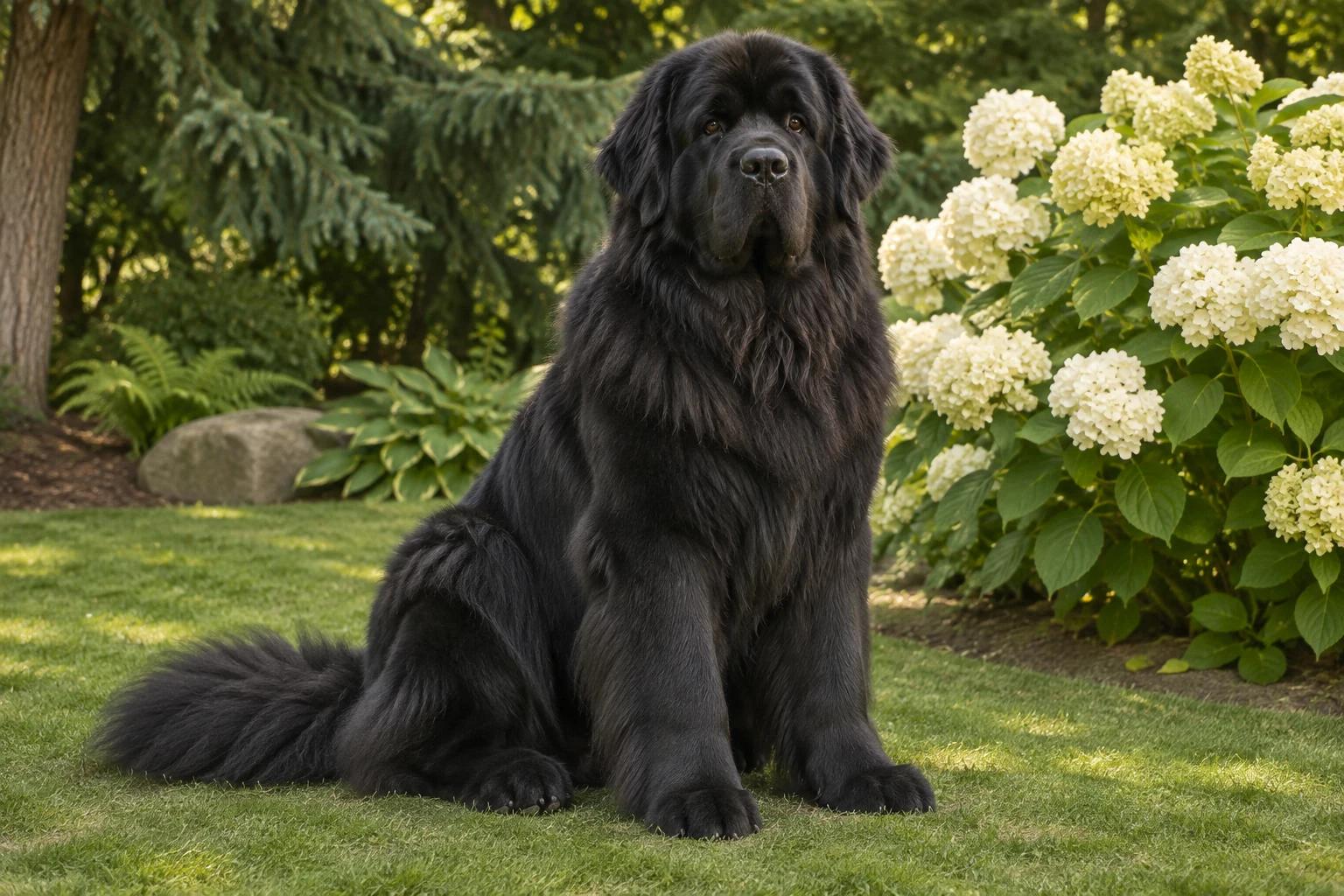
Newfoundland temperament is often reduced to a soft expression and a reassuring nickname. That image leaves out much of what you need to know before sharing your home with a very large dog. Company, excitement, patience during care and the ability to settle are separate parts of daily life, and they deserve separate questions.
A useful temperament discussion starts with what the dog actually does. Instead of asking only whether a Newfoundland is affectionate, ask what affection looks like when you are cooking, greeting a visitor or trying to leave for work. Those ordinary moments reveal the practical side of living together.
Newfoundland temperament in everyday company
The UKC breed standard presents a sweet-dispositioned, devoted companion as the Newfoundland ideal. Treat that as a description of the breed's intended character, not a substitute for learning about an individual dog's experiences and habits.
For a companion-focused household, the appealing picture may be a Newfoundland resting nearby while everyone gets on with the evening. Make room for that arrangement deliberately. A comfortable resting place should let the dog be included without lying in the doorway or being repeatedly stepped around.
Consider where company ends and constant attention begins. You may enjoy a dog nearby but still need to work, cook or speak to someone without interacting continuously. Before bringing a dog home, discuss how the current caregiver handles those moments. Ask what quiet companionship already looks like, rather than assuming that affection automatically includes the ability to wait.
The Newfoundland breed profile connects personality with broader care needs. Read those commitments together: wanting a close companion also means making practical room for that companion during an ordinary week.
A large young dog is still a young dog
The AKC's Newfoundland puppy guide emphasizes that a young Newfoundland can look imposing while remaining emotionally immature. Adult-looking size is not evidence that a youngster should already cope like an experienced adult.
This distinction changes how you interpret an awkward afternoon. A puppy who becomes distracted by a visitor has not necessarily lost its agreeable personality. The situation may simply be more demanding than previous practice. Look at what happened before deciding that a permanent trait explains everything.
Keep your expectations tied to experience. If the dog has only met visitors one at a time, a crowded gathering is a different event. If it settles during a quiet meal, that does not prove it understands where to rest when guests keep moving between rooms. Ask for smaller, clearer tasks instead of expecting size to supply maturity.
Observe greetings from beginning to end
Newfoundland personality becomes easier to discuss when you describe a sequence. Does the dog approach immediately? Does it remain close once the visitor sits down? Can it move away and rest? A friendly beginning and a comfortable ending are different observations.
During a planned meeting, let the caregiver manage the introduction. You do not need to create an exciting test, crowd the dog or provoke a reaction. Watch the routine they already use and ask why it works for that dog.
Notice the practical effect of enthusiasm. A large head nudging a hand, a broad body leaning into a person or a tail moving beside a low table can change the room even without jumping. Decide which interactions you enjoy and which need a different arrangement. Put fragile objects and crowded furniture layouts out of the greeting route rather than blaming the dog for every collision.
For repeat visitors, consistency helps everyone. Tell them where to enter, where to put bags and when to offer attention. An orderly arrival makes the dog's behavior easier to understand because fewer things are changing at once.
Quiet is not the same as disengaged
The breed profile describes barking as generally occasional. That does not mean a quiet Newfoundland has no preferences or that silence proves contentment. Pay attention to where the dog chooses to be, whether it approaches or withdraws and how easily it returns to ordinary activity.
You might notice that your dog likes company in the evening but chooses a quieter spot when several people arrive. Make that option available. A resting place is useful only if people leave the dog undisturbed there, rather than following it to continue a greeting.
Avoid turning watchfulness into an assigned job. You do not need to encourage suspicious behavior to appreciate an attentive companion. If a reaction becomes difficult to manage or changes suddenly, discuss it with your veterinarian and a qualified reward-based behavior professional rather than treating it as inevitable breed behavior.
Ask what happens during the less charming moments
The most informative Newfoundland characteristics may appear during routine care rather than a photo-friendly cuddle. Ask how the dog responds when the lead is clipped on, when grooming equipment appears or when a familiar person leaves the room. A caregiver should be able to describe more than broad adjectives.
These questions are not a pass-or-fail temperament test. They help identify what has already been taught and where you will need time, support or a different setup. A dog accustomed to one quiet groomer may need preparation for another person and location.
When meeting an adult, request ordinary examples from the recent routine. When considering a puppy, ask about the experiences already introduced and the next steps recommended for that particular puppy. Keep notes on actual observations so that several appealing meetings do not blur into one vague impression.
Build a household picture before making a choice
Write down the periods when your Newfoundland would have company and the periods when it would not. Include commuting, shopping and social plans, not just contracted working hours. A strong interest in people calls for a realistic care arrangement, not an assumption that a bigger bed compensates for a long absence.
Also list the forms of interaction you genuinely enjoy. Some people like leisurely outings and companionable downtime; others want frequent visitors and a dog involved in every errand. Neither description alone determines a match. Compare your plans with the individual dog's established routine and capacity to adapt.
The dog match quiz can organize your preferences. If the breed's working side interests you, Newfoundland drafting control and teamwork provides a separate introduction to a formal activity. It should not replace the quieter question of how you and this dog will share daily life.
FAQ
Are all Newfoundlands calm?
No. The breed's companionable ideal does not mean every Newfoundland is calm in every setting. Age, experience and the immediate situation matter. Ask about greetings, settling and daily care separately instead of relying on a single label.
Does Newfoundland behavior change during adolescence?
A growing Newfoundland may look adult before its behavior and experience catch up. Keep expectations realistic, maintain clear household routines and seek professional help for concerns rather than interpreting every difficult day as a fixed personality change.
How can I assess a Newfoundland's personality before adoption?
Ask the caregiver for recent examples of ordinary routines, then observe a calm, planned meeting. Discuss company, visitors, grooming and time apart. Avoid manufactured stress tests, and use more than one interaction when the adoption process allows it.
Sources behind this article
Article source checked: November 15, 2026. Source checked 2026-11-15
Keep reading

Airedale Terrier Temperament: What Everyday Life Can Feel Like
Read article →