Leonberger vs Newfoundland: Choosing a Giant Companion
Compare Leonberger and Newfoundland coats, adult size, handling and household logistics to decide which giant companion fits your life.
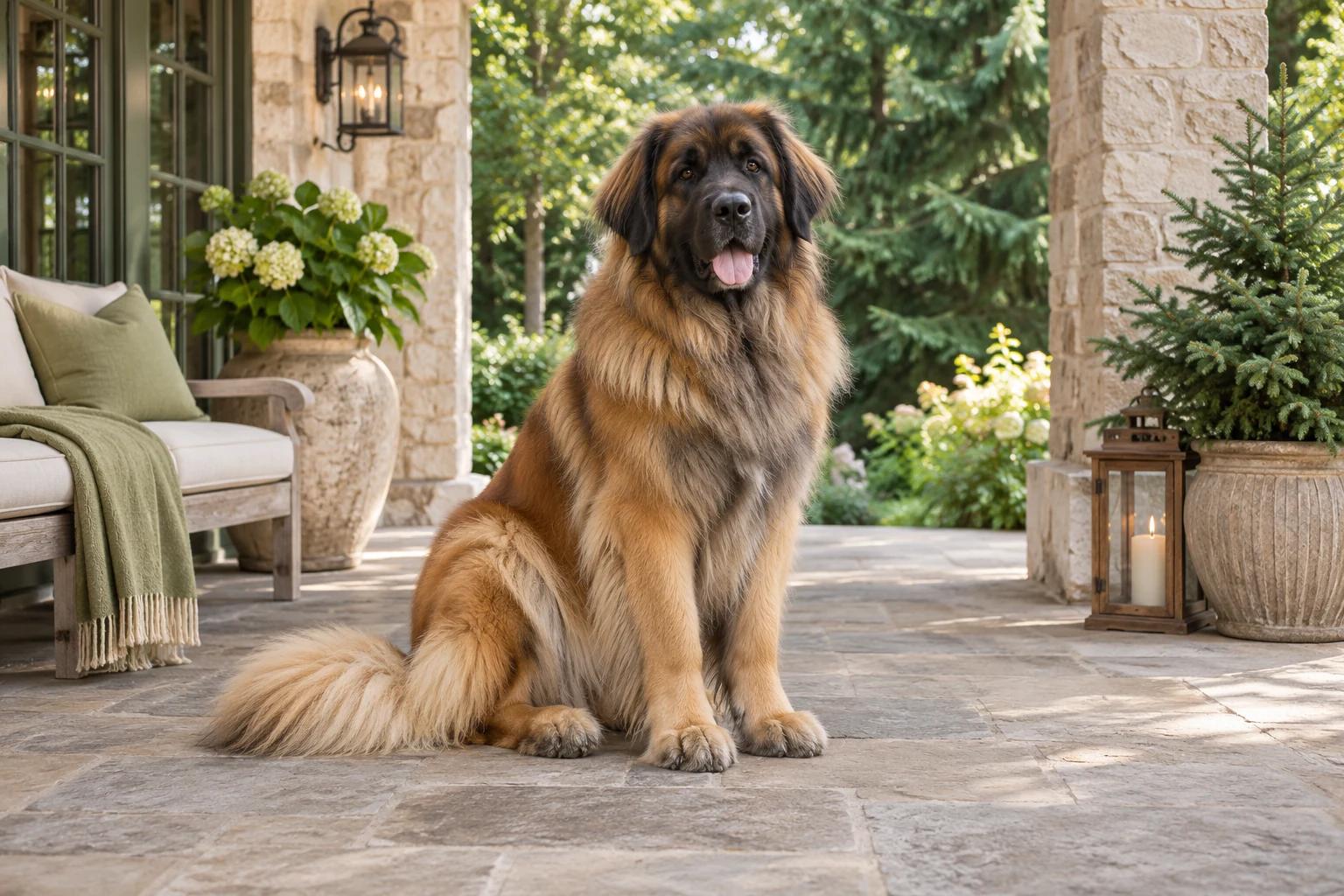
A leonberger vs newfoundland comparison should begin with life at floor level: where the dog will sleep, how you will pass each other in the hall and where a wet coat will dry. Both breeds bring considerable size and coat into the home. Their appearance differs, but choosing between them calls for more than deciding whether you prefer a lion-like mane or a broad-headed silhouette.
Leonberger vs Newfoundland: what you can see
The Leonberger standard describes a long coat with undercoat, feathering and a mane more pronounced in males. Its familiar coloring ranges through yellow, red, reddish brown and sandy shades with a black mask. The Newfoundland has a substantial double coat and may be black, brown, gray, or white and black. UKC Leonberger standard, UKC Newfoundland standard.
Those visual differences help identify the breeds, but photographs can exaggerate the importance of coat. A full mane changes the outline without telling you how much room the dog needs to turn around. A dark coat can hide body contours in an image. Meet adult dogs standing, walking and resting before deciding what their size would mean in your house.
Compare the dog with your actual spaces
The AKC Leonberger standard gives adult heights of 28–31.5 inches for males and 25.5–29.5 inches for females. UKC lists Newfoundland adult heights of 28 inches for males and 26 inches for females, with respective weight ranges of 130–150 and 100–120 pounds. These references are not individual predictions. AKC Leonberger standard, UKC Newfoundland standard.
Instead of asking which is bigger in the abstract, inspect the narrowest point in your routine. It may be the rear door of your vehicle, the turn beside a stairway or the space between your bed and a wall. A comfortable resting area is not useful if getting to it means squeezing past furniture several times a day.
Map the route to outdoor access as well. A ground-floor room with a straightforward exit presents different practical demands from an upper-floor apartment reached by a small lift. Ask how you would manage a veterinary trip if the dog could not follow its normal route. Discuss suitable assistance with your veterinary practice rather than assuming that you could simply carry a giant adult.
Make room for coat work before choosing a coat
The most useful grooming comparison happens beside a real dog and a set of tools. Ask an experienced owner to show you their setup, including the floor surface, where they sit and where the dog stands or rests. Find out what they do themselves and what they arrange with a groomer.
Your own physical comfort matters. Can you reach the areas that need attention without balancing awkwardly? Is there enough light to see through a dark or dense section? Is the equipment stored close enough that you do not have to leave the dog halfway through? A beautiful grooming station in a photograph may be less workable than a simple, spacious corner.
Plan the return from wet outings. Towels need storage and drying space, washable covers need laundry capacity, and a damp dog needs somewhere suitable to pause. Neither breed makes sense as a route to a spotless house with no daily effort. Ask about the individual dog's coat rather than buying an entire tool collection before meeting it.
Compare companionship without making promises
The Leonberger standard emphasizes a sociable working companion with a capacity for learning. The Newfoundland standard describes a devoted companion. These are reasons to include the dog in your plans, not assurances that every dog will respond identically to visitors, separation or a busy household. AKC Leonberger standard, UKC Newfoundland standard.
During a visit, ask to see an ordinary routine. How does the owner prepare to leave? Where does the dog rest while people eat? What happens when someone arrives with bags? Discuss the habits that required teaching and those that remain unfinished.
The difference between leonberger and newfoundland in your home may be less important than the difference between two individual dogs with different ages and experience. Avoid comparing a settled adult of one breed with an exuberant adolescent of the other and treating the result as a breed rule.
Handling should work without a strength contest
For either breed, plan everyday cooperation before size makes improvisation difficult. Choose a place for lead attachment, a visitor routine and a way to keep doorways clear. Agree on the rules across the household so that the dog is not invited to jump up by one person and corrected by another.
If you are weighing newfoundland vs leonberger for an inexperienced owner, look closely at available support. A nearby instructor comfortable with giant dogs, an accessible grooming arrangement and practical help from the breeder may matter more than a simplified easy-to-train ranking.
Ask to observe a suitable adult being handled, with its owner's permission. Notice how the person organizes a turn, passes an obstacle and rewards cooperation. The goal is not to see whether you can physically restrain the dog. It is to understand what skills and setup make routine handling manageable.
Choose the support network as well as the breed
Before deciding on a leonberger or newfoundland, contact the professionals you expect to use. Ask a groomer about capacity for a dog of that size and coat. Check transport arrangements with anyone who may help. If you use boarding or day care, discuss the specific dog and facility rather than assuming that all services accept giant breeds.
Obtain actual quotes instead of relying on a generic annual cost figure. Separate equipment, recurring care and occasional professional help so that you can see where the commitment lies. Leave room in the plan for replacement equipment as a puppy grows.
Read the Leonberger profile and Newfoundland profile, then use the breed quiz to order your priorities. The separate Leonberger DNA-report guide helps organize questions about existing records; it does not decide which breed fits your home.
FAQ
Is a Leonberger always taller than a Newfoundland?
No individual comparison is guaranteed. The Leonberger standard covers a height range, while the Newfoundland reference gives adult heights by sex. Meet and measure the actual dog when planning equipment or space.
Which breed requires less household preparation?
Neither should be chosen as the low-preparation option. Both require a workable plan for a giant adult, substantial coat, transport, handling and professional services. Your home's layout and available support may determine the more manageable match.
Can I choose by temperament descriptions alone?
No. Breed descriptions provide a starting point, but visits, the dog's history and concrete examples of daily behavior are more useful for assessing an individual match.
What is the best first step before choosing?
Meet adult dogs of both breeds in ordinary settings and inspect your practical arrangements afterward. Compare grooming access, vehicle space and handling support before reserving a puppy based on appearance.
Sources behind this article
- United Kennel Club: Leonberger ↗
- United Kennel Club: Newfoundland ↗
- American Kennel Club: Official Leonberger Standard ↗
Article source checked: November 15, 2026. Source checked 2026-11-15
Keep reading

Affenpinscher vs Brussels Griffon: Everyday Differences
Read article →