Korat vs Russian Blue: adult size, shape and companionship
Compare Korat vs Russian Blue using current adult weights, head and coat structure, and a thoughtful look at the Russian Blue’s social style.
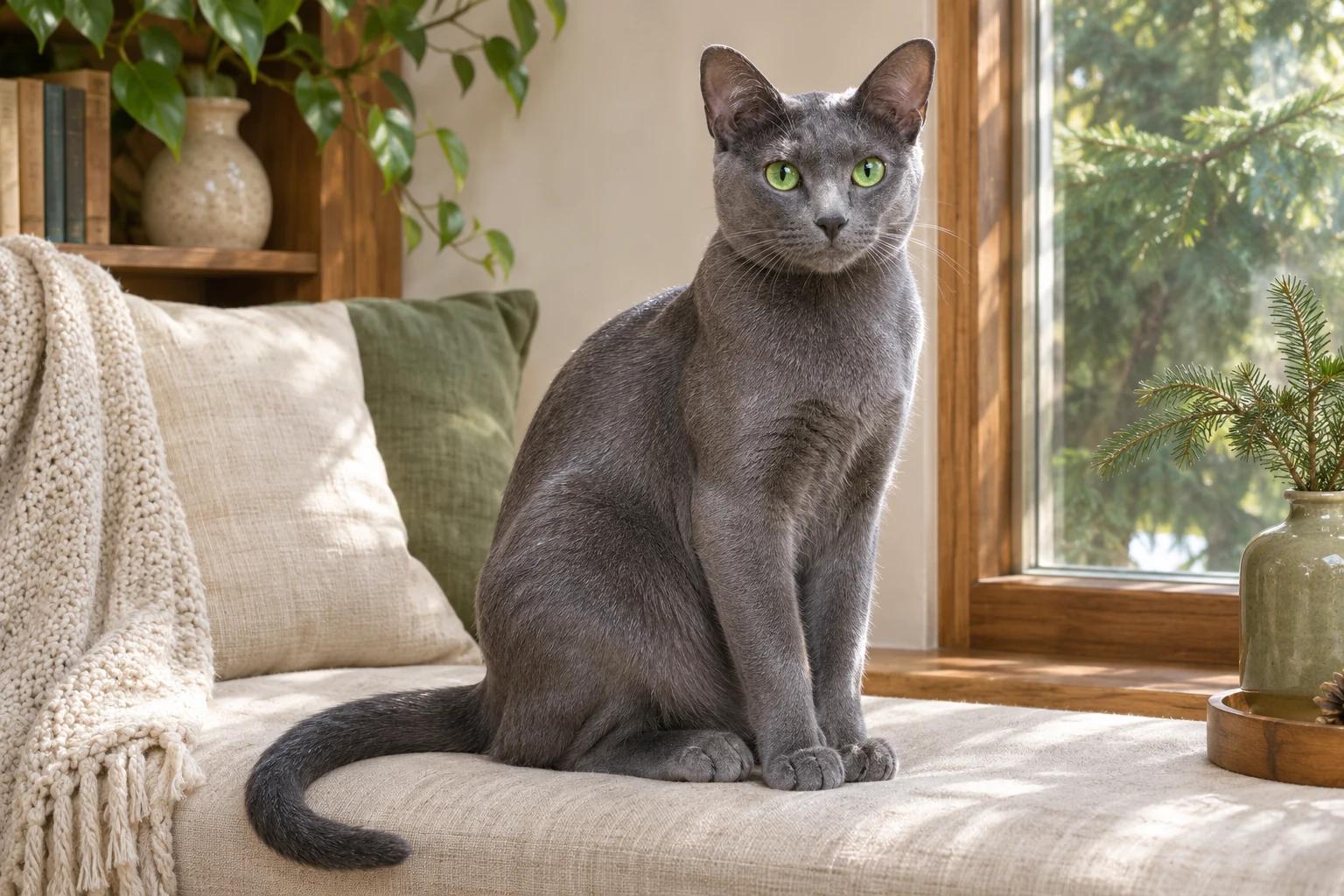
Korat vs Russian Blue is not a comparison that can be settled by the largest number on a breed page. The female weight ranges overlap substantially, while the male ranges meet at one endpoint. Compare the relevant adult references first, then consider the physical outline and the experience of spending time with an individual cat.
Korat vs Russian Blue: the weight comparison in context
The current Korat profile lists adult females at 6–8 pounds and males at 8–10 pounds. The current Russian Blue profile lists adult females at 7–10 pounds and males at 10–12 pounds.
For females, the named references overlap at 7–8 pounds. A seven-pound adult female fits either reference. The figures therefore do not support saying that every female Russian Blue is heavier than every female Korat.
For males, the two listed ranges meet at ten pounds. That is the upper end for the Korat and the lower end for the Russian Blue. If someone describes a ten-pound male without identifying its breed, the weight alone does not distinguish these two possibilities.
The combined references are 6–10 pounds for Korats and 7–12 pounds for Russian Blues, but those shortcuts conceal the sex differences. Keep the female and male figures attached when deciding between a Korat or Russian Blue, especially when someone quotes a single impressive adult weight.
These are reference ranges, not instructions to make an individual reach a particular endpoint. For an assessment of your own cat's weight, consult the veterinarian who can examine that animal. The comparison is useful for expectations, not for selecting a desired number independently of the cat.
The Korat’s heart-shaped outline
CFA's Korat standard describes the heart-shaped head through its component curves: the brow forms the upper outline and the sides of the face narrow toward the chin. Large ears have rounded tips and broad bases. The body is muscular, broad-chested and supple, with more weight than its appearance might suggest.
That is a structural description, not just a romantic nickname. When viewing a Korat, notice the breadth across the eyes and the way the cheeks lead into the lower face. A heart shape does not mean a pointed, fragile chin or a sharply pinched muzzle.
The short single coat lies close to the body. Its blue hairs have silver tips, and the fine coat follows the cat's shape rather than creating a deep plush outline. This makes the relationship between the frame and the visible surface particularly important in a Russian Blue vs Korat comparison.
The Korat's musculature and coat should be considered together, but they describe different things. A smooth outer line does not mean the body beneath it is slight, and the amount of visible fur is not a substitute for the adult weight references.
The Russian Blue's plush coat changes its outline
The CFA Russian Blue standard describes a fine-boned, muscular body with long legs and a medium wedge-shaped head. Its short double coat is dense and stands away from the body, giving a plush surface rather than a close-fitting one. Silver-tipped hairs contribute to its sheen.
The difference between Korat and Russian Blue appearance is therefore not simply a choice between two shades of grey. In the Russian Blue, the thickness of the fur can soften the visible boundaries of the underlying frame. CFA notes that even the long, slender neck can look shorter because of the coat and shoulder placement.
The head has a smooth wedge rather than a sharply exaggerated point. The ears are relatively large, broad-based and widely set, with tips more pointed than rounded. Consider these features together with the body and coat instead of relying on the eyes alone.
For an owner comparing photographs, separate the silhouette made by fur from the proportions of the animal beneath it. The coat is a real breed feature, but it is not a direct measurement of bone, muscle or body weight.
Reserve does not rule out affection or play
VCA's Russian Blue account describes a preference for a quiet household and affection toward familiar people. It cautions against confusing shyness around strangers with aloofness, and notes that these cats can occupy themselves with toys when a person is not joining the game.
That distinction is useful when meeting a prospective companion. The cat's response to a newcomer and its relationship with an established caregiver are not the same observation. A reserved greeting does not tell you everything about the kind of interaction that occurs once the person is familiar.
Ask to see the ordinary activities the cat already enjoys, rather than expecting it to demonstrate affection on demand. Watching its familiar caregiver can give you a more relevant example than repeatedly approaching it yourself. The aim is to understand the existing relationship, not to make the animal pass a sociability test during one visit.
This does not establish that a Russian Blue is less affectionate than a Korat, or that either breed can be assigned a universal limit on companionship. It gives you a practical way to distinguish unfamiliar-person reserve from the broader relationship you hope to build.
Explore your preferences with the cat breed quiz. For a separate household transition, read preparing a Korat’s routine before a baby arrives.
Frequently asked questions
Can a seven-pound female fit either breed's range?
Yes. Seven pounds falls within both the Korat's 6–8-pound female range and the Russian Blue's 7–10-pound female range.
Where do the male weight references overlap?
The Korat and Russian Blue male references meet at ten pounds: Korat males are listed at 8–10 pounds and Russian Blue males at 10–12 pounds.
Are these adult weights targets for a kitten?
No. Korat and Russian Blue adult ranges are comparison references, not individual growth targets. Your veterinarian can assess the particular cat.
Sources behind this article
- CFA Korat ↗
- CFA Russian Blue ↗
- VCA Russian Blue ↗
- TICA Traits adult reference — adult-weight reference ↗
- Hill’s adult reference — adult-weight reference ↗
Article source checked: November 16, 2026. Source checked 2026-11-16Article source checked: November 18, 2026. Source checked 2026-11-18
Keep reading

Abyssinian vs Somali: Coat, Size and Everyday Company
Read article →