Irish Wolfhound vs Scottish Deerhound: Everyday Fit
Compare Irish Wolfhound and Scottish Deerhound size, home logistics, coat care, training, and the practical meaning of living with a large hound.
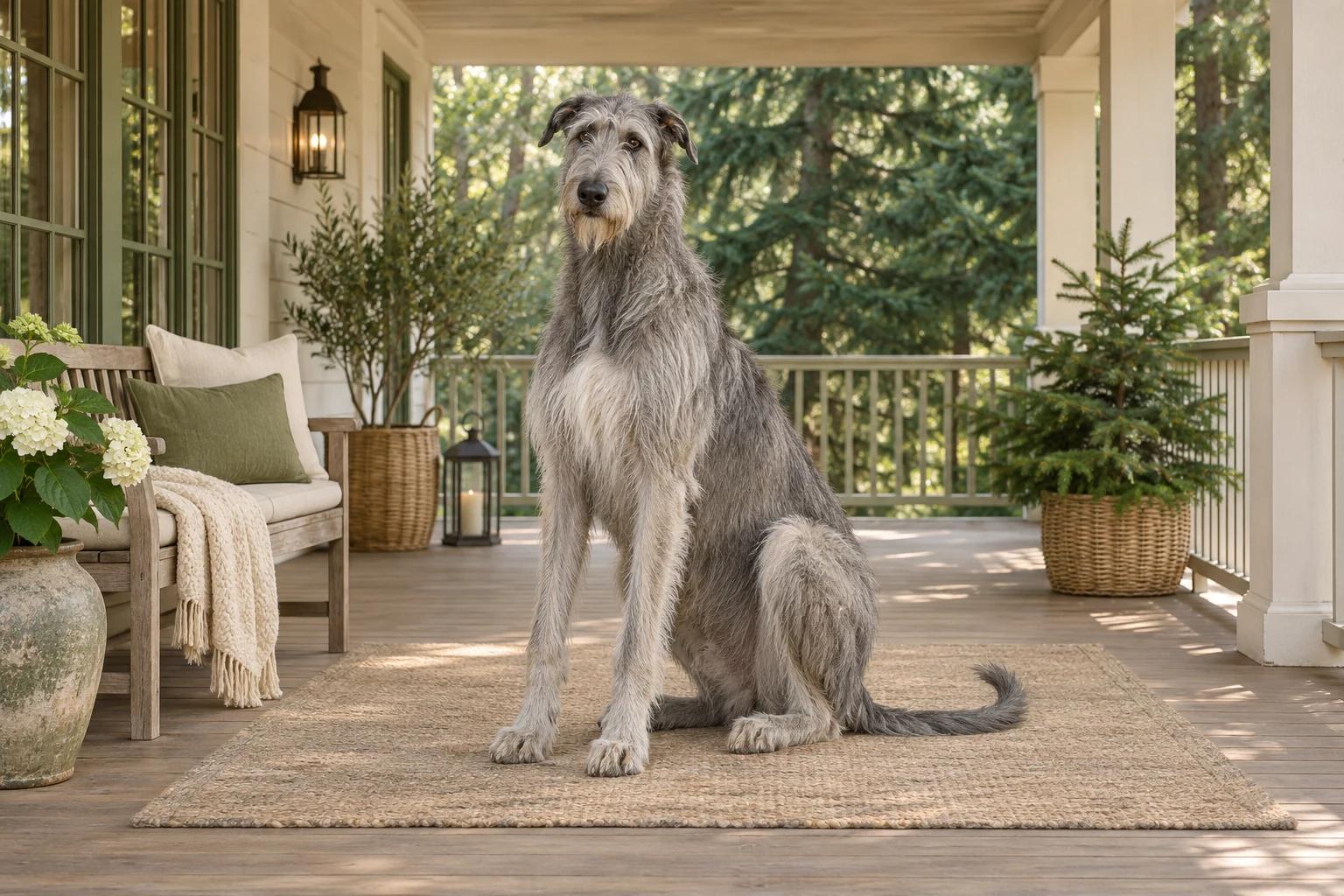
Irish Wolfhound vs Scottish Deerhound is a comparison best made standing beside adult dogs, not scrolling between portraits. Both have rough coats and long-limbed hound outlines. The differences become more meaningful when you imagine loading the car, arranging a sleeping place, or walking through a narrow entrance with one of them.
Read the Irish Wolfhound profile and Scottish Deerhound profile, then use a visit with adults to turn those descriptions into practical questions.
Irish Wolfhound vs Scottish Deerhound: size is daily logistics
The Irish Wolfhound is generally the larger, more substantial dog in this pairing. Its UKC standard emphasizes great size alongside graceful movement. The Scottish Deerhound standard describes a large, rough-coated hound with a Greyhound-like outline. Neither is a small alternative to the other.
Measure the places a dog will use, not just the space where a bed might fit. Consider turning room by the front door, the car opening, and the path to your usual outdoor area. Check that a resting dog can stretch out without blocking the household's only walkway.
Equipment should fit the individual. Two adults of the same breed may need different travel arrangements, and a puppy's current dimensions tell you little about the eventual setup. Ask the breeder or rescue to help you plan for the adult dog rather than repeatedly improvising as it grows.
Think about assistance too. If your usual handler is unavailable, who can manage transport and daily care? A realistic backup arrangement matters more than whether you can accommodate a large bed today.
Similar coats do not make care identical
Both breeds have a rough coat, but the standards describe variations in texture across the body. For example, the Deerhound has softer hair on the breast and belly; the Wolfhound has especially wiry, longer hair around the eyebrows and underjaw.
Ask to see a normal grooming routine rather than a freshly prepared show photograph. Which tools are used, how does the dog stand or lie during care, and what happens between professional appointments?
VCA's Wolfhound profile includes regular brushing in its care guidance. The practical commitment includes positioning a large dog and reaching all the relevant areas, not merely passing a brush across the visible back.
For either breed, speak with a groomer about the actual coat and your goals. Do not assume that “natural-looking” means unattended, or that a method demonstrated on one hound is automatically right for the other.
Calm company still needs teaching
A composed adult can make large-hound ownership look effortless. Ask what teaching made that ordinary behavior possible. Waiting while a lead is attached and moving aside in a doorway are particularly useful skills when the dog occupies substantial space.
VCA notes that an Irish Wolfhound can be unhurried in responding and recommends reward-based learning. Give a dog time to understand a request rather than interpreting a slower response as a reason to escalate pressure.
The Deerhound standard describes a willing disposition, but a standard is not a completed training record. Ask the caregiver which cues are familiar and where the dog needs support. A demonstration in a quiet garden does not establish the same response in a crowded public place.
If you want a companion for formal training, discuss your interests with people who work with each breed. Enjoy the process with the individual dog rather than choosing solely from an expectation of speed or precision.
Plan outings around access and management
For a Scottish Deerhound vs Irish Wolfhound comparison, examine the routes available from your own front door. Are paths wide enough to pass others comfortably? Can you step aside without squeezing into traffic? Is there a suitable enclosed space if you want opportunities for free movement?
Both are sighthounds. Treat secure boundaries and controlled outings as practical planning requirements rather than assuming an affectionate dog will always ignore something moving in the distance.
Ask about each dog's previous experience with livestock, wildlife, and other household animals. Do not test those relationships by releasing the dog and watching what happens. A caregiver or qualified professional can help assess introductions and management.
Choose a routine you can maintain on workdays. An impressive country outing once in a while does not solve the daily problem of getting outside through a difficult building entrance or transporting the dog to every suitable route.
Evaluate the household, not a temperament nickname
The difference between Irish Wolfhound and Scottish Deerhound life may be less dramatic than the difference between two individual homes. A quiet household with a straightforward entrance offers different demands from one with frequent visitors, tight corridors, and several animals.
Tell the breeder or rescue about those details. Ask how the dog reacts to visitors entering, activity around its resting place, and changes in the daily schedule. Look for specific examples rather than accepting a general label such as “easygoing.”
Decide where the dog can rest without being continually stepped around. Arrange visitor routines so greetings do not become a crowded event at the door. These preparations do not require an elaborate house, but they do require honest attention to how people use the space.
For a puppy, ask how the current setup prepares it for your household. For an adult, ask which parts of its existing routine can be preserved during the transition.
Compare the full care arrangement
Before choosing an Irish Wolfhound or Scottish Deerhound, obtain realistic local information about grooming, transport, boarding, and veterinary access. Confirm that providers can accommodate a dog of the actual size, rather than relying on a general statement that they accept dogs.
Health-record questions belong in a separate, careful conversation. The Irish Wolfhound puppy screening-record article explains one specific record to discuss with a veterinarian; it is not a basis for ranking these breeds by health.
Use the breed quiz to clarify your preferences, then compare two realistic ownership plans. The better choice is the one whose needs you can meet consistently and whose individual temperament you understand.
FAQ
Is the Scottish Deerhound a small Irish Wolfhound?
A Scottish Deerhound is a distinct breed, not a small Irish Wolfhound. The Scottish Deerhound is still a large dog. Compare actual adults, their routines, and the equipment they need rather than treating one as a scaled-down version of the other.
Which breed needs less space indoors?
The Irish Wolfhound is generally more substantial than the Scottish Deerhound, but practical space depends on the individual dog and the home's layout. Check resting room, turning space, doorways, and travel arrangements for either candidate.
Does a calm adult need little training?
A calm Irish Wolfhound or Scottish Deerhound still needs learned household skills. Both dogs benefit from clear teaching for walking, handling, entrances, and everyday cooperation. Ask how an adult's existing manners were established and what still needs practice.
Sources behind this article
- UKC: Irish Wolfhound standard ↗
- UKC: Scottish Deerhound standard ↗
- VCA Animal Hospitals: Irish Wolfhound ↗
Article source checked: November 16, 2026. Source checked 2026-11-16
Keep reading

Affenpinscher vs Brussels Griffon: Everyday Differences
Read article →